

Pakistan, Saudi Arabia discuss Red Sea security, Palestine as Middle East tensions escalate
Ishaq Dar and Prince Faisal discuss Red Sea security, back Jordan's push for an Arab-Islamic meeting on Palestine.

News Desk
The News Desk provides timely and factual coverage of national and international events, with an emphasis on accuracy and clarity.
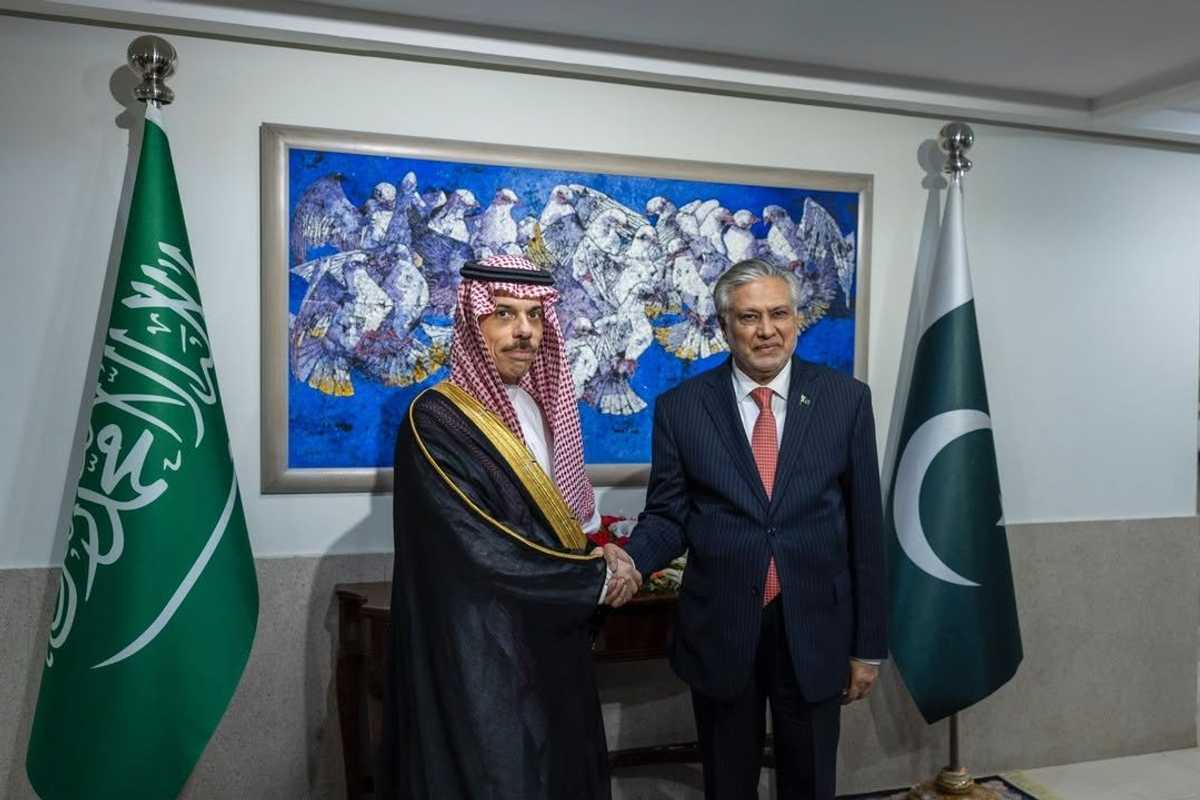
Pakistan and Saudi Arabia held high-level talks on Thursday on the deteriorating security situation in the Red Sea and the Bab al-Mandeb Strait, as military exchanges between the United States and Iran threatened to widen the conflict across the Middle East.
What did Pakistan and Saudi Arabia discuss?
Pakistan's Deputy Prime Minister and Foreign Minister Ishaq Dar spoke by telephone with Saudi Foreign Minister Prince Faisal bin Farhan to discuss regional and international developments, Pakistan's Foreign Ministry said. The two reviewed the security situation in the Red Sea and exchanged views on broader regional issues, with a focus on maritime security.
What did Pakistan and Saudi Arabia say about Jordan's proposal on Palestine?
The two ministers also discussed the worsening situation in Palestine, particularly in East Jerusalem, and welcomed Jordan's proposal to convene a meeting of Arab and Islamic countries. The proposed meeting aims to address the situation in the occupied Palestinian territories and coordinate a collective response. The Foreign Ministry said the two leaders agreed to stay in close contact and continue consultations on issues of mutual interest, reaffirming close coordination between Pakistan and Saudi Arabia on regional and international affairs.
Why are Middle East tensions escalating?
The call came hours after the U.S. military said it struck command centers and drone facilities belonging to Iran's Revolutionary Guards, following Iranian attacks on U.S. forces in the region. Iranian state media, citing the Revolutionary Guards, said three civilians were killed and two children wounded in U.S. strikes on Qeshm Island, while three Guards members were killed in Zanjan province. Iran's Khuzestan governor said two student dormitory complexes in Ahvaz were damaged in the overnight attacks.
The Islamic Revolutionary Guard Corps said it struck the U.S.-run Azraq base in Jordan in response, stating in a statement carried by state media that "the aggressor will be punished today." The Pentagon did not immediately respond to requests for comment on damage at the base.
How have other countries responded to the escalation?
Jordan's armed forces said Thursday they intercepted five Iranian missiles, while an Iranian strike hit a building owned by a Chinese company in northern Kuwait, killing one worker, according to Kuwait's Defense Ministry. Saudi Arabia on Wednesday publicly joined military strikes alongside U.S. forces for the first time since the five-month conflict began, targeting Iran-aligned groups in eastern Iraq in retaliation for drone attacks on Saudi oil facilities.
Following the joint operation, Saudi Defense Minister Prince Khalid bin Salman met U.S. Vice President JD Vance in Washington and urged the Trump administration not to escalate the conflict further, two sources told Reuters.
How did the current conflict between the US, Israel and Iran begin?
The war began in February when the United States and Israel launched a bombing campaign against Iran that President Donald Trump said would last only a few weeks. A ceasefire reached in June later collapsed amid renewed fighting over the Strait of Hormuz, which Iran says it now controls. Iran-aligned Houthi militants in Yemen declared a naval blockade on Saudi Arabia last week, threatening an alternative Red Sea route used for Saudi oil exports to Asia.
Attacks on commercial shipping have also prompted London's marine insurance market to expand its "high risk" zone in the Red Sea to include more waters near Saudi ports. Trump said Washington would respond forcefully to Iranian missile attacks on U.S. forces but maintained that the United States was still seeking a peace agreement to end the conflict, which has unsettled global energy and financial markets. Benchmark Brent crude prices surged more than 8% on Wednesday before easing about 1% on Thursday to trade just below $90 a barrel.




Comments
See what people are discussing