

Pakistan-Saudi-Turkey defense pact could reshape Muslim world's security order
Kamran Khan says the agreement brings together three major military, economic and geopolitical powers amid growing regional uncertainty

News Desk
The News Desk provides timely and factual coverage of national and international events, with an emphasis on accuracy and clarity.
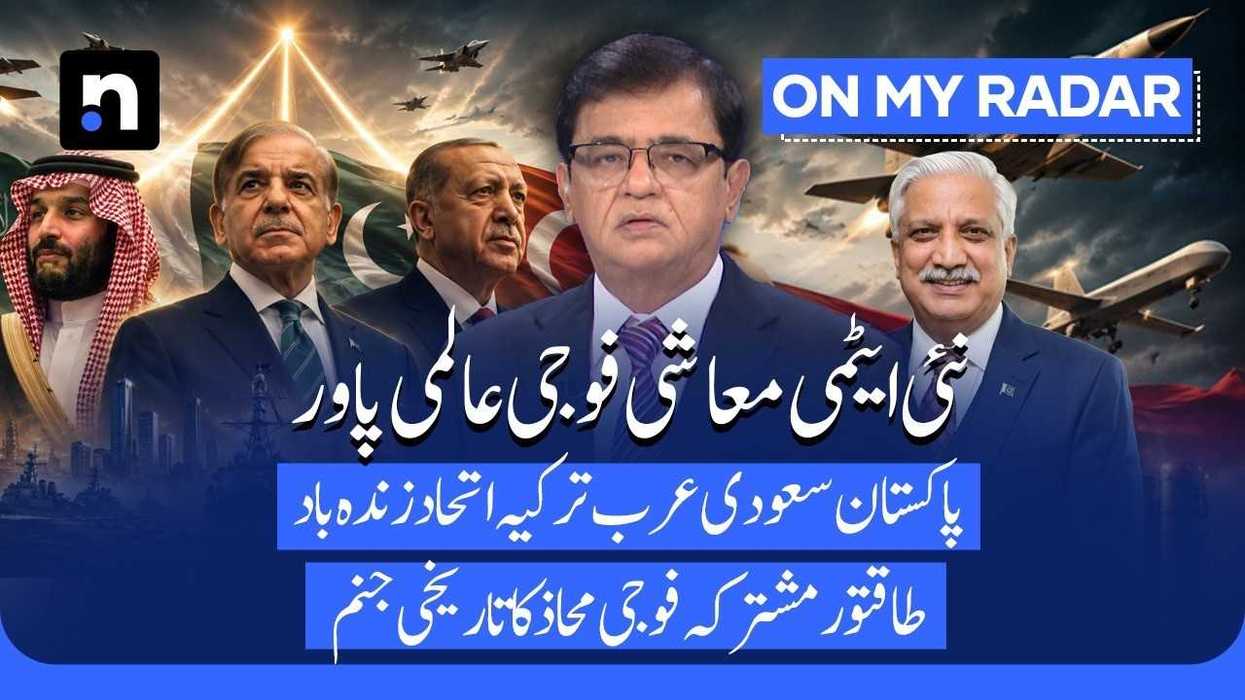
The defense agreement signed by Pakistan, Saudi Arabia and Turkey could mark a significant shift in the security landscape of the Muslim world, bringing together three countries with major military, economic and geopolitical influence under a shared commitment to collective defense. At its core, the agreement sends a simple but potentially far-reaching message: an attack on one member would be considered an attack on all three.
Kamran Khan, speaking in the latest episode of On My Radar, said the agreement brings together three major military, economic and geopolitical powers at a time of growing uncertainty across the region. Its most consequential element is the principle of collective defense, under which the security of each member becomes a shared responsibility of the other two.
The concept closely resembles the principle underpinning NATO's Article 5, which states that an armed attack against one member is considered an attack against all allies. In practical terms, the agreement means that, at least in principle, a threat to Pakistan's security could become a concern for Saudi Arabia and Turkey, just as an attack on either of the other two countries could trigger a collective response.
To understand the potential strength of this arrangement, it is important to look at what each country brings to the table.
Pakistan is the Muslim world's only nuclear-armed state and has a large professional military, significant missile capabilities and a strategically important geographic position linking South Asia, Central Asia and the Middle East.
Turkey, meanwhile, is a NATO member with one of the region's most capable armed forces. Over the past decade, it has also rapidly expanded its capabilities in drones, missiles, warships, electronic warfare and indigenous defense production. Its geographic position, straddling Europe, Asia and the Middle East, adds another important strategic dimension.
Saudi Arabia brings a different but equally significant set of strengths. It is one of the world's major oil exporters, the custodian of Islam's two holiest sites and an influential power in the Arab and Muslim worlds. Its considerable financial resources could provide another pillar for deeper defense cooperation.
Taken together, these capabilities could give the partnership considerable strategic weight. If the three countries eventually move towards joint command structures, intelligence sharing, military exercises, integrated air and missile defense, drone cooperation, naval security and joint defense production, the strategic significance of the agreement could grow substantially.
Another important feature is that the agreement does not appear to be designed as an explicitly anti-American alliance. Pakistan, Saudi Arabia and Turkey all maintain important strategic relationships with Washington. Rather than positioning itself as a military bloc against the West, the agreement could signal that major Muslim countries want to maintain their ties with the United States while simultaneously developing greater capacity for collective self-defense.
But the agreement also raises important questions about how its collective-defense commitment would work in a real conflict.
If Pakistan and India were to go to war, for example, how far would Saudi Arabia and Turkey's obligations extend? If Saudi Arabia faced a major attack in the Gulf, what level of military assistance would Pakistan and Turkey be expected to provide? And if Turkey became involved in a conflict, how would its obligations under the new agreement interact with its existing commitments as a NATO member?
These questions will ultimately determine whether the pact remains primarily a political commitment or develops into a genuinely integrated military alliance.
If Pakistan, Saudi Arabia and Turkey succeed in building a comprehensive defense architecture, historians may eventually view August 7, 2026, not simply as the date a new agreement was signed, but as the beginning of a new chapter in the security order of the Muslim world.
The question, therefore, is no longer simply why Pakistan, Saudi Arabia and Turkey signed the agreement.
The bigger question is how far this alliance could eventually expand — and which country could be next to join it.





Comments
See what people are discussing