

Pakistan may issue second Panda bond soon: Standard Chartered
Bank executives see CPEC 2.0 shifting toward private investment, with Chinese supply chains and a potential tenfold rise in Pakistan's exports to China

Haris Zamir
Business Editor
Experience of almost 33 years where started the journey of financial journalism from Business Recorder in 1992. From 2006 onwards attached with Television Media worked at Sun Tv, Dawn Tv, Geo Tv and Dunya Tv. During the period also worked as a stringer for Bloomberg for seven years and Dow Jones for five years. Also wrote articles for several highly acclaimed periodicals like the Newsline, Pakistan Gulf Economist and Money Matters (The News publications)
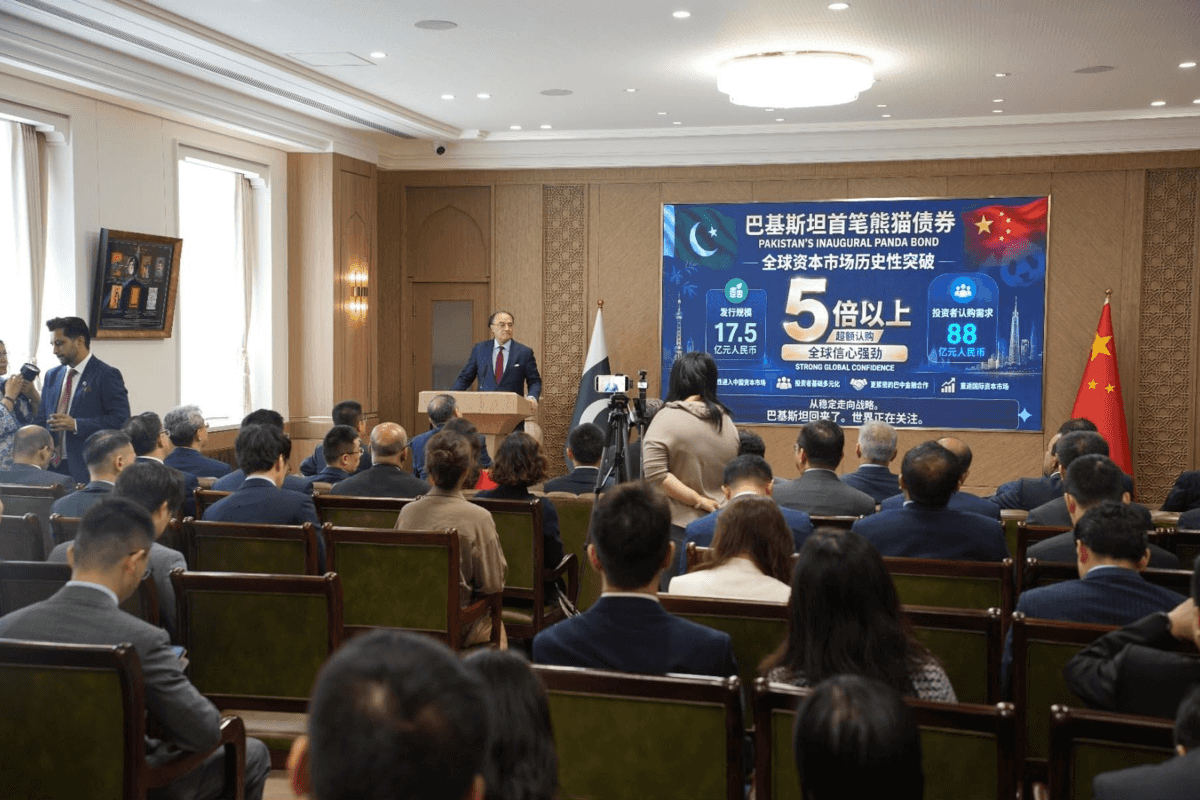
Finance Minister Muhammad Aurangzeb addresses Pakistan's inaugural Panda bond issuance ceremony in Beijing on May 15, 2026.
PID
Pakistan could issue its second Panda bond in China within the next few months, Standard Chartered Bank Pakistan Chief Executive Adil Salahuddin said at a media roundtable in Islamabad on November 24. He said the bank had discussed a possible follow-up with the Ministry of Finance after helping arrange Pakistan's first issuance in May.
When could Pakistan issue its second Panda bond?
Salahuddin said Pakistan could return to China's domestic bond market within months, although no issuance date or size has been announced. Standard Chartered is interested in participating, but its role has not been decided. The government issued its first yuan-denominated Panda bond in May as part of a USD 1 billion program.
The inaugural issuance raised CNY 1.75 billion, equivalent to approximately USD 250 million, with Standard Chartered serving as a joint lead underwriter and bookrunner.
The bond marked Pakistan's entry into China's domestic debt market and was supported by the Asian Development Bank and Asian Infrastructure Investment Bank through multilateral guarantees.
Salahuddin said Standard Chartered remained interested in supporting Pakistan's efforts to diversify its financing sources and access international capital markets.
He also said improvements in Pakistan's sovereign credit ratings and access to longer-tenor international financing had helped ease some of the country's external financing and debt rollover challenges.
How could CPEC 2.0 change Chinese investment in Pakistan?
Salahuddin said the next phase of the China-Pakistan Economic Corridor (CPEC 2.0) was expected to shift from government-to-government infrastructure projects toward business-to-business partnerships.
He identified private investment, joint ventures, local manufacturing and export development as areas offering opportunities for greater economic cooperation.
Dapeng Jeff Wang, regional general manager for North China, general manager of Beijing and head of China corporates for North China at Standard Chartered Bank (China), said Chinese investment opportunities extended beyond the automotive industry.
Wang described the automotive sector as a starting point for broader industrial partnerships, including relocating entire supply chains, establishing manufacturing facilities and transferring industrial and technological expertise.
Such investments could create employment opportunities and help Pakistani businesses become part of international production networks, he said.
However, Wang stressed that Chinese investors needed greater clarity about Pakistan's long-term investment priorities and policy direction.
He said identifying the sectors the government intended to prioritize over the next five years would help businesses make investment decisions and plan their operations.
Geopolitical uncertainty and efforts to diversify supply chains were also encouraging Chinese companies to explore emerging markets, including Pakistan, the Middle East and Africa, he said.
How much could Pakistan increase its exports to China?
Pakistan currently accounts for approximately 0.1% of China's annual imports, equivalent to around USD 2.7 billion, according to Salahuddin.
He said increasing that share to 1% could raise Pakistan's exports to China to approximately USD 27 billion, representing a tenfold increase from the current level.
The figure illustrates the potential size of the opportunity rather than an announced government export target.
Salahuddin said Pakistani exporters needed to better understand Chinese consumer demand and improve their production capacity, competitiveness and international certifications to capture a larger share of the market.
He identified minerals, mining, meat, seafood, dairy products and medical equipment among the sectors offering export opportunities.
The Standard Chartered executive also supported reviewing the Pakistan-China Free Trade Agreement, where necessary, to better align trade arrangements with Pakistan's current economic priorities and export potential.
He called for a business roadshow bringing together Pakistani and Chinese companies to identify investment, trade and joint venture opportunities.
How could renminbi financing support Pakistan-China trade?
Salahuddin said Standard Chartered had provided approximately USD 1 billion in financing and was witnessing growing financing activity involving Pakistani and Chinese businesses, particularly in working capital and trade finance.
He said financing in Chinese renminbi could offer Pakistani companies an alternative to borrowing in US dollars or Pakistani rupees, citing comparatively lower interest rates in the Chinese currency.
Standard Chartered was already facilitating renminbi transactions, cross-border payments, trade finance and working capital financing, he added.
Vera Zhan, executive director for the China Corridor covering the Middle East and Pakistan at Standard Chartered UAE, said the bank could help connect Gulf investors, Chinese technology providers and supply chain companies with Pakistani businesses.
She said combining Gulf capital with Chinese technology and investment opportunities in Pakistan could create new partnerships across multiple sectors.
Zhan also highlighted opportunities in logistics and services, including electric commercial vehicles, logistics infrastructure and supply chain solutions that could help address existing inefficiencies.
She said access to local-currency financing could help Chinese businesses manage foreign exchange risks associated with investing in Pakistan by providing a natural hedge against currency exposure.
What other sectors could attract Chinese investment?
Beyond manufacturing and trade, Salahuddin identified software development, gaming, artificial intelligence and robotics as potential areas for cooperation between Pakistani and Chinese companies.
He said Pakistan's young workforce could help attract Chinese investment, provided the country improved vocational training, technical skills and professional certifications.
The executives' remarks come as Pakistan seeks to attract foreign direct investment, strengthen exports and move beyond infrastructure-led cooperation toward private-sector-driven economic partnerships with China.




Comments
See what people are discussing