

Pakistan shifts focus to investment-led growth after stabilization, Aurangzeb says
Finance minister tells J.P. Morgan investors Pakistan will prioritize private capital, exports and productivity while maintaining macroeconomic stability

Business Desk
The Business Desk tracks economic trends, market movements, and business developments, offering analysis of both local and global financial news.
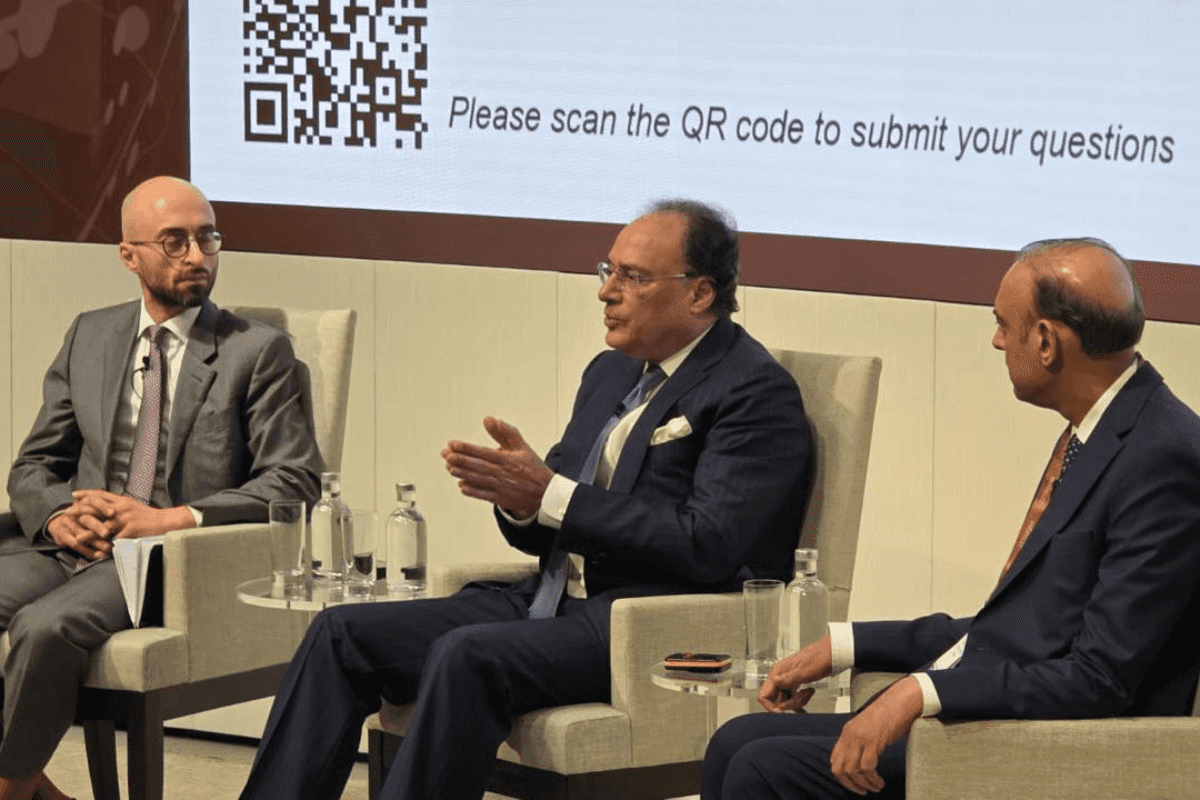
Finance Minister Muhammad Aurangzeb says the government’s priority is to make economic stability durable
Photo courtesy Ministry of Finance
Pakistan is shifting its economic focus from macroeconomic stabilization toward investment, capital formation, exports and private sector-led growth, Finance Minister Muhammad Aurangzeb said at a J.P. Morgan conference in London, according to a Finance Division statement issued Friday.
Speaking at the “Fireside Chat: Pakistan: External Shocks Remain Manageable” at the J.P. Morgan Emerging and Frontier Markets Opportunities Conference, Aurangzeb said the government’s priority was to make economic stability durable while building a growth model driven by productivity, investment and exports.
The conference drew strong interest from international institutional investors, with 55 global investment funds holding one-on-one meetings with Pakistan’s delegation and participating in an investor session, according to the Finance Division. J.P. Morgan Pakistan CEO and Country Head Amin Khowaja also attended the meetings.
What are Pakistan’s economic priorities after stabilization?
Aurangzeb outlined six priorities: making macroeconomic stability durable and strengthening resilience to fiscal and external shocks; pursuing sustainable growth based on productivity, investment and exports; continuing structural reforms; shifting from aid toward trade and investment; expanding access to finance; and preparing for emerging areas including digitalization, blockchain and Web 3.0.
He said Pakistan’s main economic task over the past three years had been restoring macroeconomic stability and rebuilding economic credibility.
Aurangzeb cited progress in fiscal consolidation, external-sector stability, inflation, debt management and access to international capital markets. Pakistan’s economy grew 3.7% in FY26, while the fiscal deficit narrowed to 2.6% of GDP and the country recorded a primary surplus for a third consecutive year.
State Bank of Pakistan Governor Jameel Ahmad highlighted higher foreign exchange reserves, stronger remittance flows and improvements in external-sector fundamentals.
Ahmad also pointed to the growing contribution of Roshan Digital Account flows, external-sector reforms and stronger financial-sector fundamentals. He said progress in containing inflation had strengthened the foundation for sustainable growth and investment.
Aurangzeb said the government now wanted stabilization to provide the base for an economy increasingly driven by investment, productivity, exports and private-sector activity rather than short-term consumption-led growth.
How is Pakistan changing its debt and capital-market strategy?
The finance minister said the government had pursued active liability management, extended domestic debt maturities and reduced refinancing risks as part of efforts to strengthen the sovereign balance sheet.
He said Pakistan had also restored access to international capital markets through a wider range of instruments and investor groups.
Aurangzeb cited Pakistan’s inaugural Panda Bond and subsequent USD 3 billion dual-tranche Eurobond as examples of renewed market access, saying both transactions attracted strong investor demand.
“The objective is not simply to raise financing,” Aurangzeb said, according to the Finance Division statement, but to maintain regular access to international markets, diversify the investor base, extend maturities and gradually improve financing terms.
The government also wants to deepen Pakistan’s domestic capital markets by strengthening equity and corporate debt markets, increasing investor participation and initial public offerings, and improving market infrastructure.
Aurangzeb said greater foreign participation, alongside development of Islamic finance and Sukuk markets, could expand channels for long-term investment.
How does the government plan to attract more private capital?
Aurangzeb said the government is pursuing privatization and greater private-sector participation across state assets. PIA’s privatization has been completed, while work continues on power distribution companies, financial institutions, other state-owned enterprises and airport operations.
The government is also developing a National Private Equity Policy Framework aimed at mobilizing institutional capital into businesses and projects while strengthening Pakistan’s private equity and venture capital ecosystem.
Aurangzeb said greater access to credit was also being pursued for small and medium-sized enterprises, agriculture and housing.
He said public-sector balance sheets alone would not be sufficient to finance Pakistan’s next phase of economic expansion and that private capital would need to play a larger role.
The finance minister highlighted Pakistan’s large domestic market, young workforce and geographic position as parts of its investment proposition. He said reforms covering tax administration, tariff rationalization, energy, state-owned enterprises and the financial sector were intended to raise productivity and redirect economic activity toward exports, technology, manufacturing, minerals, agriculture and value-added services.
Why is Pakistan shifting from aid to trade and investment?
Aurangzeb said Pakistan was moving away from traditional dependence on aid toward stronger trade and investment flows.
While recognizing the importance of bilateral partnerships, he said Pakistan needed to expand goods and services trade and attract more long-term investment through mutually beneficial economic relationships.
He also highlighted opportunities in emerging technologies, particularly blockchain and Web 3.0, saying Pakistan’s young workforce and expanding digital ecosystem could help the country participate more effectively in new areas of the global economy.
Aurangzeb said Pakistan’s investment proposition was increasingly centered on its reform and re-rating potential rather than solely on overcoming immediate economic pressures.
He reaffirmed the government’s commitment to fiscal discipline, external sustainability and continued structural reforms while creating greater room for domestic and international private capital.




Comments
See what people are discussing