

Pakistan tanker becomes first crude carrier to exit Hormuz since US blockade
Shalamar sailed for Karachi after loading UAE crude amid sharply reduced Hormuz crossings

News Desk
The News Desk provides timely and factual coverage of national and international events, with an emphasis on accuracy and clarity.
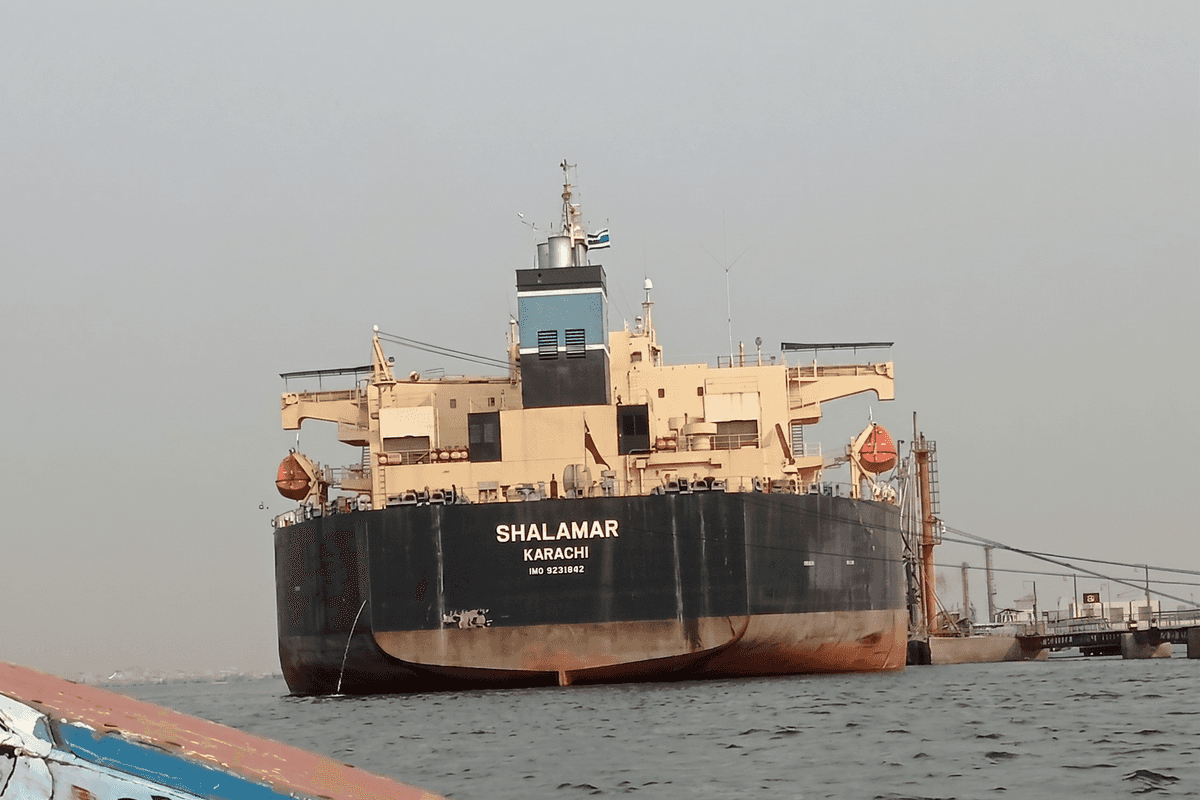
The tanker, Shalamar, sailed south of Iran’s Larak Island and entered the Gulf of Oman late Thursday carrying about 450,000 barrels of crude.
Courtesy: Vessel Finder
A Pakistan-flagged tanker has become the first carrier to leave the Strait of Hormuz with a crude cargo since a U.S. blockade began Monday, highlighting the sharply reduced traffic through one of the world’s most important oil shipping routes, Bloomberg reported.
The tanker, Shalamar, sailed south of Iran’s Larak Island and entered the Gulf of Oman late Thursday carrying about 450,000 barrels of crude, according to ship-tracking data cited by Bloomberg.
The crude was loaded at Das Island in the United Arab Emirates. The Aframax-class tanker was reported to be only half full and was signaling Karachi, Pakistan, as its destination.
The Strait of Hormuz links the Persian Gulf with the Gulf of Oman and the Arabian Sea and is a critical route for global energy supplies.
Bloomberg reported that vessel transits through the narrow waterway have mostly remained in single digits since U.S. and Israeli strikes began at the end of February.
After a temporary increase over the weekend, traffic levels returned to those lower numbers, the report said.
A U.S. Navy blockade now requires shipowners to obtain clearance from both Iranian and American authorities to move oil and other goods from the Persian Gulf to the wider world, according to Bloomberg.
The report said three supertankers carrying non-Iranian crude crossed out of Hormuz last week, but few others with similar cargoes have made the passage over the past seven weeks.
Bloomberg said Shalamar’s transit was unusual because it crossed only days after entering the Gulf and amid tightened controls.
Before the latest U.S. action, Iran’s own fleet had continued exporting crude, transporting nearly 1.7 million barrels per day in March, Bloomberg reported.
That flow has now largely stopped as both sides consider a new round of negotiations, the report added.
Shalamar first tried to cross into the Persian Gulf on Sunday but turned back as peace talks between Iran and the United States broke down, Bloomberg said.
The vessel later completed the crossing and headed to Das Island in the UAE.
President Donald Trump announced the blockade of Iran’s coastline, which took effect Monday, prompting shipowners to reassess the risks of sailing through the area, according to Bloomberg.
By Thursday, Shalamar had turned east and was sailing through the Gulf of Oman toward the Arabian Sea.
Bloomberg also cited U.S. Central Command as saying Thursday that 14 vessels had turned around over three days after attempting to leave the Persian Gulf.
The blockade stretches from the Omani coastline near Ras al Hadd northeast to the Iran-Pakistan border, according to a map shown in an online video shared by the command.
On Friday, four vessels headed to non-Iran destinations had either completed or were approaching inbound transits, while two bulk carriers arriving from Iran were seen leaving into the Gulf of Oman, Bloomberg reported.
Shalamar is owned and managed by Pakistan National Shipping Corp., according to maritime database Equasis. Bloomberg said the company did not immediately respond to a request for comment.





Comments
See what people are discussing