

Pakistan tax officials fail open-book test, raising questions about FBR competence
Kamran Khan examines a Karachi assessment in which only four officers qualified to independently decide both types of tax cases

News Desk
The News Desk provides timely and factual coverage of national and international events, with an emphasis on accuracy and clarity.
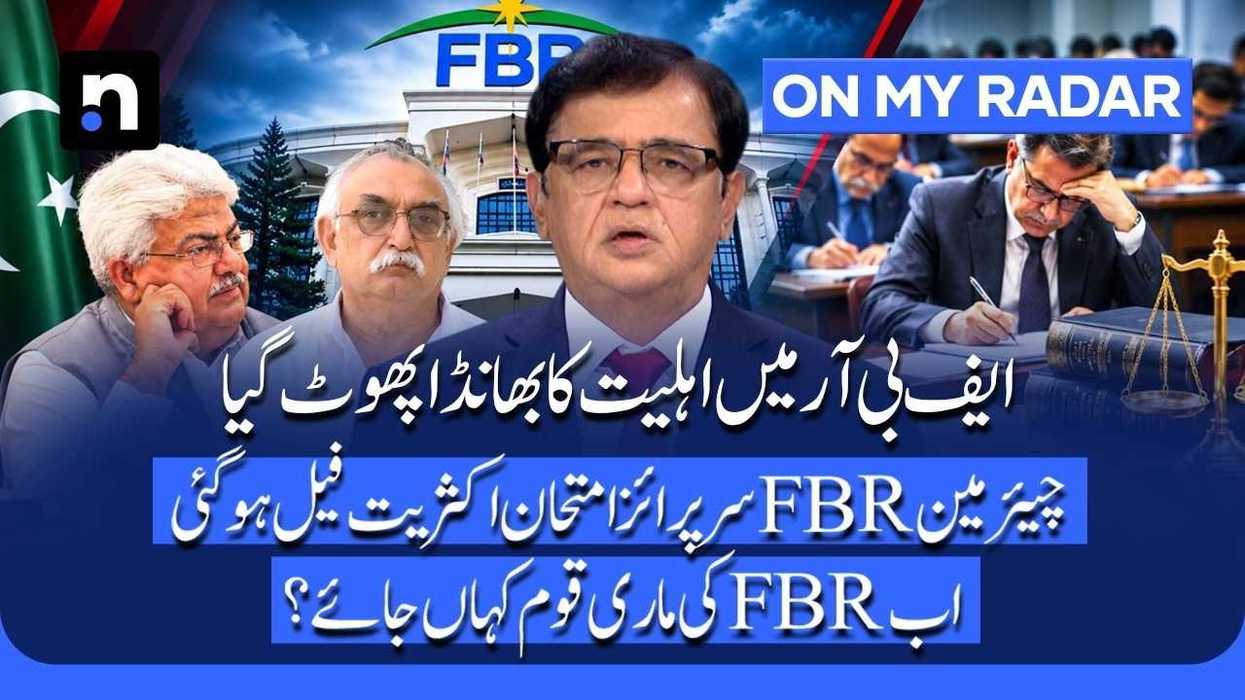
Pakistan's tax authorities are facing fresh questions over their professional competence after an unannounced examination ordered by Federal Board of Revenue (FBR) Chairman Rashid Mahmood Langrial found that only a handful of senior tax officials could independently handle sales tax and income tax cases.
The assessment in Karachi exposed serious gaps in the legal and technical knowledge of officers responsible for scrutinizing tax returns, issuing tax demands and deciding disputes involving millions of rupees.
According to an 11-page report cited in Kamran Khan's latest episode of On My Radar, 150 sales tax officers scored an average of just 26.4%, while 143 income tax officers recorded an average of 33.3%.
Only 15 of the 150 sales tax officers met the required standard to independently decide cases. In the income tax examination, just 14 of 143 officers demonstrated the necessary competence.
Even more concerning, among the 139 officers who took both examinations, only four were found capable of independently deciding both sales tax and income tax cases.
An unexpected examination
According to sources cited in the program, Langrial made an unannounced visit to the Inland Revenue headquarters in Karachi last week, held a brief meeting with senior officials and ordered relevant officers in grade 17 and above to take an immediate examination.
The sudden order reportedly caused anxiety among officials, who had received no advance notice and had no time to prepare. Examination supervisors were also brought in from other FBR cadres to oversee the process.
Officers were given hypothetical sales tax and income tax cases, each containing three cases with a total of 36 legal, accounting and judicial errors.
They were required not only to identify the mistakes but also to explain them with reference to relevant laws. The examination was open-book, allowing participants to consult legal texts and legislation.
Despite being allowed to use reference material, most officers failed to meet the required standard.
The performance of senior officials was similarly disappointing. Among 56 commissioners and additional commissioners who took the sales tax assessment, only four met the standard for identifying serious errors in tax orders prepared by other officers.
In the income tax assessment, only six of 53 senior officials met the required standard.
A wider accountability drive
The examination is part of a broader effort by Langrial to address allegations of corruption, questionable reputations and poor performance within the FBR.
Official figures show that 211 Inland Revenue Service officers, ranging from grade 16 to grade 21, were suspended between August 2024 and June 2026.
In addition, 32 senior officials from Inland Revenue and Customs were removed from key operational responsibilities over concerns about their reputations. Most were grade 20 or higher, with some reassigned to administrative positions with limited operational authority.
However, action taken over questions about an officer's reputation does not mean that corruption has been established against every individual concerned.
The latest examination has added another dimension to the accountability drive: whether the officials responsible for enforcing Pakistan's tax laws possess the professional skills needed to do their jobs.
Concerns about corruption and administrative weaknesses at the FBR are not new. An International Monetary Fund governance and corruption diagnostic report released in November 2025 also highlighted corruption risks, weak internal accountability and inadequate oversight within the institution.
Questions over Pakistan's tax system
The findings raise questions about whether corruption, inefficiency and a lack of professional expertise within the tax collection agency are contributing to Pakistan's persistent revenue collection problems.
Millions of traders remain outside the tax net, while businesses already paying taxes frequently complain about FBR notices, tax demands and legal proceedings.
If tax officials themselves lack the legal knowledge to properly handle disputes, the consequences could extend beyond the department, potentially creating uncertainty for taxpayers and undermining confidence in the country's tax system.
Media reports indicate that similar professional assessments have also been conducted in Islamabad and Peshawar. An assessment of Inland Revenue officers was scheduled in Lahore on Nov. 17, although no official details about its completion or results have been released.
In his analysis, Kamran Khan argues that the exercise should be extended across the country, with officials holding key FBR positions subjected to independent and transparent assessments of their legal knowledge, understanding of tax laws, familiarity with court judgments and ability to handle cases correctly.
He also calls for officers to be given the right to challenge or seek a review of their results, while those with weak performance should receive further training. Sensitive legal responsibilities, he argues, should be assigned only to officials who demonstrate the required competence.
The bigger question, however, is whether the chairman's initiative will lead to lasting institutional reforms or remain an exercise designed merely to intimidate officials.
Pakistan needs accountability for tax evasion, but the integrity, competence and performance of those collecting taxes must also come under scrutiny. An economy already struggling with weak revenue collection cannot afford tax evasion, corrupt officials or a system in which the people deciding tax disputes lack the professional ability to do so.
The episode also featured former FBR Chairman Shabbar Zaidi.



Comments
See what people are discussing