


News Desk
The News Desk provides timely and factual coverage of national and international events, with an emphasis on accuracy and clarity.
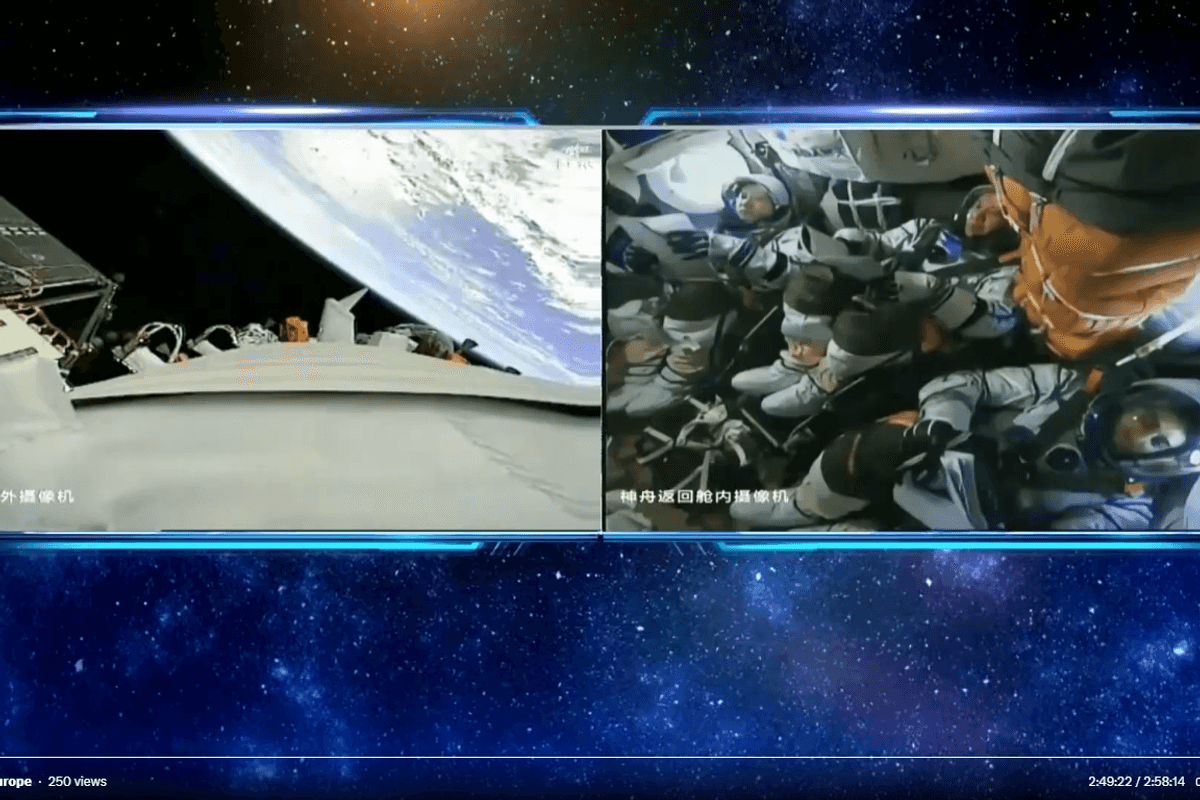
Pakistan's first astronaut, Muhammad Zeeshan Ali, embarks on a historic journey to China's Tiangong space station aboard the Shenzhou-24 spacecraft.
Picture Courtesy: CGTN
Pakistan has achieved a historic milestone in its national space program as its first astronaut, Muhammad Zeeshan Ali, launched into space aboard China's Shenzhou-24 mission to the Tiangong space station on Wednesday morning, marking the country's debut human spaceflight, according to Pakistan's Space and Upper Atmosphere Research Commission (SUPARCO) and China's state news agency Xinhua.
Lifting off atop a Long March-2F carrier rocket from the Jiuquan Satellite Launch Centre in northwestern China at 5:18 am Pakistan Standard Time (8:18 am Beijing time), the Shenzhou-24 spacecraft entered its designated orbit in what the China Manned Space Agency (CMSA) declared "a complete success".
Flying alongside Chinese mission commander Tang Hongbo and flight engineer Wu Yi, the 40-year-old payload specialist becomes both the first Pakistani citizen in space and the first foreign partner astronaut to join a crewed mission to China’s orbital outpost.
How did Muhammad Zeeshan Ali prepare for the orbital mission, and what research will he conduct?
According to SUPARCO, the mission follows the landmark bilateral cooperation agreement signed in February 2025 between Islamabad and the CMSA to train and send a Pakistani payload specialist to the Tiangong space station.
As per Xinhua and Radio Pakistan, Zeeshan Ali—alongside backup candidate Khurram Dawood—underwent rigorous multi-stage screening in Pakistan before completing intensive microgravity, centrifuge, spacecraft operations, rescue survival, and Chinese-language technical training alongside Chinese taikonauts in Beijing.
During his roughly one-week stay aboard Tiangong, the Pakistani specialist is scheduled to conduct scientific experiments designed by Pakistani researchers and universities in the fields of microgravity medicine, agriculture, biotechnology, and materials science—including an orbital experiment studying photosynthetic microorganisms—before returning to Earth aboard the outgoing Shenzhou-23 spacecraft.
How did Pakistani and Chinese leaders hail the historic launch?
According to Associated Press of Pakistan (APP), Prime Minister Muhammad Shehbaz Sharif and national leadership hailed the launch as a proud moment for the nation, noting that Pakistan's entry into human spaceflight strengthens its strategic scientific partnership with China under the Space Cooperation Framework and inspires a new generation of Pakistani scientists and engineers.
"Pakistan-China friendship is surpassing the heights of the Himalayas, in its journey to outer space," Prime Minister Sharif wrote, calling the mission a "harbinger of deep space exploration".
President Asif Ali Zardari also lauded the milestone, quoting national poet Allama Iqbal's verse "Sitaron se aagay jahan aur bhi hain" to urge young Pakistanis to pursue scientific discovery and innovation.
Attending the launch ceremony in Jiuquan, Federal Minister for Planning, Development and Special Initiatives Ahsan Iqbal noted that the mission coincides with the 75th anniversary of Pakistan-China diplomatic relations, adding that bilateral cooperation has expanded "from highways to information superhighways, and now to skyways".
The flight lays the groundwork for deeper space collaboration, including a Pakistani-built lunar rover scheduled to fly aboard China's Chang'e-8 lunar mission around 2028.





Comments
See what people are discussing