

Judges in Pakistan’s Peshawar strike after lawyers disrupt murder case hearing
Judges of Peshawar High Court walked out in protest after lawyers were accused of blocking a police officer’s court appearance

Kamran Ali
Correspondent Nukta
Kamran Ali, a seasoned journalist from Khyber Pakhtunkhwa, Pakistan, has a decade of experience covering terrorism, human rights, politics, economy, climate change, culture, and sports. With an MS in Media Studies, he has worked across print, radio, TV, and digital media, producing investigative reports and co-hosting shows that highlight critical issues.
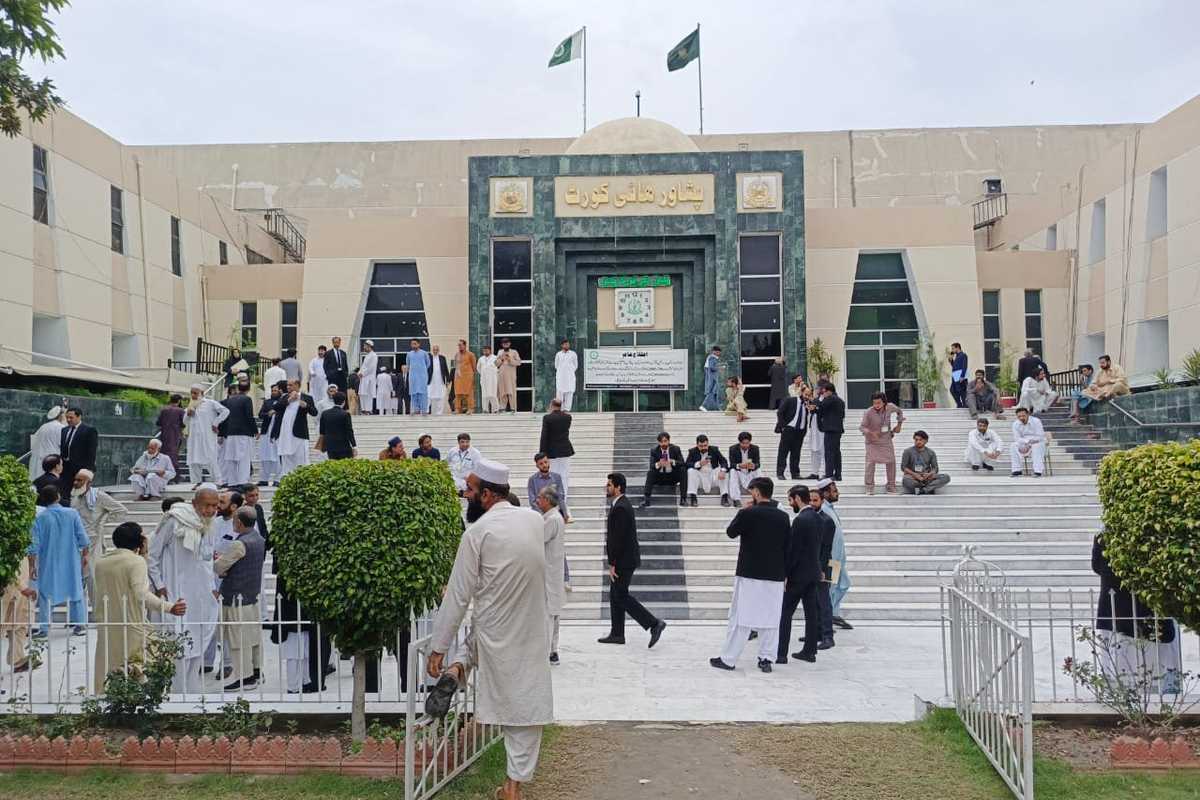
Proceedings of Peshawar High Court resumed after five hours following a meeting between the judiciary and representatives of the bar.
Courtesy: Umar Khan Advocate
Judges in Pakistan’s Peshawar staged an hours-long strike on Monday to protest an incident in which lawyers allegedly tried to stop a police officer accused of murder — along with their defense lawyers — from appearing before the court.
The judiciary condemned the act as a violation of the court’s dignity and decorum.
Judges of the Peshawar High Court (PHC) and lower courts in the city walked out of their courtrooms without hearing cases, following directives from Chief Justice Attique Shah.
Proceedings resumed after five hours following a meeting between the judiciary and representatives of the bar.
In an official statement, the PHC said the chief justice and other judges expressed deep concern and dismay over the “unpleasant incident” that occurred on October 3. The statement called such acts “intolerable” and warned that no leniency would be shown to those found responsible.
The court said a committee had been formed to investigate the incident and that “appropriate remedial and corrective measures” would be taken to prevent similar episodes in the future. “The sanctity, dignity, and decorum of the High Court and its premises shall never be compromised, diminished, or undermined under any circumstances,” the statement added.
Aminur Rehman Yousafzai, president of the PHC Bar Association, confirmed that the chief justice had summoned representatives of the bar after a complaint was filed by Advocate Shabbir Hussain Gigyani. “During the meeting, the judges remarked that we were allegedly preventing some lawyers from appearing in court,” he said.
Yousafzai clarified that the bar had only suspended the memberships of certain lawyers and therefore restricted their entry into the barroom. “They are free to appear before the court if they wish,” he added.
He said the chief justice also mentioned a perception that the bar had influenced the cancellation of bail granted to a police officer named in a lawyer’s murder case. “We categorically denied this,” Yousafzai said, calling it a false impression.
Yousafzai said the bar had recently launched an operation against “toutism,” leading to the suspension of several members. “Those whose memberships were revoked may be reinstated if they tender an apology and submit an affidavit,” he said.
What’s the issue
In mid-August, a young lawyer, Muhammad Asim Shah, was murdered. A police officer, Station House Officer (SHO) Behramand, was nominated in the First Information Report (FIR). After remaining at large for some time, the SHO filed a bail petition before the Peshawar High Court, which was scheduled for hearing on October 3.
However, members of the legal community reportedly gathered at the court and tried to prevent the accused and his lawyers, Shabbir Hussain Gigyani and Ali Azeem Afridi, from pursuing the case.
They allegedly assaulted them within the court premises and chanted slogans inside the courtroom. The court later rejected the bail petition on legal grounds.
Following the incident, the Peshawar High Court Bar Association and the Peshawar Bar Association suspended the memberships of the two lawyers, their associates, and clerks, and barred them from entering the court premises.
The two lawyers later wrote to the chief justices of the PHC and Pakistan’s Supreme Court, urging them to ensure justice and protection, stating that they had been obstructed from performing their constitutional duties.



Comments
See what people are discussing