

PIMS fire raises questions over safety failures and accountability
Kamran Khan questions why repeated safety warnings at PIMS go unaddressed and who is accountable

News Desk
The News Desk provides timely and factual coverage of national and international events, with an emphasis on accuracy and clarity.
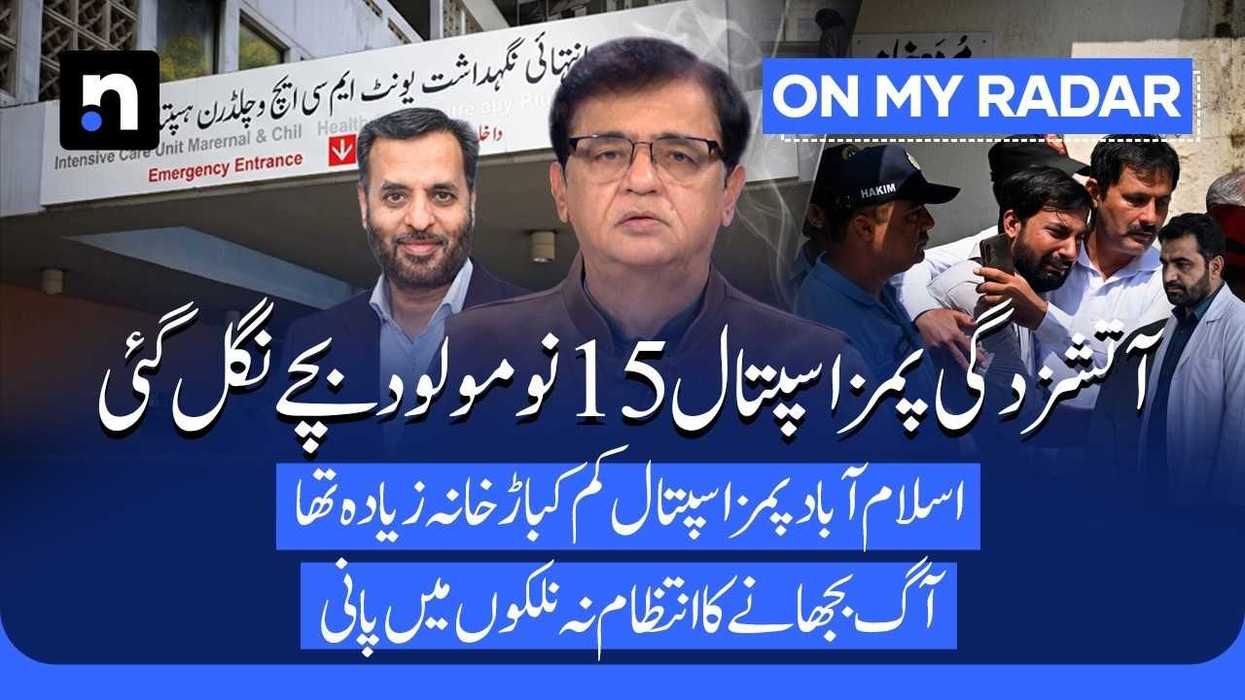
The deaths of newborn babies in a fire at Islamabad's Pakistan Institute of Medical Sciences (PIMS) have exposed longstanding questions over fire safety, emergency preparedness and accountability at one of the capital's largest public hospitals.
The tragedy has also brought renewed scrutiny to PIMS at a time when the hospital has faced questions over its facilities and ability to provide critical medical services. Kamran Khan said in the latest episode of On My Radar that recent developments surrounding PIMS had raised broader questions about the functioning and capacity of the state-run hospital.
The fire broke out at around 6:45 a.m. on the third floor of the Mother and Child Health Ward, where newborn babies were being cared for. According to officials, 16 infants were inside the nursery when the blaze started. A female doctor managed to rescue one baby, while the others died.
Fourteen babies were severely burned, while another died from suffocation, according to the account presented by officials.
The scale of the loss has prompted questions about why adequate staff were not present in the nursery when the fire broke out. CCTV footage reviewed during the initial inquiry reportedly showed no doctor, ward attendant or other member of staff inside the incubation center at the time of the incident.
The absence of staff has also become a central concern for grieving parents, who have questioned who was responsible for protecting their newborn children when the fire started.
What caused the PIMS fire?
The Health Ministry said an air-conditioner compressor exploded in the nursery, triggering the fire, which then intensified because of the oxygen being used to treat the babies.
Initial findings have also pointed to significant shortcomings in the hospital's fire-safety arrangements. Investigators found no water available at a designated fire point, missing couplings for fire hoses and blocked emergency exits.
CCTV footage reportedly showed that the nursery did not have an automatic sprinkler system or smoke-detection equipment.
The findings have raised questions over whether the deaths could have been prevented if basic fire-safety systems had been in place and functioning properly.
Were authorities aware of the safety risks?
One of the most serious issues emerging from the incident is that concerns over PIMS' fire safety did not begin with Wednesday's blaze.
According to the information presented in the investigation, the hospital had received repeated notices since 2018 over deficiencies in its fire-prevention, fire-protection and life-safety systems.
Fire and Disaster Management officials of the Metropolitan Corporation Islamabad had repeatedly informed PIMS that several required safety measures remained incomplete.
A notice issued in 2024 also pointed to unresolved deficiencies, suggesting that the risks had been identified well before the fire.
Federal Health Minister Mustafa Kamal has acknowledged that PIMS' firefighting system is outdated compared with those in modern hospitals.
The sequence of warnings has shifted the focus from the immediate cause of the fire to a broader question: why were known safety deficiencies not addressed before a fire broke out in a ward housing critically vulnerable newborns?
Why has PIMS faced wider scrutiny?
The incident is not the first time PIMS has come under scrutiny over its facilities.
The hospital, the capital's largest public-sector medical facility, was also in the spotlight last week when former Prime Minister Imran Khan required a medical test that reportedly could not be performed because the necessary equipment was unavailable at PIMS.
The latest tragedy has added another layer to concerns over the hospital's infrastructure, equipment and management.
What action has the government taken?
Prime Minister Shehbaz Sharif ordered the removal of Federal Health Secretary Aslam Ghori following the deaths and directed authorities to investigate the incident.
However, questions remain over whether responsibility will extend to the hospital administration and officials responsible for maintaining fire-safety standards.
The allegations of negligence have yet to be fully established, and the investigation is expected to determine whether safety regulations were breached, whether warnings were ignored and whether the emergency response was adequate.
The incident therefore presents authorities with a question extending beyond the cause of the fire: who was responsible for ensuring that the nursery was safe, and why were previously identified deficiencies allowed to remain?
For the families who lost their newborn children, an inquiry alone may not be enough. They are seeking answers over how a fire in a hospital nursery could claim so many lives and whether the tragedy could have been prevented.




Comments
See what people are discussing