

PPP's 'Form 47' stance raises questions over its role in Pakistan's power structure
Kamran Khan discusses Pakistan's evolving election discourse and the debate surrounding the PPP's position

News Desk
The News Desk provides timely and factual coverage of national and international events, with an emphasis on accuracy and clarity.
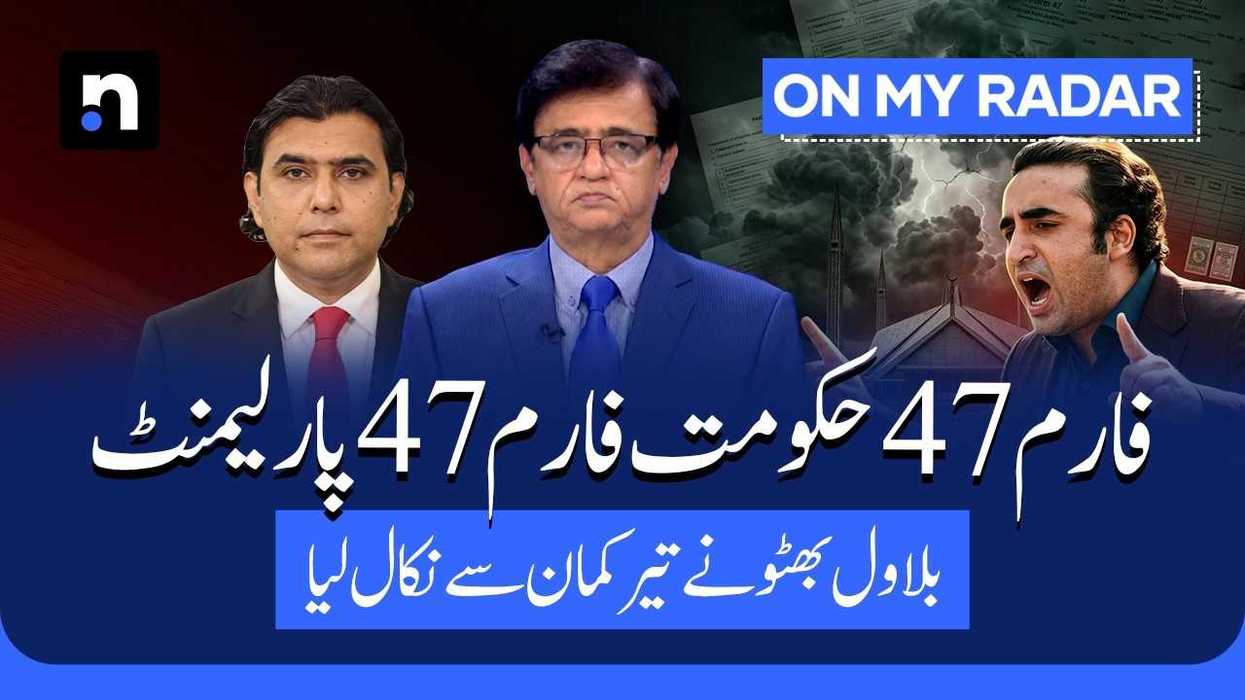
Pakistan's politics has long been shaped not only by disputed election results but also by the evolving vocabulary used to describe alleged electoral fraud.
In the latest episode of On My Radar, Kamran Khan discussed how these terms have changed over the decades and why the Pakistan Peoples Party's recent embrace of the phrase "Form 47" raises questions about its own role in the current political order.
Every general election in Pakistan has been followed by allegations of rigging. What is striking, however, is that each electoral cycle has also produced a new political catchphrase to describe the alleged manipulation, with those terms often dominating public debate for years.
Governments may change every five years, but so does the country's lexicon of election controversies. Over the years, Pakistan's political discourse has revolved around phrases such as jharloo ("the broom operation"), "RO elections," the RTS collapse, "35 punctures," and allegations of political engineering. Following the 2024 general election, the latest addition to that list was "Form 47."
Kamran Khan said in the latest episode of On My Radar that it was Pakistan Tehreek-e-Insaf (PTI) that first rejected the 2024 election results and popularized the term "Form 47" as shorthand for alleged electoral fraud.
The Pakistan Peoples Party (PPP), despite playing a pivotal role in forming the current coalition government, initially raised no significant objections to the election outcome. However, more than two years later, the party has increasingly begun criticizing the government by branding it a product of "Form 47."
There is little dispute that the credibility of the 2024 elections has been questioned not only by opposition parties but also by independent observers. Yet, the PPP's shift in position has prompted fresh debate, given that it continues to be one of the principal beneficiaries of the very political arrangement it now criticizes.
To illustrate the contradiction, Kamran Khan pointed to the PPP's extensive share in the country's power structure.
Pakistan's constitutional head of state, President Asif Ali Zardari, is the PPP's co-chairman. The party is part of governing administrations across the country, including in Sindh and Balochistan, while also sharing power in Gilgit-Baltistan and Azad Jammu and Kashmir. In Punjab and Khyber Pakhtunkhwa, the governors are also from the PPP.
Beyond the executive, the PPP holds several key constitutional and parliamentary positions. It occupies the office of the Senate chairman, while the deputy speaker of the National Assembly also belongs to the party. In the Senate, the PPP chairs 18 of the chamber's 45 standing committees, compared with six chaired by its coalition partner, the Pakistan Muslim League-Nawaz (PML-N). In the National Assembly, it heads 14 standing committees—more than any other political party.
Kamran Khan argued that the situation raises an obvious question: if the federal mandate is now being portrayed as controversial because of alleged "Form 47" manipulation, what does that imply for elections elsewhere in the country? He pointed to Karachi, where PTI swept the 2018 elections but the PPP secured a commanding victory in 2024.
He also questioned whether, if the entire electoral system is considered illegitimate, non-transparent, and a product of "Form 47," then should every constitutional office and political position derived from that system also be viewed through the same lens? That would include the presidency, provincial governments, governorships, parliamentary committee chairmanships, and the broader coalition framework that currently governs Pakistan.



Comments
See what people are discussing