

Punjab opposition urges governor to block secret trials bill
Punjab opposition and rights groups ask the governor to block a secret trials bill, warning it threatens fair-trial rights under Article 10A.

Laiba Zainab
Correspondent
Laiba Zainab is an award-winning journalist with nearly a decade of experience in digital media. She has received the DW & CEJ-IBA Data Journalism Award and the top digital media prize at the National Media Fellowship. At NUKTA, she covers underreported stories on health, crime, and social justice.
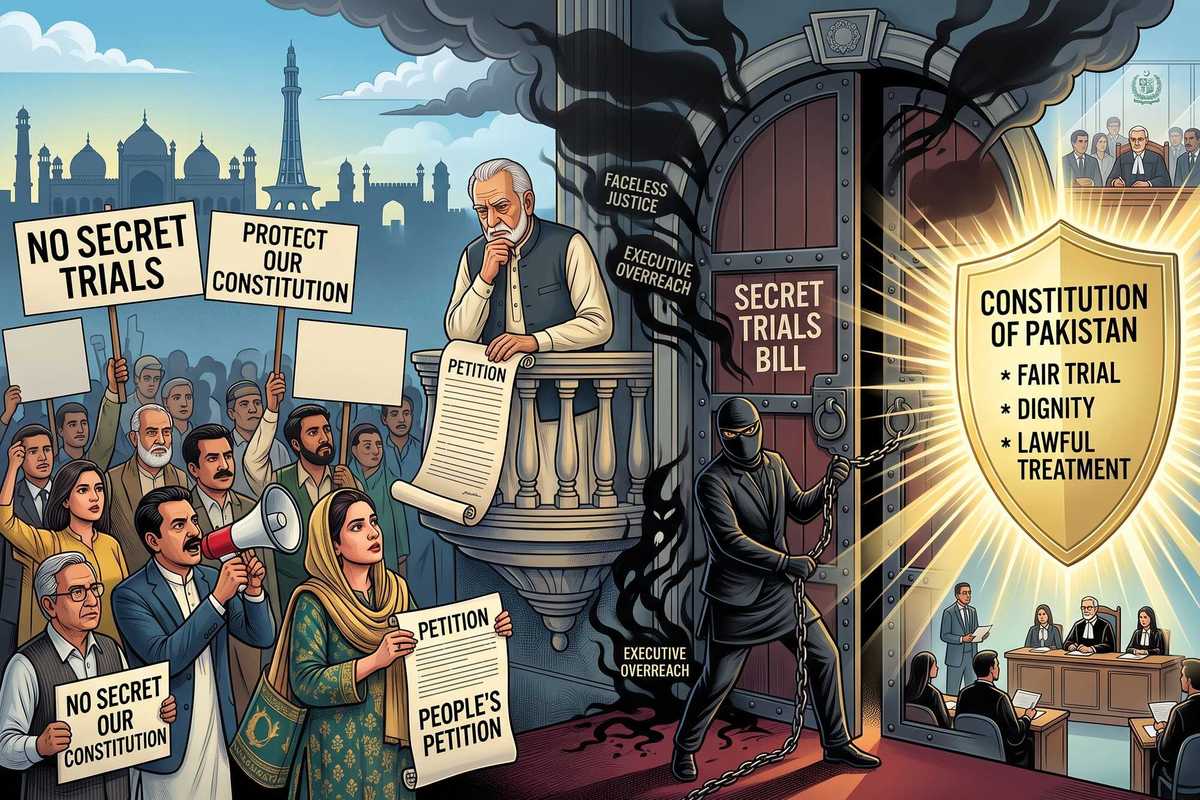
The bill creates "special security cases" under a proposed Section 21AAA. It allows a Grade-20 designated authority to conceal the identities of judges, prosecutors, defense lawyers, witnesses and police officers, seal court records and use voice-modification technology.
AI-generated image
Punjab opposition lawmakers have asked Governor Sardar Saleem Haider Khan to withhold assent to the Anti-Terrorism (Punjab Amendment) Bill 2026. They warn its secret trials provisions could undermine constitutional guarantees of fair trial and due process. The Punjab Assembly passed the bill on August 31, 2026, after an opposition walkout, and petitioners want it returned for reconsideration.
What does the Punjab secret trials bill propose?
The bill creates "special security cases" under a proposed Section 21AAA. It allows a Grade-20 designated authority to conceal the identities of judges, prosecutors, defense lawyers, witnesses and police officers, seal court records and use voice-modification technology. Petitioners say the measure goes far beyond existing witness-protection safeguards allowed under current law.
The representation was submitted by Opposition Leader Moeen Riaz Qureshi, PTI lawmakers Chaudhary Muhammad Ejaz Shafi and Sheikh Imtiaz Mehmood, Judicial Activism Panel Chairman Muhammad Azhar Siddique and lawyer Muneer Ahmad, among others. They say security measures for trial participants are legitimate but argue the bill's scope is far too broad. Their central objection is that an accused may not know the identity of the judge or prosecutor handling the case, while witnesses could appear under coded identities and other protective measures.
Who would control the special trials?
A major concern is the proposed Designated Authority, described in the bill as a Grade-20 or equivalent officer whose identity could remain undisclosed. That identity could potentially be known only to the chief justice of the Lahore High Court. The authority would decide which cases receive extraordinary protection and oversee arrangements covering prosecution, witness coding and sealed proceedings.
Petitioners argue that giving an executive or administrative official this role raises serious separation-of-powers concerns, since criminal trials should not become an administrative process because security concerns exist. They also question concealing a judge's identity, since an accused could then be unable to determine whether the judge has a conflict of interest or grounds for recusal. They say meaningful appellate oversight would also become difficult if a decision-maker's identity and authority cannot be established. The same secrecy provisions cover prosecutors and defense lawyers, and petitioners argue an accused must know who represents both sides in a criminal case. They further object to coded witnesses and voice distortion, saying these measures could interfere with an accused person's ability to cross-examine evidence.
Does the bill conflict with Pakistan's Constitution?
The representation centers on Article 10A of Pakistan's Constitution, which guarantees the right to a fair trial and due process. Petitioners say a fair trial requires an independent tribunal, meaningful knowledge of the case and evidence, the ability to cross-examine witnesses and reasoned decisions that higher courts can review. They argue concealing the identities of judges, prosecutors or witnesses could undermine those safeguards, and they also invoke Articles 4, 9, 14 and 25, covering lawful treatment, security of person, dignity and equality before the law.
Another objection involves Article 175(3), which separates the judiciary from the executive. Petitioners argue an executive authority should not decide which cases get special judicial treatment, control witness coding or influence sealed proceedings. They also challenge provisions on sealed proceedings and records, arguing that if large portions of a trial stay inaccessible, an accused's ability to appeal could be compromised, and that judicial secrecy should not prevent higher courts from properly scrutinizing proceedings.
Why do critics say the bill conflicts with federal law?
Lawyer Asad Jamal said the provincial legislation could face a constitutional challenge because the Anti-Terrorism Act 1997 is federal law. He said a provincial assembly may amend federal criminal law and procedure only to the extent that it does not conflict with the federal statute, and argued this bill does conflict, since federal law lets courts, not an executive authority, anonymize only a witness while protecting a defendant's fair-trial right.
Jamal said the Punjab amendment goes much further by making trials faceless in their entirety and vesting that power in an executive authority, which he called problematic under Article 142 and Article 10A of the Constitution and under international human rights law that Pakistan has ratified. He also questioned whether the system could realistically work, saying it would need heavy financial investment and could otherwise be poorly implemented. Petitioners have raised a possible Article 143 challenge if the law is found to conflict with federal legislation, and they have called for a formal legal opinion on whether the Punjab Assembly has the authority to make these changes.
What protections already exist under current law?
The opposition and legal petitioners question the need for a new framework, pointing to existing safeguards. Section 21 of the Anti-Terrorism Act already permits in-camera proceedings and identity protection, while the Punjab Witness Protection Act 2018 provides a separate framework for protecting witnesses. Their position is that the government should strengthen these existing mechanisms rather than create a parallel, opaque trial structure.
Petitioners say they do not oppose security measures altogether and support restricted disclosure, pseudonyms, protective screens and video testimony when necessary. However, they argue such measures should be case-specific, proportionate and authorized by a court, not through blanket administrative power. They warn broadly framed anti-terrorism powers could affect political opponents, protesters, journalists, lawyers, human rights defenders and civil society if an executive authority can designate wide classes of cases for special treatment.
What are petitioners asking the governor to do?
Petitioners say the bill does not demonstrate a constitutional emergency that would justify replacing existing safeguards with such an extensive secrecy regime. They have asked the governor to reject or defer the bill and refer it to relevant committees for detailed constitutional scrutiny, alongside consultations with the Lahore High Court, bar councils, prosecution authorities, legal experts and human rights organizations.
Among their proposed safeguards are prior judicial authorization, case-specific necessity and proportionality tests, continuing judicial control, written reasons, periodic review and effective appellate oversight. They want the identity and lawful authority of the judicial officer to stay ascertainable to the accused, defense counsel and reviewing courts, and they oppose letting an executive official control the core judicial character of proceedings. Petitioners have reserved the right to challenge the legislation before the Lahore High Court and Supreme Court if it becomes law.
What has the Human Rights Commission of Pakistan said?
The Human Rights Commission of Pakistan has also called for the bill to be reconsidered, particularly the provisions allowing cases to be designated as "special security cases." HRCP warned the legislation would let the identities of judges, prosecutors, police officials, witnesses and defense counsel be withheld, and questioned whether the circumstances triggering the special security regime are sufficiently defined.
HRCP said this vagueness could allow the law to be applied beyond genuine security threats, potentially affecting ordinary citizens, political opponents and protesters. The commission acknowledged that protecting judges, witnesses and other trial participants in terrorism cases is a legitimate concern, but said security measures should be narrowly tailored and subject to independent judicial supervision. It called for the legislation to be reconsidered in light of constitutional guarantees on security of person, fair trial and dignity, as well as Pakistan's obligations under Article 14 of the International Covenant on Civil and Political Rights.



Comments
See what people are discussing