

R4 and European foreign ministers urge de-escalation in US-Iran standoff and Middle East conflicts
Foreign ministers from the R4 regional grouping and four major European powers called for urgent diplomacy, dialogue, and de-escalation to resolve the US-Israel-Iran conflict and address Houthi aggression against Saudi Arabia

Aamir Abbasi
Editor, Islamabad
Aamir; a journalist with 15 years of experience, working in Newspaper, TV and Digital Media. Worked in Field, covered Big Legal Constitutional and Political Events in Pakistan since 2009 with Pakistan’s Top Media Organizations. Graduate of Quaid I Azam University Islamabad.
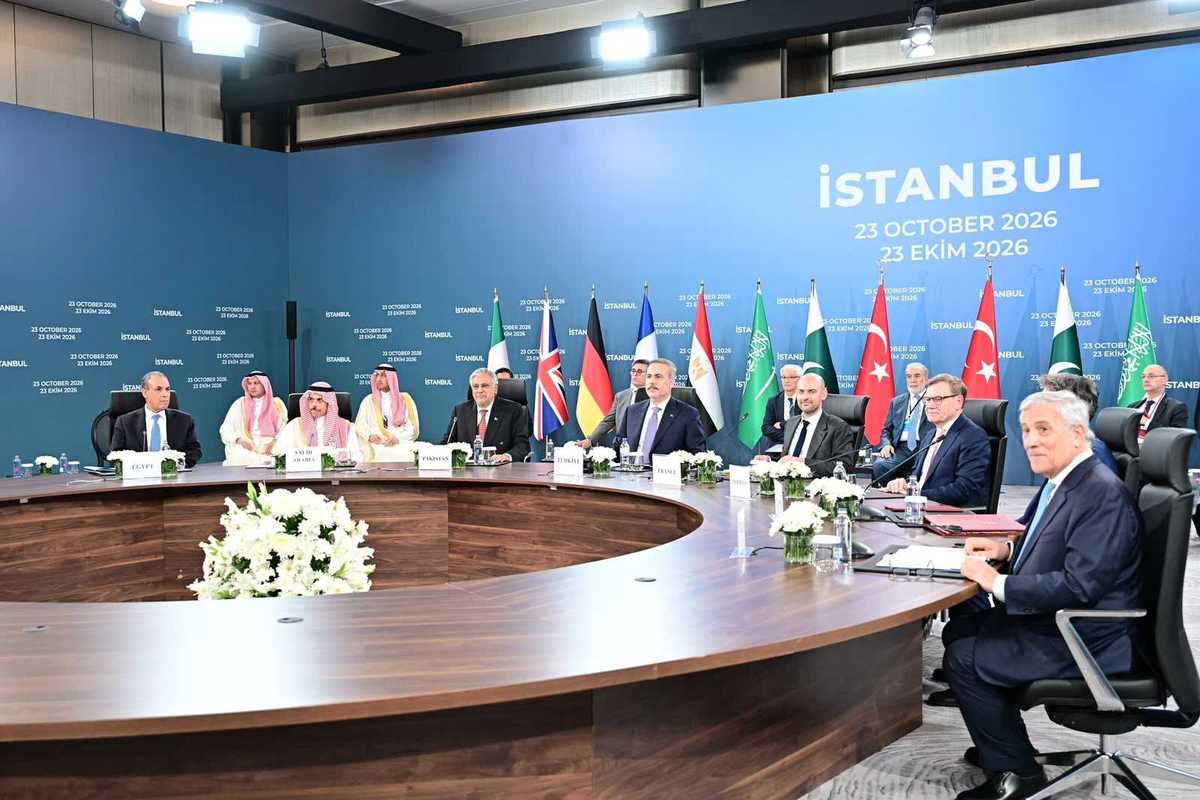
Foreign ministers from Pakistan, Türkiye, Saudi Arabia, Egypt, and four European nations meet in Istanbul to discuss Middle East de-escalation, regional security, and the protection of vital maritime shipping routes.
Picture Courtesy: Government of Pakistan
Foreign ministers representing Pakistan, Türkiye, Saudi Arabia, Egypt, and four European powers issued a joint call on Saturday, October 24, for urgent dialogue, diplomacy, and de-escalation to resolve spreading regional conflicts and safeguard international shipping routes across the Middle East.
What key security flashpoints and maritime corridors were addressed in Istanbul?
The high-level consultative session, convened in Istanbul on Friday, October 23, brought together foreign ministers of the R4 grouping—Pakistan, Türkiye, Saudi Arabia, and Egypt—alongside counterparts from the United Kingdom, France, Germany, and Italy. The landmark meeting marked an unprecedented expansion of the consultative channel, linking leading regional powers from the Muslim world with key European governments exposed to the security and economic fallout of Middle Eastern instability.
According to a joint press release issued by Pakistan’s Ministry of Foreign Affairs (MoFA) on Saturday, the eight foreign ministers reviewed the escalating US-Israel-Iran conflict, the broader Israeli-Palestinian crisis, and the urgent necessity of reaching a negotiated two-state solution anchored in United Nations resolutions.
The ministerial discussions also focused directly on maritime security and cross-border aggression, addressing recent drone and missile strikes by Yemen's Houthi militia against civilian infrastructure and commercial targets in Saudi Arabia and Yemen. Highlighting recent strikes and naval blockades affecting commercial shipping, the ministers underscored the imperative of protecting freedom and safety of navigation across critical maritime chokepoints, specifically the Strait of Hormuz, the Bab el-Mandeb Strait in the southern Red Sea, and the Black Sea. The diplomats warned that prolonged maritime disruption threatens to compound global energy shocks, disrupt trade transit, and destabilize world markets.
How does new eight-nation diplomatic format plan to advance de-escalation?
The joint gathering, hosted by Turkish Foreign Minister Hakan Fidan, included consultations with Turkish President Recep Tayyip Erdogan at Dolmabahçe Palace. During the proceedings, ministers stressed that renewed military offensives in the Persian Gulf would carry catastrophic humanitarian and economic costs.
French Foreign Minister Jean-Noël Barrot cautioned that further armed escalation between Washington and Tehran "would create nothing but losers and would undoubtedly have very serious consequences for hydrocarbon prices".
Reaffirming their collective commitment to international law and sovereign equality under the UN Charter, the eight participating nations agreed to institutionalize regular consultations in the same format to coordinate diplomatic interventions, defuse emerging flashpoints, and prevent conflicts from expanding.
Pakistan’s Deputy Prime Minister and Foreign Minister Mohammad Ishaq Dar held bilateral consultations on the sidelines of the gathering, reiterating Islamabad’s commitment to constructive regional diplomacy and reaffirming solidarity with Riyadh against cross-border aerial incursions targeting Saudi territorial sovereignty.
Regional technical teams are preparing preliminary recommendations on maritime safety monitoring and commercial transit corridors ahead of follow-up ministerial engagements.




Comments
See what people are discussing