

Shehbaz government faces mounting legal, political challenges
Kamran Khan said the government’s response to the Supreme Court order and growing rift with the PPP could shape its political future

News Desk
The News Desk provides timely and factual coverage of national and international events, with an emphasis on accuracy and clarity.
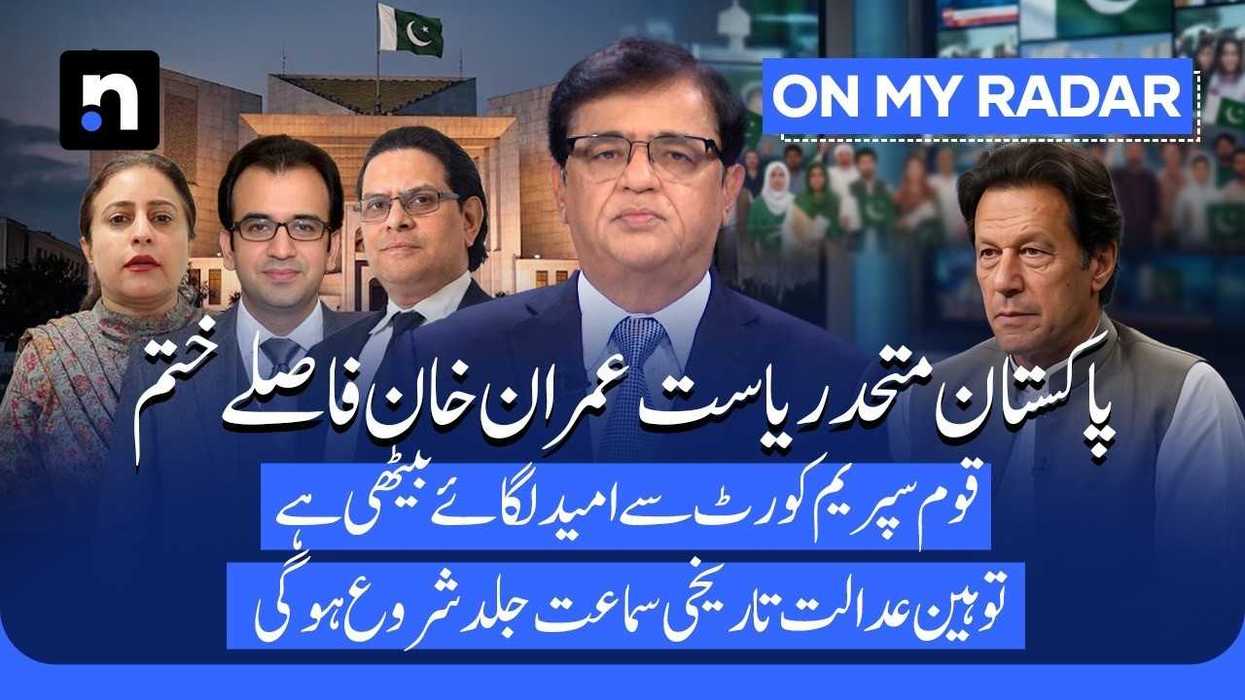
Prime Minister Shehbaz Sharif’s government is confronting its most serious political test yet, with a Supreme Court order over jailed former premier Imran Khan’s treatment, growing tensions with key coalition partner Pakistan Peoples Party (PPP) and a newly consolidated opposition alliance putting increasing pressure on the ruling Pakistan Muslim League-Nawaz (PML-N).
Kamran Khan said in the latest episode of On My Radar that the government’s response to the Supreme Court’s Aug. 18 order and the widening political rift with the PPP could have far-reaching consequences for its political future.
The Supreme Court’s order has become a major source of tension after the government did not comply with its directive to move Imran Khan from Adiala Jail to Shifa International Hospital within 48 hours and provide him with medical treatment there until Sept. 16. PTI has since sought contempt proceedings against Prime Minister Shehbaz Sharif and key members of his cabinet.
PTI resubmitted its contempt petition to the Supreme Court on Tuesday after addressing objections raised by the court. Uzma Khan, Imran Khan’s sister, also filed a separate application seeking an early hearing of the petition.
The dispute stems from an Aug. 18 order issued by a three-member Supreme Court bench directing the government to transfer Imran Khan to Shifa International Hospital within 48 hours. Instead, the government moved him to PIMS Hospital at midnight, where he underwent a medical examination before being returned to Adiala Jail a few hours later.
The court’s order extended beyond medical treatment. It directed authorities to allow Imran Khan’s family to meet him once a week and permit him to speak to his sons by telephone twice a week. The court also sought details of all cases against him that were under trial, pending or had resulted in convictions.
Imran Khan was subsequently allowed to meet his sister Noreen Niazi in the jail’s conference room.
The central question now is whether the Supreme Court will accept the government’s explanation or consider its actions a violation of the court’s order. If the court proceeds with contempt proceedings, it will also have to determine who should be held responsible.
PTI has specifically blamed Prime Minister Shehbaz Sharif for the alleged non-compliance and filed the contempt petition under Article 204 of the Constitution. The same provision was used in 2012 against then-Prime Minister Yousaf Raza Gilani, who was convicted of contempt and subsequently stepped down from office.
The government’s problems, however, extend well beyond the dispute over Imran Khan’s treatment.
The PPP, the government’s largest coalition partner, has emerged as another major challenge. A dispute that began over allegations of rigging in the Azad Kashmir elections has escalated into an open political confrontation, with the PPP warning the government of a countdown and refusing further cooperation on parliamentary quorum and legislation until its concerns are addressed.
PPP Chairman Bilawal Bhutto Zardari has said his party will not cooperate with the PML-N in parliament until the issues surrounding the Azad Kashmir elections are resolved.
The widening rift was underscored when a PPP delegation led by Bilawal met Mahmood Khan Achakzai and PTI opposition leaders to seek cooperation on legislation in parliament and its standing committees. The meetings signaled that the PPP could be preparing to distance itself further from the government.
The third major challenge is the growing unity within the opposition under Jamiat Ulema-e-Islam-Fazl (JUI-F) chief Maulana Fazlur Rehman. Fazlur Rehman was previously an ally of the PPP and PML-N when the two parties joined forces to oust Imran Khan’s government through a no-confidence vote.
He has now formally joined the opposition camp. The new opposition alliance held its first meeting on Monday and backed PTI’s planned nationwide protest on Sept. 27.
The meeting, attended by Fazlur Rehman, Mahmood Khan Achakzai, Barrister Gohar Ali Khan and representatives of other opposition parties, resolved to pursue peaceful political mobilization for the supremacy of the Constitution, protection of citizens’ rights and preservation of the democratic system.
The mounting pressure has also raised concerns within the PML-N. PML-N leader Nawaz Sharif met Prime Minister Shehbaz Sharif at Jati Umra on Sunday and warned that Pakistan could not afford another constitutional or political crisis.
With the Supreme Court dispute unresolved, the PPP increasingly at odds with the government and opposition parties moving towards greater unity, the Shehbaz administration faces a critical political test that could shape the next phase of Pakistan’s political landscape.




Comments
See what people are discussing