

Sindh’s unity debate raises bigger questions over governance
Kamran Khan says Sindh’s division debate must not overshadow people’s rights and governance

News Desk
The News Desk provides timely and factual coverage of national and international events, with an emphasis on accuracy and clarity.
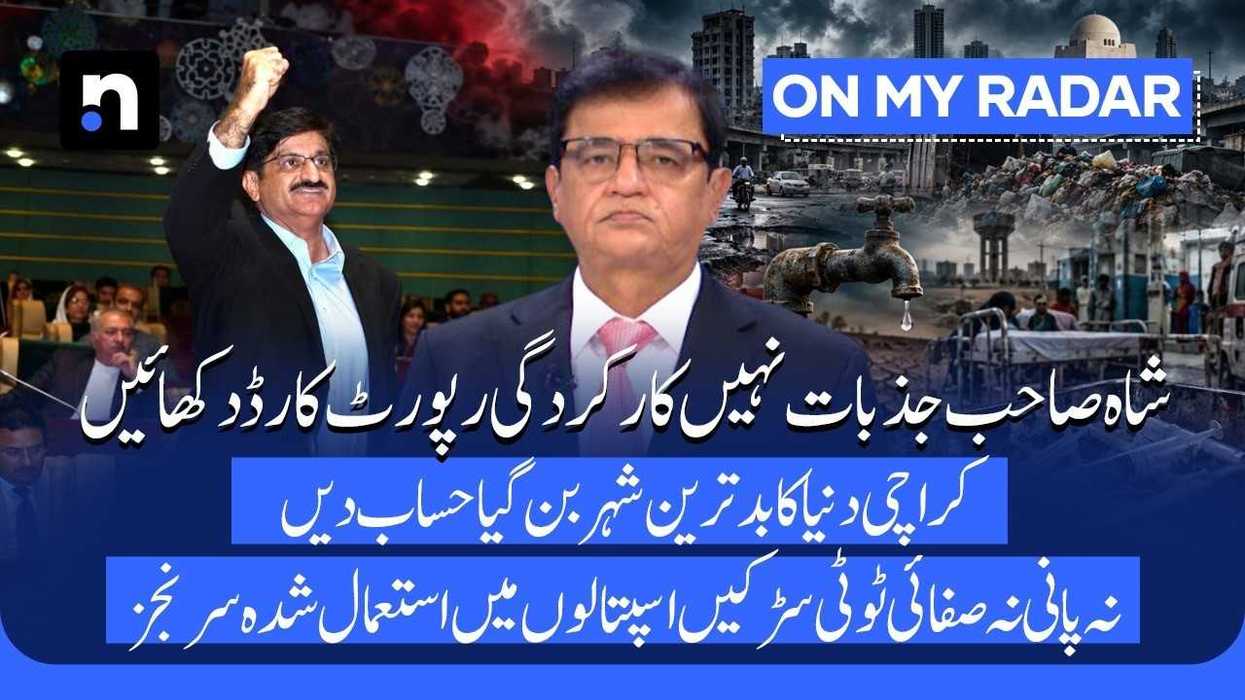
For three days, the Sindh Assembly has echoed with fiery speeches, emotional slogans and repeated declarations that Sindh will never be divided. But amid the political uproar over new provinces and administrative units, a more fundamental question remains: how well has the province been governed during the Pakistan Peoples Party’s 18-year rule?
In the latest episode of On My Radar, Kamran Khan argues that the debate over Sindh’s division should not overshadow the far bigger issue of people’s rights and governance. The Sindh Assembly has passed a resolution rejecting proposals for dividing the province or creating new provinces or administrative units, with Chief Minister Murad Ali Shah leading the political opposition to the idea.
Chief Minister, you have defended Sindh’s unity with considerable passion and anger. But have you ever shown the same intensity in defending the rights of the people of Sindh, an issue far more consequential than the constitutional procedure for dividing or retaining the province?
Since 2008, the PPP has been the only political party in Pakistan to govern one province continuously for 18 years. No other party has enjoyed such an uninterrupted period in power at the provincial level. Murad Ali Shah became chief minister in 2016 and is now serving his third term, making his record particularly relevant to any assessment of Sindh’s governance.
What has changed in the chief minister’s home constituency?
Before assessing the PPP’s broader record, consider the chief minister’s own constituency, Sehwan. After becoming chief minister, has Murad Ali Shah ever taken a close look at the conditions there, where access to drinking water remains difficult, schools are in poor shape and healthcare facilities remain inadequate?
If the situation in Sehwan has not changed substantially, what about Larkana, the hometown of Zulfikar Ali Bhutto, whose name remains central to the PPP’s political identity? The historic Benazir Bhutto Stadium, where Bhutto celebrated the 1973 Constitution with foreign heads of state, has fallen into disrepair, while schools across the city continue to reflect years of neglect.
Across much of rural Sindh, basic necessities remain a struggle. Clean drinking water, healthcare, functioning schools, roads and employment opportunities are still lacking in many areas.
The deterioration of the health sector has also had devastating consequences. In Larkana, an HIV outbreak affected thousands of children, while problems in healthcare delivery and hospital management were acknowledged even by PPP Health Minister Dr Azra Fazal Pechuho.
The issue extends beyond hospitals. When stray dogs attack children in Sindh, families have faced warnings to take precautions alongside repeated concerns over shortages of rabies vaccines.
How has Sindh’s education system performed?
Education presents another troubling picture. The 2022 floods destroyed more than 19,000 schools across Sindh, and PPP Chairman Bilawal Bhutto Zardari had specifically directed the provincial government to restore them when Murad Ali Shah was given his third term as chief minister.
Yet around 14,500 of those schools have still not been rebuilt. Many of the remaining facilities, critics argue, survive more on paper than in reality.
The same pattern can be seen during the province’s recurring floods. Every year, settlements are submerged and poor families bear the consequences, even in areas that have supported the PPP for decades.
Shikarpur, Larkana, Dadu, Mehar and Sehwan are considered PPP strongholds, yet the government has struggled to address something as basic as drainage in these areas.
What about Karachi’s water and infrastructure crisis?
If even an inch of Sindh cannot be divided, who is responsible for protecting the province’s billions of rupees in resources? And why has there not been the same political anger over allegations of corruption involving those resources?
Karachi, Pakistan’s economic engine, generates enormous economic activity through its ports, industry, trade, services and exports. Yet millions of residents still struggle to receive basic municipal services.
The Yellow Line BRT project saw Rs8.5 billion returned to the World Bank over alleged corruption. Meanwhile, residents have endured years of disruption because of the Red Line BRT project, with a public apology doing little to address their difficulties.
The city’s long-running water crisis raises similar questions. Why has the K-IV project, repeatedly presented as a solution to Karachi’s water shortage, remained incomplete? Why do water tankers still operate across the country’s largest city, while residents are pushed towards expensive alternatives such as groundwater boring?
Even when the PPP’s own chairman highlights Karachi’s water crisis, why does the issue not receive the urgency it deserves?
Is this what 18 years of good governance looks like?
Broken sewage lines, overflowing drains, garbage piles, damaged roads, destroyed footpaths and chronic traffic congestion remain familiar features of Karachi. Is this the standard of good governance after 18 years in power?
The city’s standing in international rankings offers another measure. Karachi ranked fourth from the bottom among 173 cities in the 2026 Global Liveability Index, scoring just 20 for stability, 52 for infrastructure and 54 for healthcare.
The question is simple: during three days of speeches and historical references in the Sindh Assembly, did anyone also mention Karachi’s global standing?
Security remains another unresolved problem. Numbeo’s 2026 Crime Index gives Karachi a crime score of 57.5 and a safety score of just 42.5, placing it among South Asia’s less-safe cities.
Yet the Safe City project has remained unfinished despite years of promises and hundreds of meetings of the Apex Committee. Karachi still lacks the level of surveillance infrastructure that even Kabul received under the Taliban government.
What do corruption allegations say about Sindh’s governance?
Corruption allegations have also repeatedly raised questions about the province’s governance. Karachi’s unchecked illegal construction is one example. Despite the Sindh Building Control Authority, unapproved buildings, additional floors and unsafe structures have continued to emerge.
Similar allegations have surrounded the Board of Revenue, land utilization, state land allocations and land records, including claims of corruption, forgery, encroachments and the misuse of government land.
Government officials themselves have spoken about the powerful “system” operating within Sindh, yet ordinary citizens continue to face difficulties getting even basic land documents corrected.
For an ordinary citizen, the strength of that system becomes apparent when a simple land record takes months or years to resolve. For influential individuals, however, even land maps can allegedly be altered.
What makes the situation more striking is that senior PPP figures have themselves acknowledged problems within government departments.
Saeed Ghani, who is now threatening to resign over the division of Sindh, has held key portfolios including education, health, local government, information and labor. Yet the deterioration and alleged mismanagement of these departments did not prompt a similar call for resignation.
What should Sindh’s political debate really focus on?
The PPP leadership says dividing Sindh would betray the legacy of Benazir Bhutto. But after 18 years in power, can the party also say it has adequately addressed the grievances of the people who have continued to struggle with basic services?
Murad Ali Shah frequently describes Sindh as a mother. But if Sindh is a mother, why are so many of her children still deprived of clean water, healthcare, safe roads and effective local government?
Why should citizens not have greater control over decisions affecting their own communities?
Perhaps, before passing resolutions against the division of Sindh, the provincial assembly should consider a resolution on the quality of governance in Sindh.
The question today is not whether Sindh belongs together. The question is whether its government is delivering for the people who live there.
If new provinces are not the answer, then what is? If administrative units are unacceptable, then fully empowered local governments could provide an alternative.
Authority and resources for taxation, policing, water, sewage, mass transit and urban planning could be transferred to the local level.
The people of urban Sindh may not be demanding the division of the province. They are demanding something much simpler: a government that works at their doorstep.



Comments
See what people are discussing