

Tens of millions to vote in high-stakes US midterm elections to decide control of Congress
Americans head to the polls in a crucial midterm election that will determine whether Republicans retain control of Congress or Democrats secure a divided government during President Donald Trump’s second term

News Desk
The News Desk provides timely and factual coverage of national and international events, with an emphasis on accuracy and clarity.
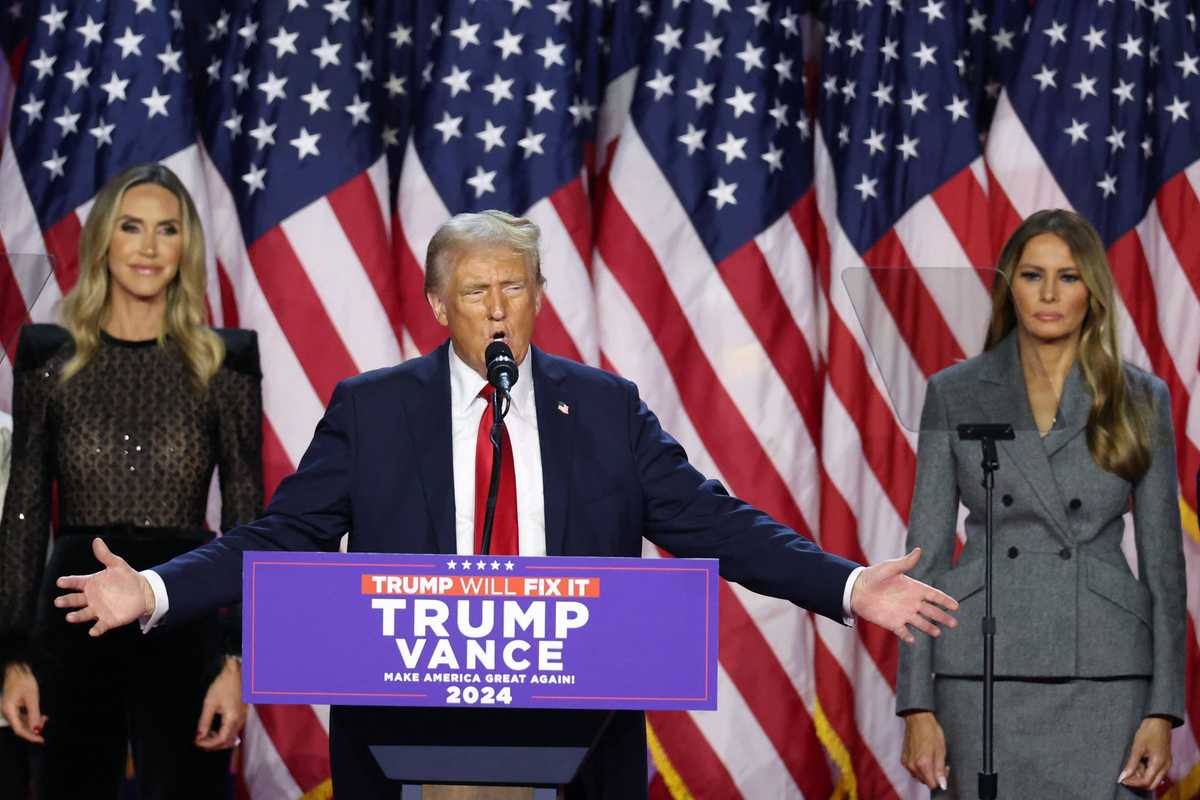
FILE: Republican presidential nominee and former U.S. President Donald Trump is flanked by Melania Trump and Lara Trump as he addresses supporters, during the 2024 U.S. Presidential Election, in Palm Beach County Convention Center, in West Palm Beach, Florida, U.S., November 6, 2024.
Tens of millions of American voters headed to the polls on Tuesday for the U.S. midterm elections—a high-stakes nationwide referendum that will determine the legislative balance of power in Washington for the remaining two years of President Donald Trump’s second term.
While the presidency is not on the ballot, control of both chambers of the United States Congress, 36 state governorships, and thousands of state legislative seats will be determined as polling precincts open across all 50 states.
How do midterms work and what seats are on ballot?
The U.S. midterms take place every four years at the exact midpoint of a president’s four-year term, functioning primarily to elect members of the legislative branch, which drafts federal laws, controls government appropriations, oversees executive agencies, and confirms judicial and administrative appointments.
All 435 voting seats in the House of Representatives are up for election across designated congressional districts nationwide, with members serving two-year terms. In the upper chamber, where 100 senators serve staggered six-year terms, roughly one-third of the body is contested every two years.
Thirty-five Senate seats are on today's ballot, comprising 33 regularly scheduled contests and two special elections to fill vacated terms in Florida and Ohio. Beyond the federal level, voters in 36 states are electing governors, alongside state attorneys general, municipal officials, and local ballot initiatives addressing reproductive healthcare, labor protections, and minimum wage policies.
What are party margins in House and Senate battlegrounds?
Both chambers of Congress currently operate under narrow Republican majorities, leaving control of Capitol Hill on a razor's edge.
In the House of Representatives, where Republicans hold a slim advantage with 218 seats against 214 Democrats and vacant seats, a party requires 218 seats to claim a governing majority. Democrats require a net gain of around four seats to reclaim the speaker's gavel.
According to The Guardian, while post-census redistricting has locked in dozens of non-competitive safe seats, the battle for the House will be decided across roughly 35 to 45 highly contested suburban battleground districts.
In the Senate, Republicans hold a 53–47 advantage, with the Democratic tally including two aligned independents.
According to Al Jazeera, Democrats face a narrow path to reach 51 seats, needing to defend vulnerable seats in Michigan and Georgia while targeting competitive Republican-held races in states including Maine, North Carolina, Ohio, Iowa, and Texas. Republicans can retain chamber control with 50 seats, as Vice President JD Vance holds the constitutional tie-breaking vote.
How could divided government reshape Trump's domestic and foreign policy?
The outcome of the vote will dictate how much executive authority and legislative leeway the Trump administration commands heading into 2027.
If Democrats flip either chamber, President Trump's legislative priorities—including permanent extensions of signature tax reductions, federal spending cuts, and deregulation packages—will face immediate legislative gridlock.
A Democratic-led House would assume committee subpoena authority, enabling congressional panels to initiate oversight inquiries into cabinet officials, executive orders, and federal agency spending. A Democratic Senate majority would hold the power to delay, amend, or reject federal judicial appointments, regulatory nominees, and cabinet vacancies.
Conversely, if Republicans defend majorities in both chambers, the administration will retain an unobstructed mandate to confirm conservative federal judges and accelerate key economic, energy, and immigration legislation without bipartisan concessions.
According to Reuters, international markets and foreign governments are closely monitoring the congressional balance. The outcome is expected to directly influence future U.S. defense appropriations, foreign aid allocations, trade tariff authorizations, and Washington’s military footprint amid ongoing maritime friction and missile strikes across the Persian Gulf and the Strait of Hormuz.





Comments
See what people are discussing