


News Desk
The News Desk provides timely and factual coverage of national and international events, with an emphasis on accuracy and clarity.
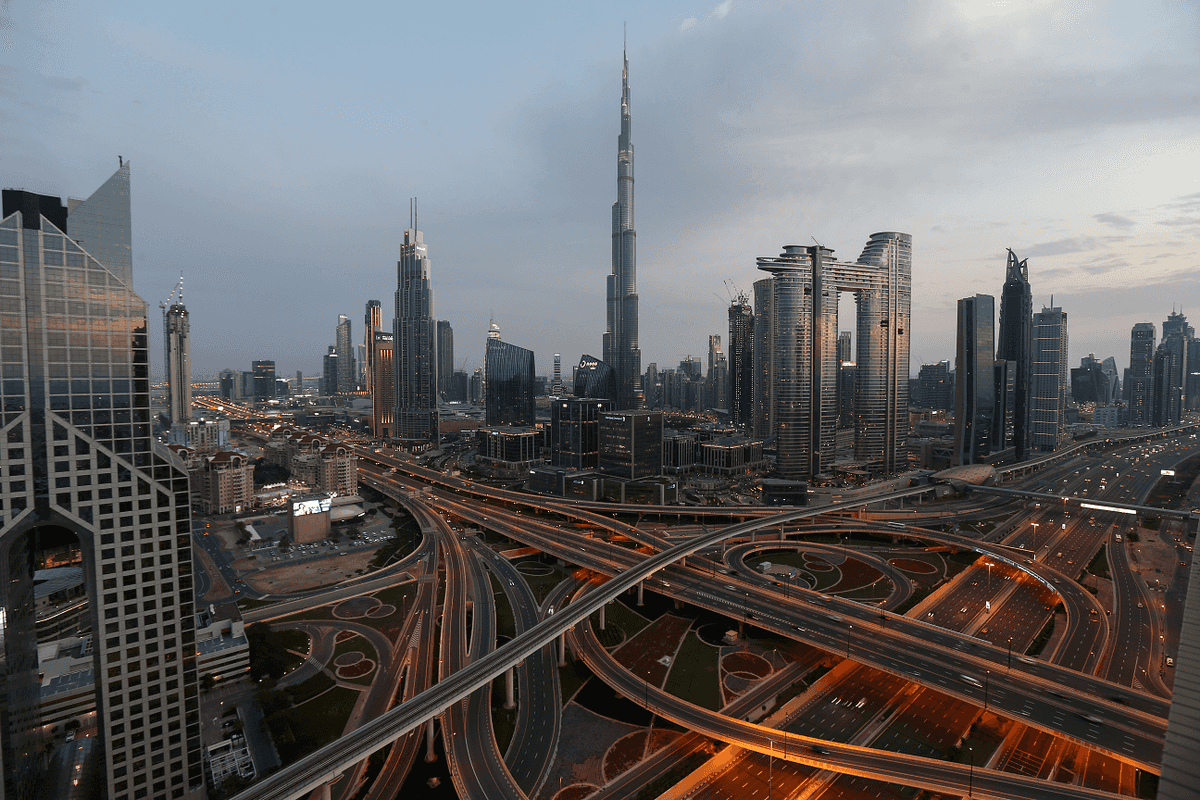
Aerial view of the Sheikh Zayed Road in Dubai, United Arab Emirates.
Reuters/File
The UAE economy continued its upward trajectory in early 2026, driven by solid performance in the banking and financial sector alongside rising indicators in foreign trade and investment, according to international reports cited by WAM.
The country further strengthened its position as a stable and adaptive global economy, reinforcing its reputation as a regional and international leader in sustainable growth.
Central Bank of the UAE data showed banking sector expansion in February 2026, with total assets rising 1.1% month-on-month to exceed AED 5.47 trillion. Credit growth reached 1.2% to AED 2.63 trillion, supported by an AED 20.6 billion increase in domestic lending, while deposits climbed 1.9% to AED 3.4 trillion.
Financial stability indicators remained robust, with the capital adequacy ratio at 17% in early March and liquidity coverage exceeding 146.6%, both comfortably above global regulatory requirements.
UAE banks also featured prominently in Forbes’ 2026 list of the world’s best banks, including First Abu Dhabi Bank, ADCB, Emirates NBD, Emirates Islamic, and Commercial Bank of Dubai.
Credit rating agencies reaffirmed the country’s strong sovereign profile. Moody’s maintained the UAE at Aa2 with a stable outlook, while S&P Global Ratings kept its AA/A-1+ rating, citing strong fiscal buffers and economic resilience. S&P estimated government net assets at around 184% of GDP and liquid assets at roughly 210%.
Trade expansion continued under the Comprehensive Economic Partnership Agreements programme, which targets AED 4 trillion in non-oil trade by 2031. In early 2026, the UAE signed new agreements with the Philippines, Nigeria, the Democratic Republic of the Congo, and Gabon.
The UAE also entered the global top ten merchandise exporters for the first time, ranking ninth according to the World Trade Organization. Total foreign trade reached AED 6 trillion in 2025, up 15% from 2024, while non-oil trade surged 27% to AED 3.8 trillion. Services trade exceeded AED 1.14 trillion.
Investment strength remained evident, with Mubadala reporting assets of AED 1.4 trillion and returns above 10% over five- and ten-year horizons. ADNOC retained its position as the UAE’s most valuable brand for the eighth consecutive year, with brand value rising 11% to $21.13 billion.
Dubai advanced to seventh place in the Global Financial Centres Index, its highest ranking to date, highlighting its growing global financial standing.
Business activity also expanded, with over 1.45 million companies registered by February. Dubai Chamber added 2,709 new firms in March 2026, while Sharjah and Ajman reported steady growth in licences and renewals, reflecting sustained investor confidence.
On the debt markets, the UAE’s March 2026 dirham Treasury bond auction raised AED 1.1 billion, attracting strong demand of AED 4.85 billion—around 4.4 times oversubscribed—for maturities extending to 2027 and 2031.




Comments
See what people are discussing