

UN experts hold India responsible for rights violations in Pakistan during May conflict
UN experts also warn India’s suspension of Indus Waters Treaty threatens Pakistanis’ rights

News Desk
The News Desk provides timely and factual coverage of national and international events, with an emphasis on accuracy and clarity.
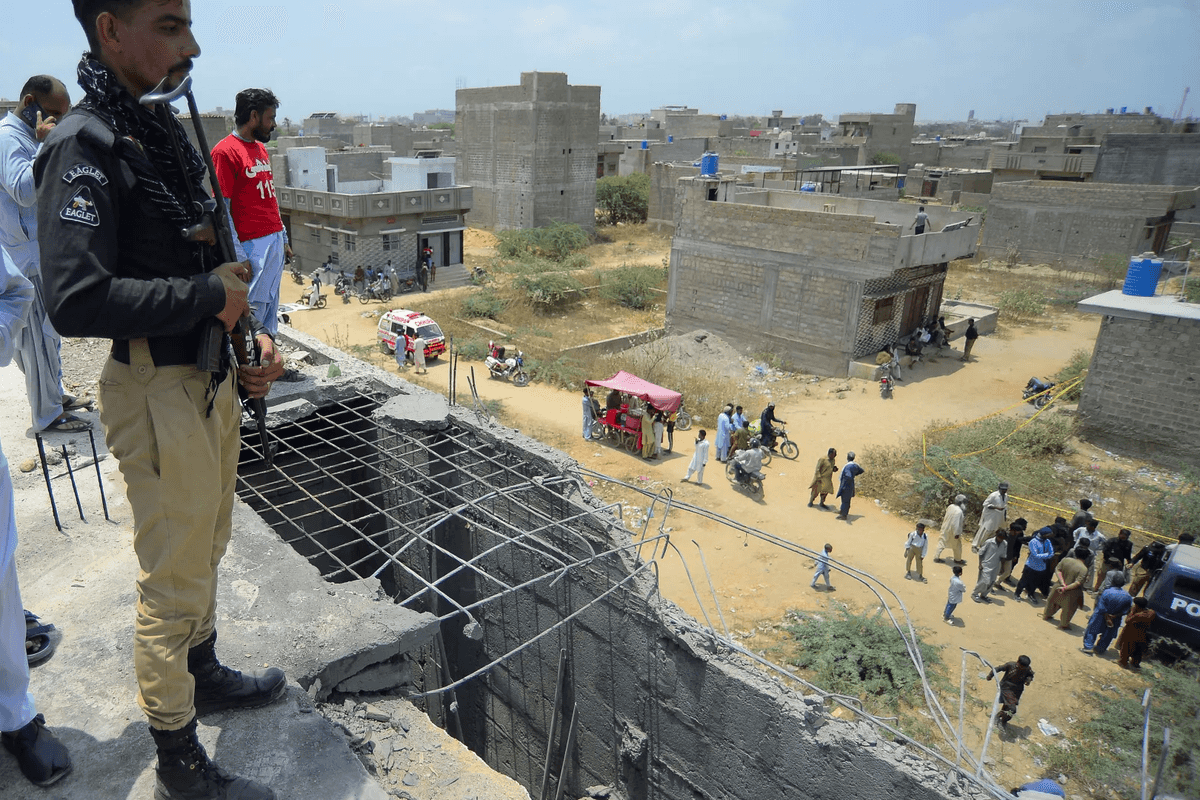
A police officer stands at the site where according to the Crime Scene Unit, a drone was brought down, on the outskirts of Karachi, Pakistan, on May 8, 2025
Reuters
A group of United Nations human rights experts has accused India of violating international law and the rights to life and security through its military strikes inside Pakistan earlier this year.
In a sharply worded legal critique dated October 16, 2025, the five independent experts also warned that India's decision to suspend the 1960 Indus Waters Treaty risks violating the economic and social rights of millions of Pakistanis and lacks valid legal grounds. The 13-page document, a formal "allegation letter" sent to the Indian government, was made public this month.
The communication centers on India's response to a deadly militant attack on tourists in the Pahalgam area of the Indian-administered Kashmir on April 22, 2025, which killed 26 people. While condemning that attack, the experts challenged the legality of India's subsequent actions.
'Unlawful use of force'
The experts stated that India's military operation, dubbed "Operation Sindoor," which involved missile and air strikes on alleged militant bases inside Pakistani territory on May 7, 2025, appeared to breach the U.N. Charter.
"We emphasize that article 2(4) of the United Nations Charter and customary international law prohibits India from the threat or use of armed force against the territorial integrity or political independence of Pakistan," the experts wrote.
They noted that while India asserted its "right to respond and preempt," it did not notify the U.N. Security Council that its operation was an act of self-defense under Article 51 of the Charter, a required procedural step.
The experts also said India "has not disclosed credible evidence that the militants who committed the Pahalgam attack were sent to attack India by the Government of Pakistan."
"As such, it appears that India has violated the prohibition on the use of force under article 2(4) of the Charter, and may itself have committed an armed attack on Pakistan," the letter states. It concludes this "unlawful use of force" constitutes a violation of the right to life under the International Covenant on Civil and Political Rights (ICCPR), to which India is a party.
Water treaty suspension risks 'severe' rights impact
The experts expressed profound concern over India's decision on April 23 to hold the Indus Waters Treaty "in abeyance" until Pakistan "credibly and irrevocably abjures its support for cross-border terrorism."
They highlighted the treaty's critical importance for Pakistan, noting the Indus river system irrigates 80% of the country's arable land, contributes 24% to its GDP, and is vital for the food security and livelihoods of its 240 million people.
"Any disruption of the flow of water under the Treaty... could have serious impacts on human rights in Pakistan," including the rights to water, food, work, a healthy environment, and development, the experts warned. They stressed Pakistan is "already a water-stressed country" and among the ten most vulnerable to climate change-induced water scarcity.
Citing U.N. interpretations, the experts said, "water should never be used as an instrument of political and economic pressure."
Legal grounds for suspension disputed
The communication systematically disputes India's potential legal justifications for suspending the treaty. It references a June 2025 ruling by the Permanent Court of Arbitration (PCA), which is adjudicating separate water disputes between the two countries. The PCA stated the treaty's provisions "definitively indicate an intent by the drafters not to allow for unilateral action."
The U.N. experts argued that the treaty itself appears to exclude unilateral suspension and that even under general international law, grounds such as a "material breach" by Pakistan or a "fundamental change of circumstances" do not appear to be substantiated. They also found the suspension would likely fail tests for being a lawful "countermeasure," as it would be disproportionate and affect fundamental human rights.
Call for Indian response and action
The letter, signed by Special Rapporteurs on counter-terrorism and human rights, extrajudicial executions, a clean environment, water and sanitation, and an expert on international order, poses six detailed questions to India. These include asking whether India will provide "reparation and apology" for rights violations from its use of force and how it will prevent harm from disrupting the water treaty.
The experts urged India to take interim measures to halt alleged violations and stated they "may publicly express our concerns in the near future." The letter notes a copy was also sent to the Pakistani government.
India and Pakistan have fought three wars since 1947, and the Himalayan region of Kashmir, divided between them, remains a core flashpoint. The Indus Waters Treaty, brokered by the World Bank, has survived previous conflicts but now faces its most severe crisis.





Comments
See what people are discussing