

Afghans behind most terror attacks in Pakistan in 2025, army says
DG ISPR also cites 'political-criminal-terror nexus' in KP as a key factor behind the province’s vulnerability

News Desk
The News Desk provides timely and factual coverage of national and international events, with an emphasis on accuracy and clarity.
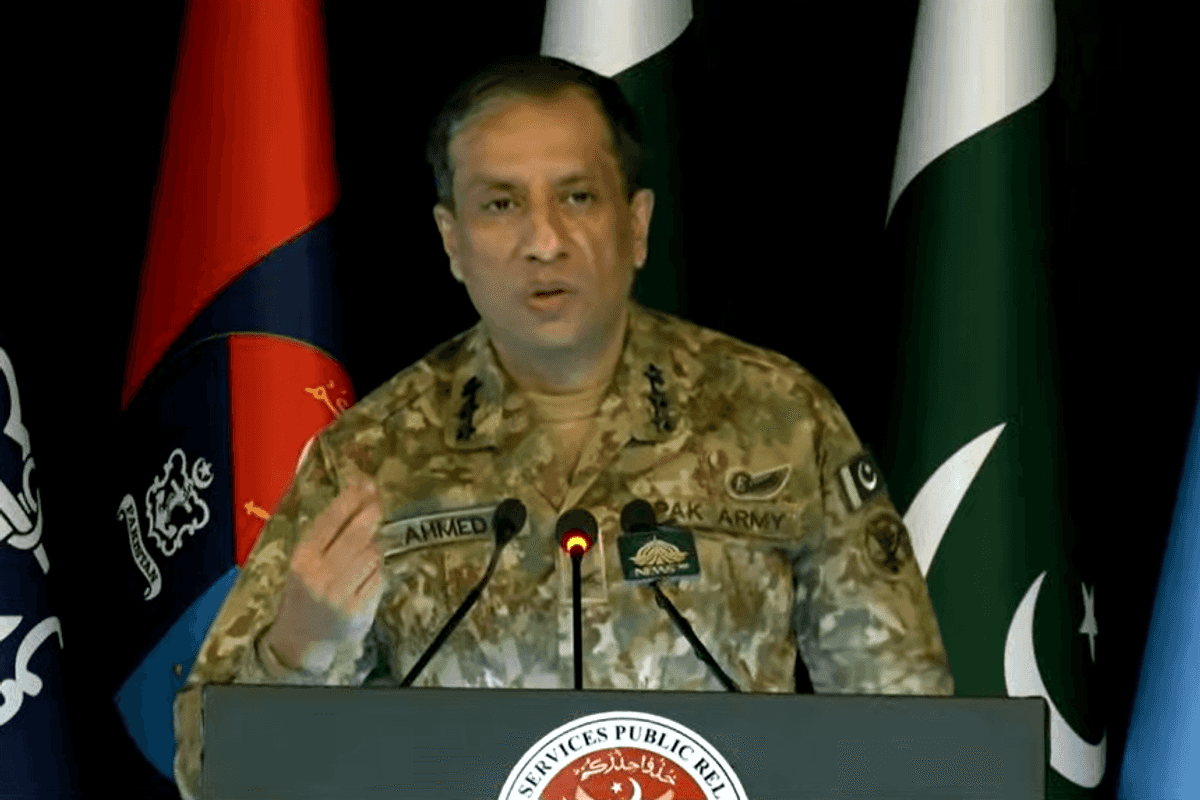
DG ISPR Lt. Gen. Ahmed Sharif Chaudhry speaks at a press briefing at the army headquarters in Rawalpindi on Tuesday.
Screengrab
Pakistan’s military said on Tuesday that Afghan nationals were involved in major terrorist attacks across the country in 2025, emphasizing Islamabad’s intensified counter-terrorism efforts over the past year.
Lieutenant General Ahmed Sharif Chaudhry, director general of the Inter-Services Public Relations (ISPR), spoke at a press briefing at the army headquarters in Rawalpindi, describing 2025 as a “landmark and consequential year in our fight against terrorism.”
“Last year, the world accepted and acknowledged Pakistan’s stance on terrorism, particularly our concerns about Afghanistan serving as a base for terrorist operations,” Lt Gen Chaudhry said.
He added that the fight against terrorism is a national effort, ongoing for more than two decades, and that 2025 saw “unprecedented intensity in counter-terrorism efforts.”
According to the military spokesperson, Pakistan’s law enforcement agencies, including the army, police, Federal Constabulary, and intelligence services, carried out 75,175 intelligence-based operations (IBOs) in 2025, averaging 206 per day.
A regional breakdown showed 14,658 IBOs in Khyber Pakhtunkhwa (KP), 58,778 in Balochistan, and 1,739 across other areas.
The DG ISPR said Pakistan recorded 5,397 terror incidents last year, with KP accounting for 71% (3,811) and Balochistan 29% (1,557). He added that 2,597 terrorists were killed in counter-terrorism operations, including 1,800 in KP, 784 in Balochistan, and 10 elsewhere. Law enforcement personnel and civilians lost 1,235 lives during the year in the ongoing struggle against militancy.
Referring to an attempted attack on Cadet College Wana in November, Lt Gen Chaudhry said Afghan-based terrorists tried to replicate the 2014 Peshawar Army Public School attack.
“This is a war of the nation, a war of every single child,” he said, rejecting the notion that counter-terrorism is solely the military’s responsibility.
‘Political-criminal-terror nexus’
The army spokesperson also cited a “political-criminal-terror nexus” in KP as a key factor behind the province’s vulnerability. “Nearly 71% of terrorist incidents occurred in Khyber Pakhtunkhwa. The primary reason for this is a politically conducive environment and the flourishing political-criminal-terror nexus,” he said.
Lt Gen Chaudhry said Pakistan gained “complete clarity on terrorism” last year and emphasized that the country remains committed to combating extremist threats both domestically and along its border with Afghanistan.
Referring to the 2020 Doha agreement between the United States and the Afghan Taliban, Lt Gen Chaudhry said assurances were given that Afghan soil would not be used for terrorist activities, but argued that those commitments had not been fulfilled.
He said Afghanistan remains a base for groups Pakistan labels Fitna al-Khawarij and Fitna al-Hindustan, adding that all major terrorist organizations targeting Pakistan operate from across the border and receive support there.
Pakistan’s authorities use the term Fitna-al-Khawarij to refer to the outlawed Tehreek-i-Taliban Pakistan (TTP), while Fitna-al-Hindustan is applied to militant groups operating in Balochistan, language the state says reflects its assertions of Indian involvement in terrorism and efforts to destabilize the country.
Addressing claims about the use of drones in counter-terrorism operations, the army spokesperson rejected what he called a “false narrative,” saying it was the TTP, which he described as part of Fitna al-Khawarij, that first deployed armed quadcopters, with backing from India.




Comments
See what people are discussing