

Pakistan finance minister says robust capital market vital for economic growth
Calls for practical reforms to remove bottlenecks across the capital market ecosystem

Business Desk
The Business Desk tracks economic trends, market movements, and business developments, offering analysis of both local and global financial news.
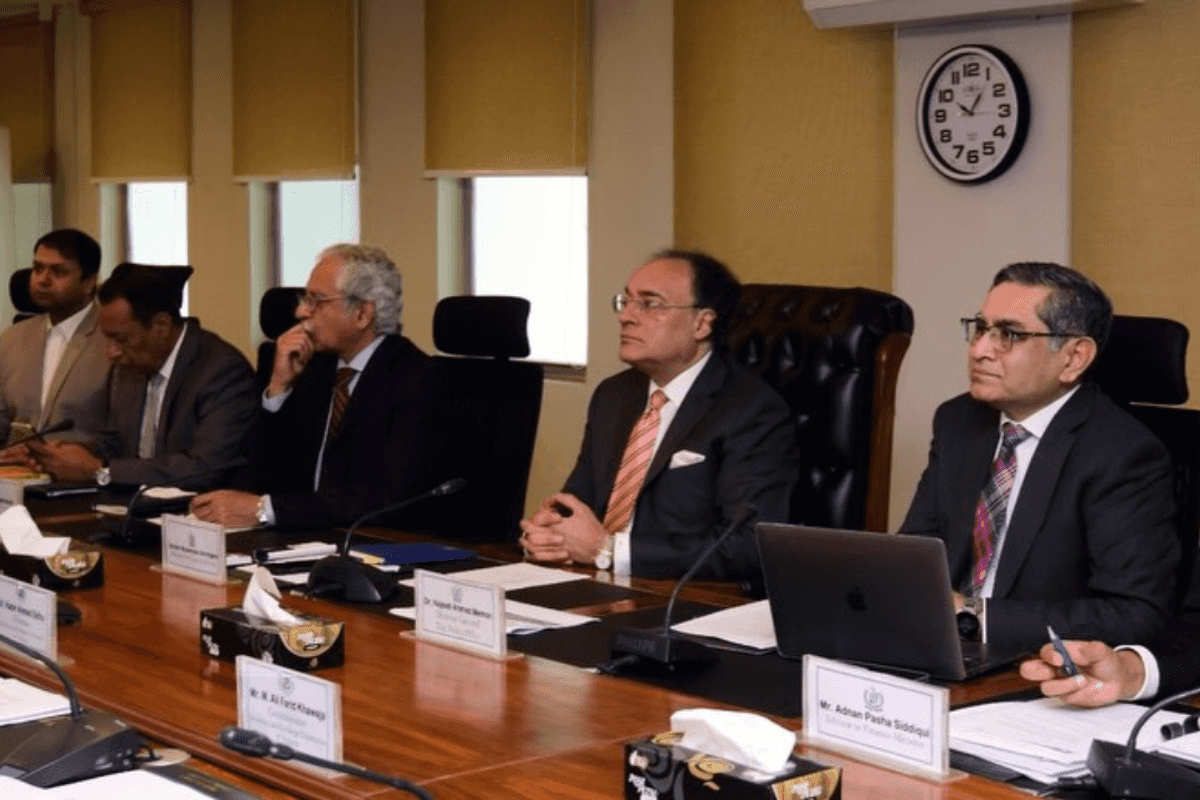
Federal Minister for Finance and Revenue Muhammad Aurangzeb chairs a meeting of the Capital Market Development Council on Wednesday.
Facebook/Ministry of Finance
Pakistan’s Finance Minister Muhammad Aurangzeb said that a well-functioning capital market is essential for sustainable economic development.
He chaired a high-level meeting of the Capital Market Development Council (CMDC) on Wednesday to review reforms aimed at strengthening the country’s capital markets and expanding their role in economic growth.
During the meeting, Aurangzeb emphasized that robust capital markets enable corporations to access long-term financing and provide diversified investment opportunities for both institutional and retail investors.
The finance minister said Pakistan needs to move toward a more balanced financial system in which capital markets complement the banking sector in meeting the economy’s financing needs.
He stressed that developing a strong corporate bond market would be key to mobilizing long-term domestic savings and supporting private-sector investment.
Aurangzeb called for practical, time-bound reforms to remove bottlenecks across the capital market ecosystem, including issuance processes, regulatory procedures, market infrastructure and secondary-market liquidity.
He said reforms should create an enabling environment for companies to raise funds through market-based instruments while improving transparency and investor confidence.
He also directed the Securities and Exchange Commission of Pakistan (SECP) to step up outreach efforts to ensure that companies, financial institutions and other market participants are aware of recent regulatory changes aimed at simplifying corporate bond issuance. These reforms include reduced documentation requirements, streamlined procedures and other facilitation measures introduced in recent months.
The meeting highlighted the importance of learning from international and regional capital market practices and adapting relevant best practices to Pakistan’s context. Improving market infrastructure and trading activity—particularly through effective market-making mechanisms—was identified as critical to boosting investor confidence and enhancing liquidity in the secondary market for corporate debt instruments.
Participants also discussed policy measures to encourage companies to rely more on capital markets rather than traditional bank borrowing. Officials noted that a deeper corporate bond market could diversify funding sources for businesses and reduce reliance on bank lending.
Another key issue taken up during the meeting was the framework for capital market participants.
The Finance Ministry’s Tax Policy Office has begun consultations to review tax-related issues affecting investors and issuers, with the aim of rationalizing the tax structure and exploring incentives to promote greater participation in the market.
Representatives from the Pakistan Stock Exchange (PSX), SECP, State Bank of Pakistan (SBP), Central Depository Company (CDC), National Clearing Company of Pakistan Limited (NCCPL), Pakistan Banks Association (PBA) and Pakistan Business Council (PBC) briefed the council on recent initiatives to facilitate corporate bond issuance and improve overall market functioning.
Officials said several regulatory reforms have already been implemented, including simplified prospectus requirements, streamlined documentation procedures, reduced regulatory fees and digitization of the issuance process to improve efficiency and transparency.
However, participants also highlighted structural challenges hindering the growth of the corporate bond market, such as approval delays, coordination gaps among market participants and limited awareness among potential issuers.
The meeting further discussed the need to improve secondary-market liquidity. Stakeholders noted that the absence of adequate market-making arrangements restricts trading activity and price discovery for corporate debt instruments. Increased participation from banks and brokerage houses could help enhance liquidity and encourage broader investor participation.
The council also reviewed its broader reform agenda to strengthen coordination among regulators, market infrastructure institutions, and the private sector. The CMDC plans to establish specialized working groups comprising regulators, financial institutions and industry stakeholders to accelerate policy implementation.
These working groups will focus on areas including tax and fiscal policy, debt issuance frameworks, market infrastructure development and investor protection.
Aurangzeb reiterated the government’s commitment to building a deeper and more efficient capital market, describing it as a key pillar for mobilizing investment, strengthening financial stability and supporting private-sector-led economic growth.





Comments
See what people are discussing