

CCP calls for grid overhaul, quality crackdown to unlock solar competition
Regulator proposes smart metering rollout, domestic manufacturing incentives, and national solar registry

Business Desk
The Business Desk tracks economic trends, market movements, and business developments, offering analysis of both local and global financial news.
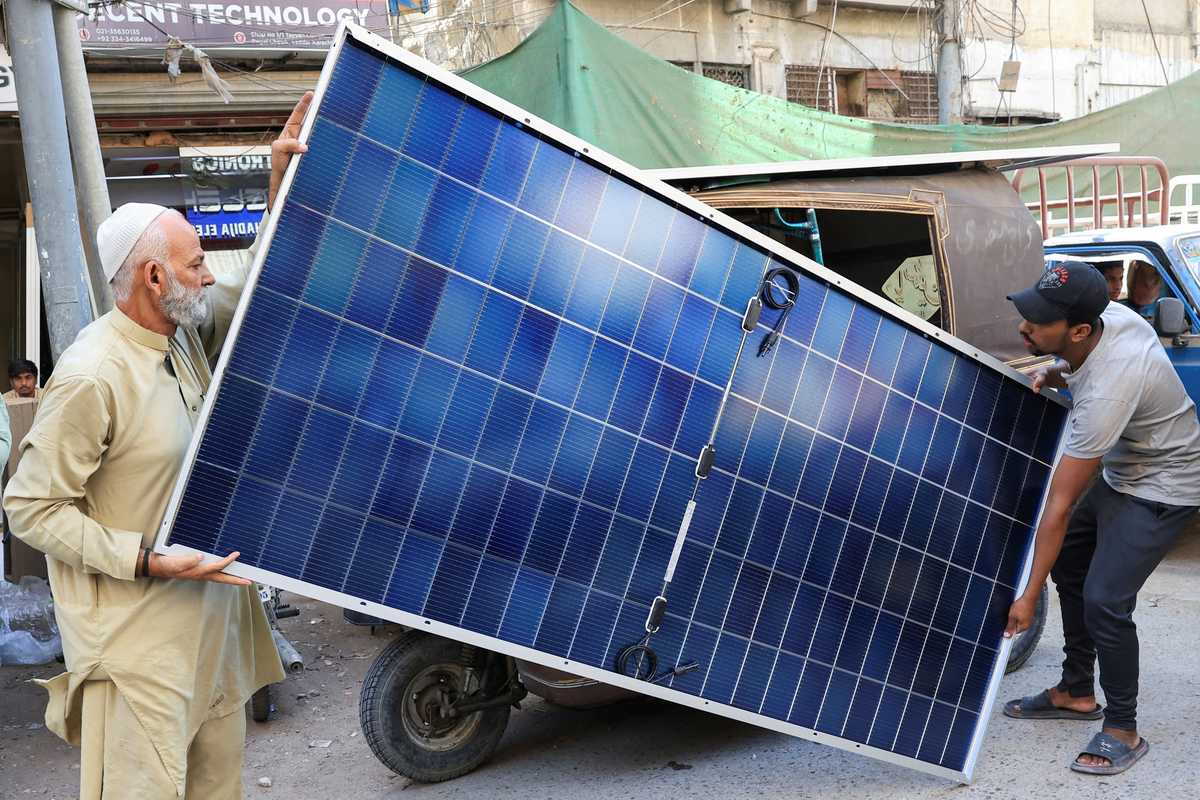
Men load solar panels on an autorickshaw at a market in Karachi, Pakistan March 26, 2025.
Reuters
Pakistan's Competition Commission has proposed a sweeping set of reforms to remove structural barriers in the country's solar energy market, warning that outdated grid infrastructure, opaque policies, and substandard equipment are collectively stifling competition and investment in the sector.
The Competition Commission of Pakistan (CCP) released the proposals in a market study titled "Unlocking Green Potential: A Market Competition Study of Solar Energy in Pakistan," which has been placed on the regulator's website for stakeholder consultation.
Grid modernization
At the center of the CCP's recommendations is an urgent call to modernize the country's distribution networks. The regulator says ageing feeders and substations are ill-equipped to handle two-way power flows from distributed solar generation, causing voltage fluctuations and constraining the expansion of net-metering — the mechanism that allows households and businesses to sell surplus solar power back to the grid.
To address this, the CCP has recommended a national smart metering rollout alongside the deployment of advanced grid automation systems, including Supervisory Control and Data Acquisition (SCADA) and Distribution Management Systems (DMS). The regulator says these technologies would improve real-time monitoring, cut transmission losses, and enable more efficient integration of renewable energy into the national grid.
Market liberalization
The commission has also taken aim at delays in Pakistan's broader power market reform agenda, urging the government to accelerate implementation of the Competitive Trading Bilateral Contract Market (CTBCM) — a long-pending framework intended to introduce wholesale electricity competition. As an interim step, the CCP has recommended pilot bilateral contracts for renewable energy, particularly for industrial clusters and Special Economic Zones, which it says could unlock cheaper electricity and stimulate market competition ahead of the full CTBCM rollout.
The study raises serious concerns over the proliferation of substandard and counterfeit solar equipment in the market. The CCP has recommended the establishment of accredited solar testing laboratories, mandatory compliance with international quality standards, and the introduction of digital verification systems to help consumers and regulators identify non-compliant products.
Storage and domestic manufacturing
Pointing to rapid global advances in battery storage — driven in part by growth in the electric vehicle industry — the CCP says Pakistan has a timely opportunity to ease pressure on the national grid by incentivizing solar-plus-storage systems. The commission has also recommended support for domestic battery manufacturing.
On the supply side, the regulator has proposed a Production-Linked Incentive (PLI) scheme and the development of dedicated renewable energy zones to reduce the country's dependence on solar panel imports. These measures, it says, should be supported by targeted tax incentives, improved financing access, and international partnerships.
The CCP flagged that the benefits of net-metering remain largely concentrated in urban centers, recommending off-grid solutions, targeted subsidies, and concessional financing to extend solar access to rural communities.
To address persistent data gaps across the sector, the commission has proposed a National Solar Registry to support policy planning and improve transparency across the solar value chain.





Comments
See what people are discussing