


News Desk
The News Desk provides timely and factual coverage of national and international events, with an emphasis on accuracy and clarity.
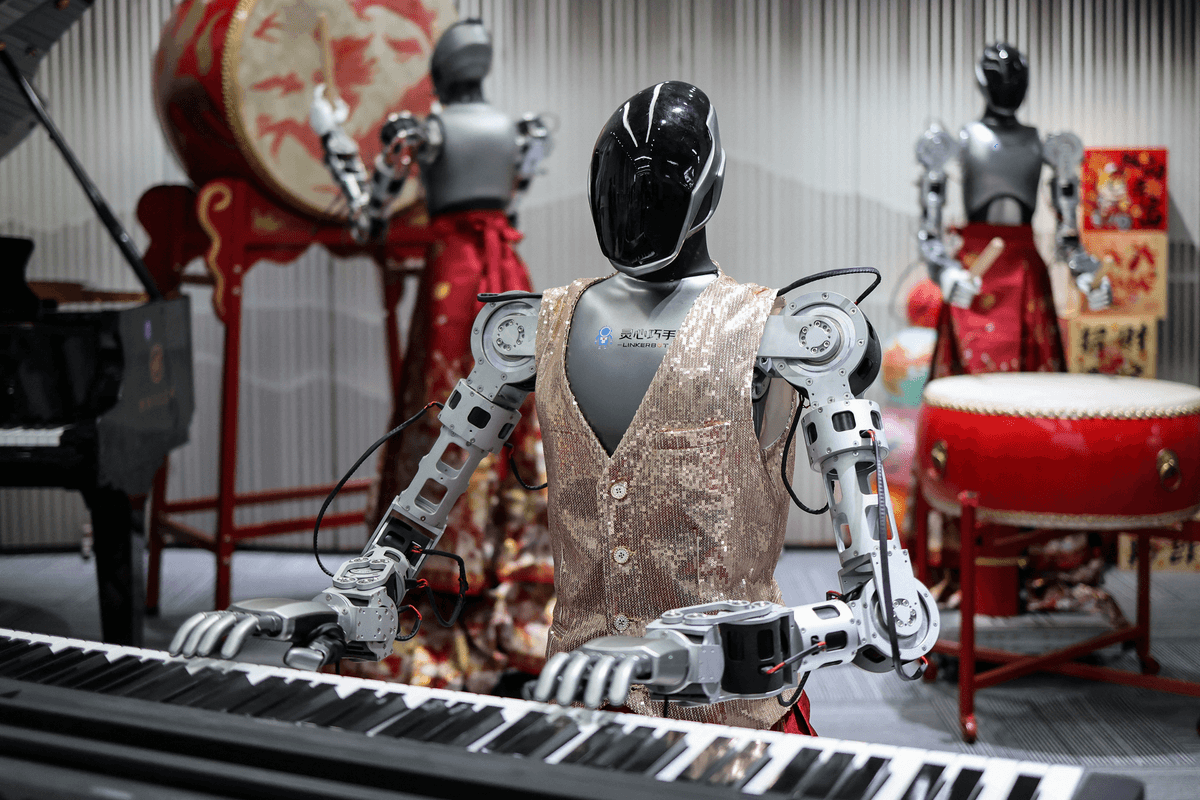
A group of Linkerbot’s humanoid robots, arranged with musical instruments, is displayed at the company’s Beijing office on April 27, 2026.
Reuters
Chinese robotics startup Linkerbot will seek a $6 billion valuation in its next financing round, double the valuation it achieved in a funding round closed last week.
The Beijing-based company holds over 80% of the global market share in high-degree-of-freedom robotic hands for humanoid robots. The announcement reflects surging investor interest in China's humanoid robotics industry in 2026.
What is Linkerbot and why is it targeting a $6 billion valuation?
Linkerbot is a Beijing-based startup and the global market leader in highly dexterous robotic hands for humanoid robots. It completed a "series B+" funding round last week at a $3 billion valuation and is now targeting double that figure in its next round. The company has not disclosed a timeline or whether the next raise will be private or an IPO.
Who invested in Linkerbot's latest funding round?
Ant Group and Sequoia spin-off HongShan Group participated in the series B+ round, alongside state-backed Zhongguancun Science Park Fund, Bank of China Asset Management and Fosun Capital. The company announced the round in a statement on Thursday. It did not disclose the total amount raised.
CEO Alex Zhou told Reuters the company plans to scale production to 10,000 robotic hand units per month from nearly 5,000 currently, though he did not give a specific date.
Investor appetite for Chinese humanoid robotics has grown sharply this year, following widely watched performances by market leaders such as Unitree at the Lunar New Year and the Beijing humanoid robot half-marathon in April. Unitree filed for a Shanghai IPO in March, seeking a valuation of up to $7 billion.
What makes Linkerbot's robotic hands different from competitors?
Unlike rivals such as X Square Robot, which focus on training robotic hands for household chores, Linkerbot targets high-value human craftsmanship. Its LinkerSkillNet platform converts human skills into standardized, reusable capabilities for robotic hands, and currently contains over 500 skills. Zhou describes it as the world's largest real-world dexterous manipulation dataset.
"We aren't just making hands. Our goal is to replicate the entire library of human dexterous skills within our hardware," Zhou said. The platform is a multimodal data collection system that stores and standardizes those skills for deployment across Linkerbot's hardware.
Georg Stieler, head of robotics and automation at technology consultancy Stieler, said the hand is "the most complex part of the whole humanoid robot," adding that Elon Musk has described it as consuming more than half of Tesla's engineering effort for its Optimus robot.
What can Linkerbot's robotic hands actually do?
Linkerbot's hands can already rapidly turn screws, grasp deformable soft objects, thread a needle and perform high-precision manufacturing tasks. Its basic O6 lightweight model carries a 50 kg load despite weighing only 370 grams, a performance advantage Zhou says is critical for industrial applications requiring both miniaturization and strength.
The company manufactures key components including joint modules, motors and reducers in-house, and uses specialized self-lubricating, corrosion-resistant polymers.
CEO Zhou, who was inspired by his childhood fondness for Doraemon, the Japanese cartoon robotic cat, envisions the hands playing piano, giving massages or performing dentistry. He describes these as skills with "value-add that is at least triple that of basic labor." Linkerbot supplies some of China's leading humanoid robot makers as well as foreign industrial companies, though it declined to name them due to non-disclosure agreements.
How is Linkerbot addressing the cost barrier to humanoid robots in factories?
A major obstacle to widespread factory use of humanoid robots is cost, with leading industrial models from Unitree, AgiBot and UBTech priced between $100,000 and $150,000 per unit, according to analysts.
Linkerbot says its hands offer a more accessible entry point, as customers can mount them onto existing robotic arms rather than purchasing a full humanoid. "Chinese factory owners are extremely pragmatic. They've realized that for most factory work, two arms and a pair of dexterous hands are enough," Zhou said.
The company has over 400 employees and operates five factories in Beijing and Shenzhen. It is also developing intelligent production lines where robotic hands manufacture other robotic hands. Beyond industrial settings, Linkerbot's products are used by research institutes and leading global universities.





Comments
See what people are discussing