

Debate over new provinces gathers pace amid calls for governance reforms
Kamran Khan says debate over new provinces enters serious policy discourse

News Desk
The News Desk provides timely and factual coverage of national and international events, with an emphasis on accuracy and clarity.
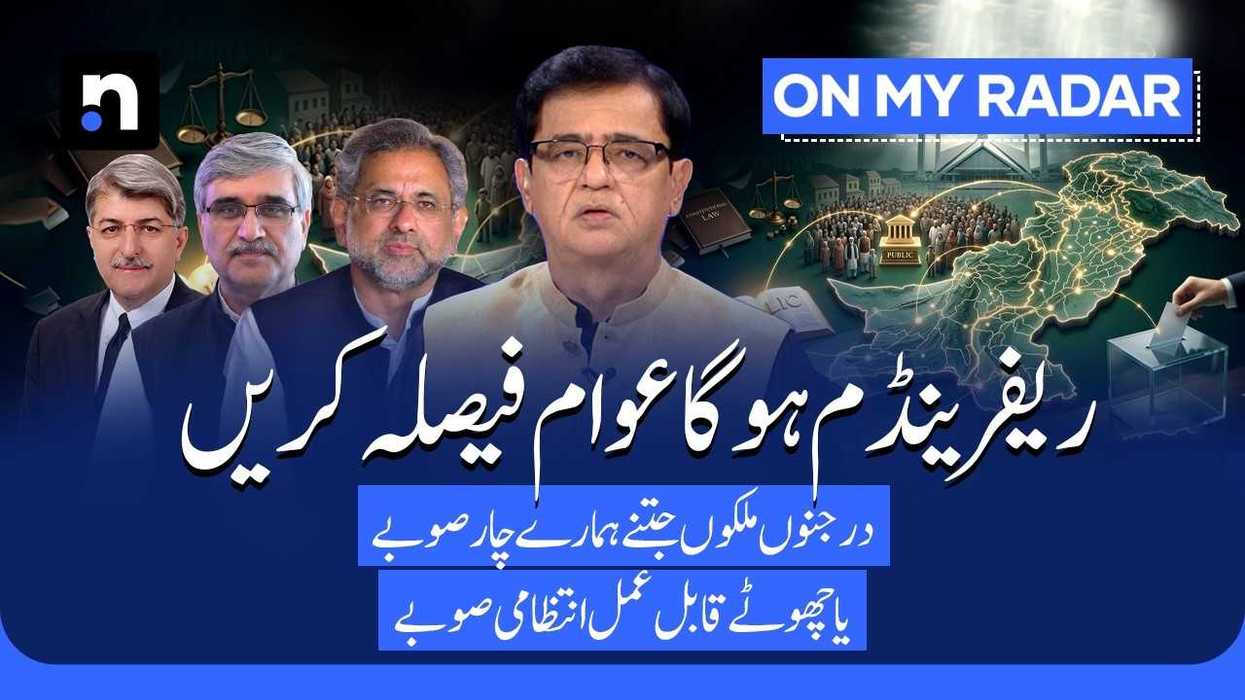
Over the past 24 hours, a series of statements from Pakistan's civilian and military leadership has propelled the long-running debate over administrative reforms into the national spotlight, with growing calls to revisit the country's governance structure as a way to improve public service delivery, security and economic management.
Kamran Khan said in the latest episode of On My Radar that the discussion over creating new provinces or administrative units is no longer confined to political rhetoric but has evolved into a serious constitutional and policy debate. According to him, influential quarters are also moving toward a principled decision to hold a nationwide referendum on the issue, potentially making it one of the country's most consequential governance debates in decades.
The debate gathered momentum after Interior Minister Mohsin Naqvi acknowledged that Pakistan's existing governance system was no longer functioning effectively and urged all political parties to come together to discuss the creation of new provinces or administrative units.
Speaking at Pakistan's first Economic Summit in Islamabad, Naqvi said the current system had effectively "collapsed" and that the government was largely engaged in firefighting rather than solving underlying problems. He argued that creating new provinces or administrative units offered the most practical path to improving governance and accelerating development, adding that any such decision should be guided by the will of the people.
A day later, Director General of Inter-Services Public Relations (ISPR) Lieutenant General Ahmed Sharif Chaudhry echoed the need for better governance while addressing a press conference on the country's security situation. He said good governance was fundamental to Pakistan's security and long-term stability and argued that if achieving it required an administrative reset or the creation of new provinces, the matter deserved serious consideration.
Chaudhry said military operations alone could not resolve Pakistan's broader challenges, stressing that effective governance remained essential for tackling issues ranging from terrorism and public administration to economic stability. He maintained that any reforms, however, should be undertaken through constitutional, legal and democratic processes in accordance with the will of the people.
Naqvi also argued that Pakistan could not move forward unless all political parties sat together to agree on a comprehensive reset of the governance system, saying broad political consensus was essential for meaningful reform.
Defence Minister Khawaja Asif has also appeared to support the idea of administrative restructuring. Speaking on ARY News' program Khabar Muhammad Malik Kay Sath, he suggested that Karachi and Gwadar should be placed under federal administration.
Adding another perspective to the debate, Dunya Media Group Chairman and former Lahore mayor Mian Amir Mahmood proposed reorganizing Pakistan into provinces based on existing administrative divisions rather than linguistic identities. He argued that Pakistan's provinces were significantly larger than many countries in both population and geographical size, making governance increasingly difficult. Administrative reorganization, he said, would improve efficiency and bring government closer to the people.
At the heart of the debate are two constitutional provisions.
The first is Article 140-A, which requires provinces to establish empowered and financially autonomous local governments. However, despite the passage of the 18th Constitutional Amendment more than 16 years ago, most provinces have yet to fully devolve powers to local governments. Provincial Finance Commissions have also remained largely ineffective, leaving authority, financial resources and decision-making concentrated in provincial capitals.
The second is Article 48(6), which allows the prime minister, with parliamentary approval, to hold a referendum on a matter of national importance. Constitutional experts say that if the question of creating new provinces were put directly to the public, it could become one of the largest democratic consultation exercises in Pakistan's history.
A referendum alone, however, cannot create new provinces. Under Article 239 of the Constitution, any change to provincial boundaries requires a two-thirds majority in both houses of Parliament as well as the approval of the relevant provincial assembly by a two-thirds majority. Nevertheless, constitutional experts argue that a clear public mandate through a referendum would be politically difficult for any government or political party to ignore.
Whether Pakistan ultimately chooses to strengthen its local government system or establish new administrative provinces, supporters of reform say the objective remains the same: to decentralize authority, resources and decision-making from Islamabad and provincial capitals to local communities.
If the current debate continues to gain momentum, it could mark not merely a redrawing of Pakistan's administrative map, but the beginning of a broader transformation in the country's system of governance.




Comments
See what people are discussing