

Democrats’ midterm victory deals major blow to Trump as Iran war fuels voter backlash
Kamran Khan examines how the election reshaped US politics, weakened Trump’s grip on Congress and produced historic firsts

News Desk
The News Desk provides timely and factual coverage of national and international events, with an emphasis on accuracy and clarity.
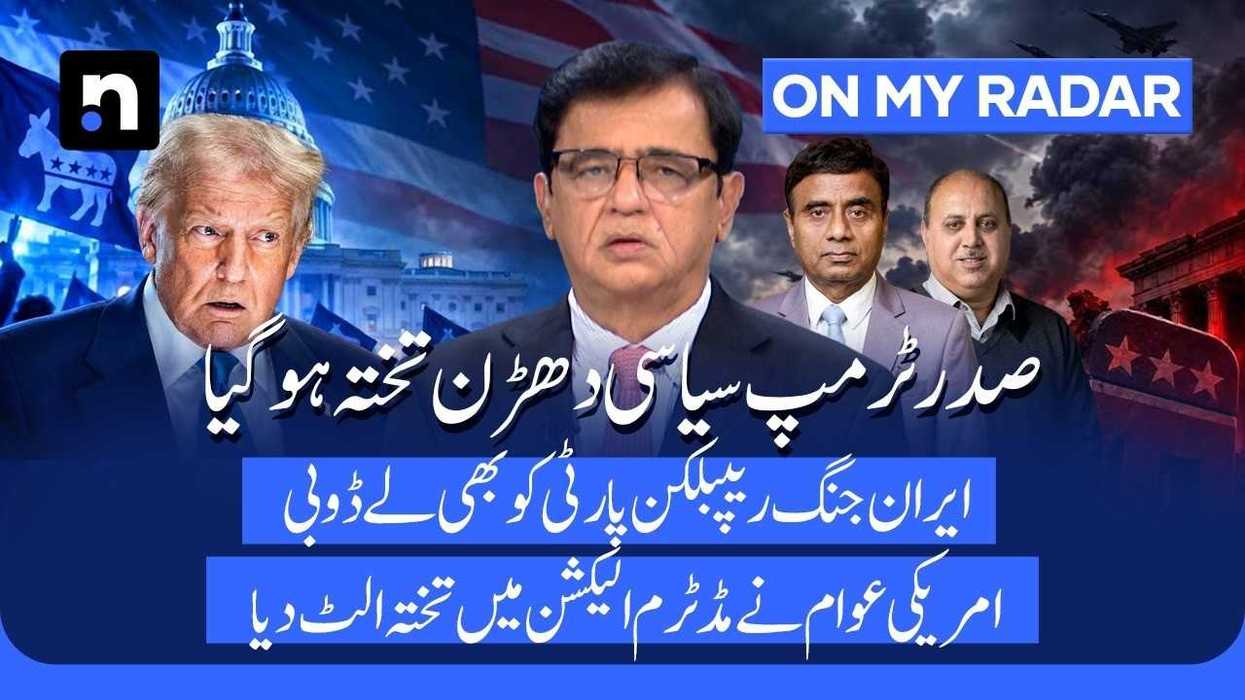
U.S. President Donald Trump faces a dramatically changed political landscape after Democrats captured control of both chambers of Congress in the midterm elections, delivering a major setback to his Republican Party and setting the stage for a contentious final two years of his presidency.
In the latest episode of his program On My Radar, Kamran Khan examines the political fallout, arguing that the war with Iran, rising inflation and soaring gasoline prices played a central role in turning voters against Trump and his administration.
Trump, who entered the White House in 2024 on his Make America Great Again (MAGA) platform, now faces growing resistance at home. The program argues that his handling of the Iran war, its economic consequences and his decisions in support of Israel have undermined the political popularity he enjoyed two years ago.
The consequences, Khan says, could extend beyond Washington. Trump, who has frequently unsettled international relations through controversial foreign policy announcements, will now face greater resistance from a Democratic-controlled Congress, potentially limiting his ability to pursue his agenda abroad and at home.
Iran war and rising prices behind Republican defeat
U.S. media outlets, including CNN and Fox News, have identified the war with Iran and its economic consequences as major factors in the Republican defeat, according to the program.
Rising gasoline prices and inflation added to public frustration, turning the cost of living into a major issue in the elections.
Trump himself acknowledged the impact of the war and higher fuel prices in interviews following the results, according to Khan. His comments amounted to an admission that the administration's war strategy and economic claims had failed to convince voters.
The election results showed Democrats and their allied independents securing 54 seats in the Senate, compared with 44 for Republicans. In the House of Representatives, Democrats had won 228 of the 367 seats called, while Republicans had secured 139.
The U.S. midterm elections are held every two years. All 435 House seats are contested, along with roughly one-third of the Senate's 100 seats. In 2026, gubernatorial elections were also held in 36 states because the governors' terms were expiring.
Democrats break Republican strongholds
Democrats also made significant gains in state elections, breaking Republican dominance in several traditionally conservative states.
In Texas, James Talarico won a Senate seat, making him the first Democrat elected to the state's Senate delegation since 1988. Gina Hinojosa defeated Republican incumbent Gov. Greg Abbott, becoming Texas' first Latina governor.
In Kansas, Adam Hamilton won a Senate seat, giving Democrats their first victory in a Senate election in the state since 1932. Republicans also suffered major setbacks in Iowa, Ohio, North Carolina and Maine.
Democrats also made historic gains in gubernatorial elections. Keisha Lance Bottoms won in Georgia, becoming the first Black woman elected governor of a U.S. state. In New Mexico, Deb Haaland became the first Native American woman elected governor.
Another historic victory came in Michigan, where Democrat Abdulrahman Mohamed El-Sayed won a Senate seat, becoming the first Muslim elected to the U.S. Senate.
Addressing supporters after his victory, El-Sayed expressed his determination to replace the phrase "Insha'Allah" with "Alhamdulillah," reflecting his celebration of the historic achievement.
The House of Representatives is also poised for a historic change in leadership. Democratic leader Hakeem Jeffries is positioned to become speaker when the new Congress convenes in January. If elected, he will become the first Black speaker in U.S. history, ending four years of Republican control of the chamber.
Trump signals confrontation and cooperation
Trump appeared unable to conceal his frustration following the Republican defeat. On social media, he criticized his own preferred television network, Fox News, over the party's losses and shared an image of a red cap bearing the word "VETO" instead of his familiar MAGA slogan.
The message appeared to signal his intention to use presidential veto powers against legislation passed by the Democratic-controlled Congress.
However, the election has also created a challenge for Democrats. Despite controlling both chambers, they cannot unilaterally reverse Trump's policies because the president retains the power to veto legislation.
They can, however, use their congressional majorities to investigate administration decisions, scrutinize government spending and obstruct parts of the president's legislative agenda.
In a notable shift, Trump, who previously mocked Democrats by calling them "Dumbocrats," has indicated that he wants to work with them rather than spend the remaining two years of his presidency simply vetoing their legislation.
He has acknowledged that he does not want to spend the rest of his term rejecting bills passed by Congress and has signaled an interest in cooperation, even as he invokes his veto powers.
Trump had previously sought to shape international affairs on his own terms. Now, with Democrats preparing to take control of Congress, his ability to advance his domestic and foreign policy priorities will face greater legislative resistance.
The election has therefore changed the balance of political power in Washington. Trump remains president, but the path to implementing his agenda is no longer as straightforward as it was under unified Republican control.
For the Democrats, the challenge will be to use their newly won majorities effectively. For Trump, the next two years will be a test of his ability to retain political influence while governing alongside an opposition-controlled Congress.
As Kamran Khan concludes, the MAGA movement's electoral setback has opened a new chapter in American politics, potentially bringing a less confrontational political environment at home and abroad.





Comments
See what people are discussing