


News Desk
The News Desk provides timely and factual coverage of national and international events, with an emphasis on accuracy and clarity.
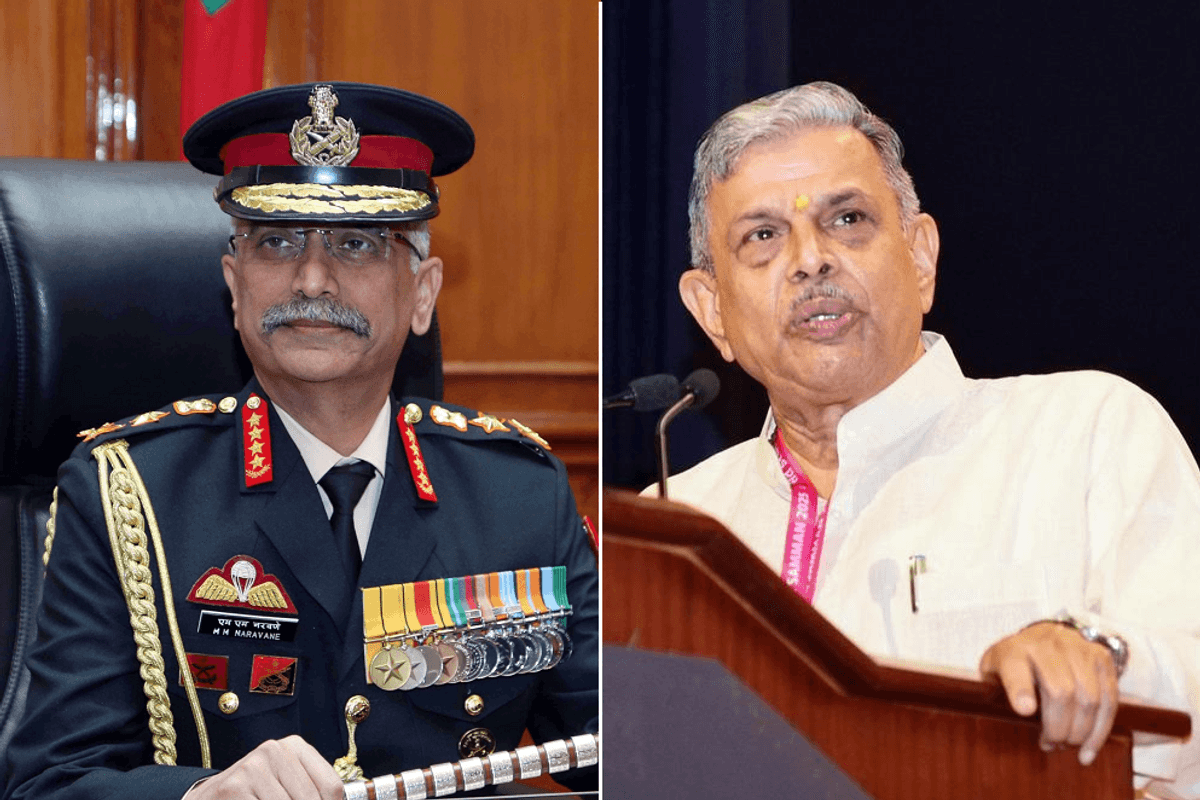
Former Indian army chief General (retired) Manoj Naravane (L) and RSS leader Dattatreya Hosabale.
X
Former Indian army chief General (retired) Manoj Naravane has endorsed calls by senior RSS leader Dattatreya Hosabale for sustained dialogue between India and Pakistan.
Naravane, speaking to PTI on Wednesday, said people-to-people engagement between the two nuclear-armed neighbors was essential for improving long-strained relations.
The remarks follow comments by Hosabale earlier in the week advocating that the door to dialogue should remain open.
What did India's former army chief say about dialogue with Pakistan?
Naravane said ordinary citizens on both sides of the border share the same basic concerns, including food, shelter and daily life, and that politics rarely drives their interactions.
He said friendship between people naturally helps improve relations between countries. "When friendship develops between the people of two countries, it naturally helps improve relations between the countries themselves," he said.
Naravane also stressed the value of informal engagement, saying people-to-people interaction "whether through Track-II diplomacy or through sporting events, is very important." He was careful to add that dialogue and military preparedness are not mutually exclusive. "India is a country that believes in speaking the language of peace, but if the need arises, we will not hesitate to use our strength and capabilities as well," he said.
What did RSS leader Hosabale say about India-Pakistan relations?
Hosabale, in an interview aired by PTI on Tuesday, said there "should always be a window for dialogue" between New Delhi and Islamabad despite recurring tensions and security concerns. He acknowledged that India must respond appropriately to security provocations, referencing the 2019 Pulwama suicide attack in Indian-administered Kashmir that killed 40 Indian paramilitary personnel. "But at the same time, we should not close the doors," he said.
Hosabale argued that diplomatic relations, trade, commerce and visa arrangements should continue. He also described the 2008 Mumbai attacks as a major turning point in bilateral relations, saying mutual trust had remained weak ever since.
"Since then, the peace period is very, very less," he said, adding that mutual confidence between the two countries was not fully restored.
He further argued that cultural and civic ties between the two countries should continue to be encouraged despite political tensions. "I believe strongly that ultimately, civic society relations and because we have a cultural relation, we have been one nation, so that has to be emphasized by some people at least," Hosabale said.
How did India's Congress party react to the RSS call for Pakistan dialogue?
The Congress party pushed back sharply, posting on X that the "RSS's love for Pakistan has once again come to the fore." The party reiterated India's longstanding allegations linking Pakistan to militancy, accusations Islamabad has consistently denied.
The reaction reflects a broader domestic debate in India over how to balance security concerns with diplomatic engagement toward its neighbor.
The RSS is widely regarded as the ideological parent of Prime Minister Narendra Modi's Bharatiya Janata Party.
The organization has long faced criticism from opposition parties, particularly Congress, which accuses it of promoting divisive majoritarian politics. The calls for dialogue from both Hosabale and Naravane have reignited that debate at a sensitive moment in India-Pakistan relations.


Comments
See what people are discussing