

Gilgit-Baltistan election campaign intensifies ahead of June 7 vote
GB heads to the polls on June 7 with 664 candidates contesting 24 seats. Here is what analysts say about federal influence, Ismaili votes and coalition math

Kamran Ali
Correspondent Nukta
Kamran Ali, a seasoned journalist from Khyber Pakhtunkhwa, Pakistan, has a decade of experience covering terrorism, human rights, politics, economy, climate change, culture, and sports. With an MS in Media Studies, he has worked across print, radio, TV, and digital media, producing investigative reports and co-hosting shows that highlight critical issues.
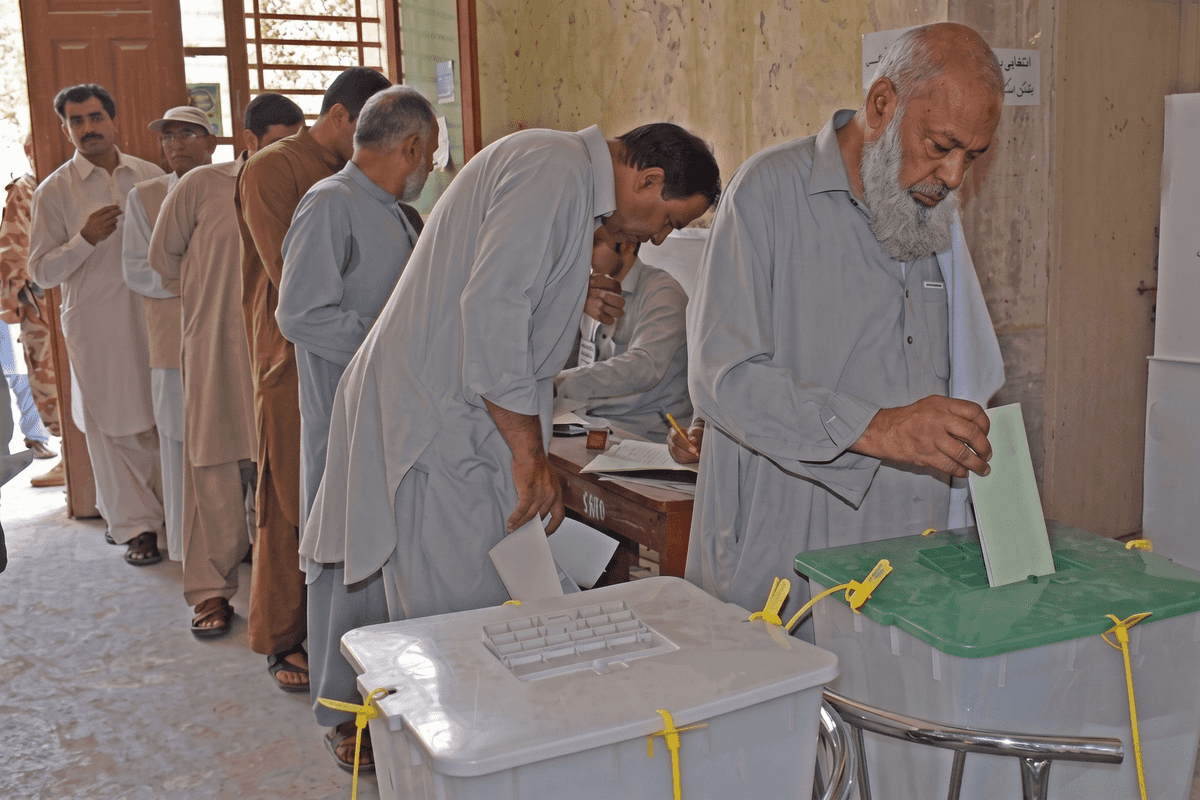
The Gilgit-Baltistan Legislative Assembly elections are scheduled for June 7, 2026. A total of 664 candidates are contesting 24 general seats across the region's 10 districts.
AFP/File
Pakistan's Gilgit-Baltistan (GB) region is heading into its fourth Legislative Assembly elections on June 7, as senior leaders of major political parties step up campaigning across key constituencies.
The electoral buildup coincides with a visit by Aga Khan V, the spiritual leader of the Ismaili community, drawing attention for its timing during a politically charged period.
What are the Gilgit-Baltistan elections and when are they?
The Gilgit-Baltistan Legislative Assembly elections are scheduled for June 7, 2026. A total of 664 candidates are contesting 24 general seats across the region's 10 districts.
The assembly holds 33 seats in total, with the remaining 9 reserved. GB has 963,034 registered voters across three administrative divisions: Gilgit, Diamer and Baltistan.
Could Aga Khan V's visit influence the GB election outcome?
Aga Khan V concluded a week-long official visit to Pakistan from May 20 to 26, marking his first trip since assuming the Imamat as the 50th Imam. A significant portion of the visit was spent in GB, where he attended community and official engagements.
Azhar Ali, a senior journalist from the Ismaili community, told Nukta that Aga Khan V made no reference to politics during his address to followers, describing the visit as purely religious in nature.
He noted, however, that political leaders who welcomed the prince, particularly from the Pakistan Peoples Party (PPP), may have seen an improvement in their standing among Ismaili followers. Those leaders may seek to leverage the visit for electoral benefit.
Ali added that GB has a substantial Ismaili population whose votes can play a significant role in shaping outcomes. Shereen Karim, a local journalist, said PPP could gain a slight advantage following the warm reception, as Ismaili voters may respond positively in return.
The Ismaili Council GB clarified in a statement that it is a non-political and impartial body that does not support or oppose any political party, candidate or electoral group in the ongoing elections. It added that every Ismaili voter is free to exercise their constitutional right according to their own conscience and political understanding.
What does GB's population look like by religion and demographics?
According to the 2023 national census, GB has a population of approximately 1.71 million. Registered voters number 963,034, of whom 456,937 are women (47.4%) and 506,097 are men (52.5%).
A study published in the Journal of Research in Humanities at the University of the Punjab found the region has a diverse religious landscape. Shia Muslims make up 39% of residents, Sunnis 27%, Ismailis 18% and Nurbakhshis 16%. Non-Muslim communities account for less than 1% of the population.
How did GB's Legislative Assembly come to be formed?
In the late modern period, GB came under Dogra Maharaja rule within British suzerainty. Following partition in 1947, the Gilgit Scouts rose against Dogra administration, and the territory subsequently came under Pakistani control.
For decades, the federal government administered the region directly through the Ministry of Kashmir Affairs and Northern Areas. A major shift came in 2009 with the GB Empowerment and Self-Governance Order, which replaced the Northern Areas Council with the GB Legislative Assembly and introduced elected representation.
The first assembly elections were held in 2009, when PPP formed the government and Syed Mehdi Shah became the region's first chief minister. PML-N won the 2015 elections, with Hafiz Hafeezur Rehman taking office as chief minister. PTI won the 2020 elections and Khalid Khurshid became chief minister, before his disqualification in a legal case led to a coalition government under Haji Gulbar Khan.
How much influence does the federal government have over GB elections?
Zakir Baltistani, a local journalist, told Nukta that federal influence on GB elections cannot be overlooked, pointing to a historical pattern of parties in power at the federal level winning in the region. He said voters are conscious of this dynamic, with concerns persisting over potential disruptions to funding and development projects if a non-federal ruling party takes power locally. He added that federal authorities also make use of government machinery during the electoral process.
Shereen Karim said PML-N and PPP remain strong contenders, but independent candidates, some reportedly backed by PTI, cannot be ruled out. She said personality-driven politics could produce upsets in certain constituencies, and independent winners may ultimately play a decisive role in government formation.
Is a coalition government likely after the June 7 polls?
Faizullah Faraq, former spokesperson for the GB government, told Nukta that while federal trends have traditionally shaped GB elections, the dynamics are different this cycle because the federal government itself is a coalition. He said parties that are allies at the federal level, including PPP, PML-N and the Istihkam-e-Pakistan Party, are competing against each other in GB. In some constituencies, the Majlis Wahdat-e-Muslimeen and independent candidates are also emerging as strong contenders.
Faraq said the fragmented landscape makes another coalition government in GB the most likely outcome. The central question, he added, is who will lead that coalition and who will become chief minister.



Comments
See what people are discussing