

Strait of Hormuz crisis deepens as US-Iran war escalates
Kamran Khan says renewed fighting has shifted to control of the Strait of Hormuz, raising global security fears

News Desk
The News Desk provides timely and factual coverage of national and international events, with an emphasis on accuracy and clarity.
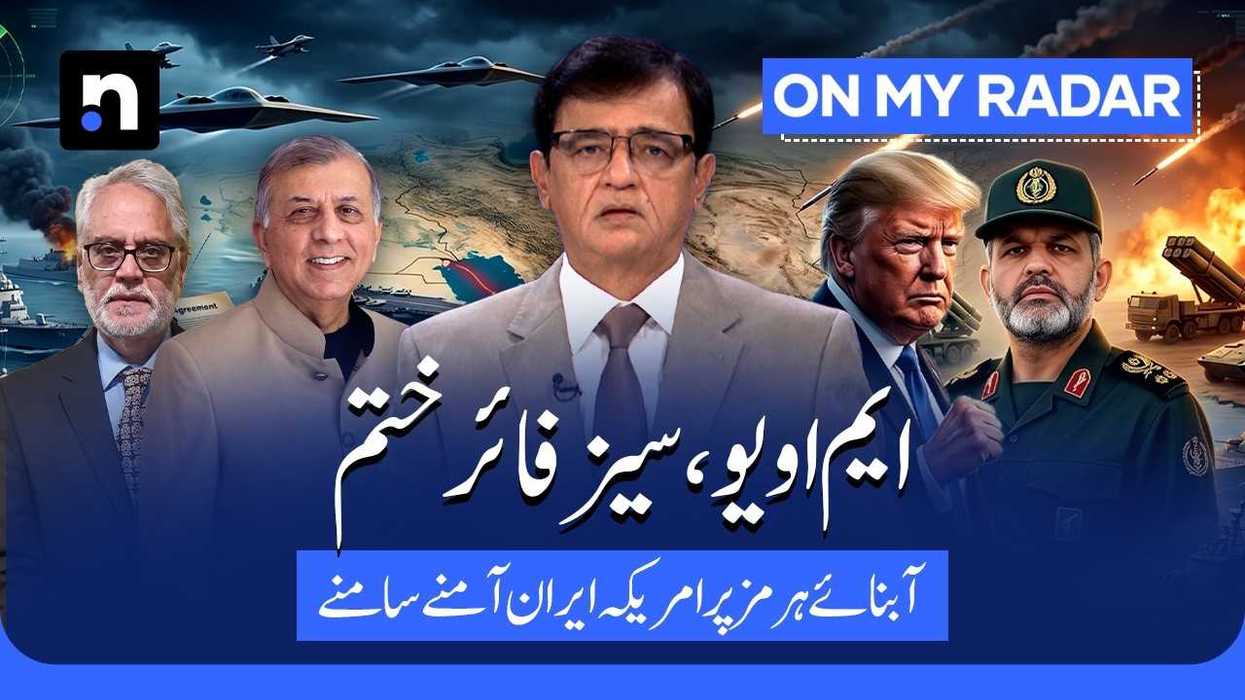
The renewed conflict between the United States and Iran has entered a more dangerous phase, with fighting increasingly centered on control of the Strait of Hormuz after a ceasefire and interim memorandum of understanding effectively collapsed, according to the latest episode of Kamran Khan's On My Radar.
The program said U.S. President Donald Trump has declared that both the memorandum of understanding and the ceasefire are effectively over, while military operations have intensified after several rounds of failed negotiations.
A key development highlighted in the program was Pakistan's public support for the international position on the Strait of Hormuz. Islamabad said any attempt to disrupt shipping through the strategic waterway, described as a lifeline for the global economy, would violate international law, rejecting Iran's position on the issue.
According to the program, the latest phase of the conflict began last Monday when Iran's Islamic Revolutionary Guard Corps (IRGC) attacked three commercial vessels near Oman, including ships linked to Qatar and Saudi Arabia.
The United States and Iran exchanged strikes through Wednesday before fighting briefly subsided on Thursday and Friday. The pause ended Saturday when the IRGC attacked another container ship near Oman, claiming it was using an unauthorized route. Iran then announced the complete closure of the Strait of Hormuz.
The program said the two sides have exchanged six rounds of attacks over the past week.
In response, U.S. forces carried out extensive airstrikes focused on Iranian cities surrounding the Strait of Hormuz. According to U.S. Central Command (CENTCOM), American forces struck 140 Iranian military sites on Saturday and more than 300 targets over three nights.
The United States said the operations were intended to weaken Iran's ability to attack commercial shipping passing through the strait. Overnight, U.S. forces launched another hours-long air campaign targeting dozens of additional Iranian military positions.
Iran has also expanded its military response. The program said Tehran claimed to have targeted U.S. military bases in Qatar, Oman, the United Arab Emirates, Jordan, Bahrain and Kuwait, with those countries confirming attacks. On Monday, the IRGC said it launched another wave of strikes against U.S. military targets in Bahrain, Kuwait, Jordan and Iraq.
The program noted that despite Trump's repeated claims since the conflict began on Feb. 28 that Iran is eager to reach a deal and that the war would end soon, each diplomatic development has been followed by renewed military escalation, raising questions about those assertions.
Another major concern, according to the program, is that Oman and Qatar, which have been mediating between Washington and Tehran, are now being drawn into the conflict themselves.
Talks held Saturday in Muscat between Iranian Foreign Minister Abbas Araghchi, Omani officials and a Qatari delegation on the future of the Strait of Hormuz and safe shipping ended without a breakthrough.
The program said Iran later attacked Oman, dealing a significant blow to diplomatic efforts. Qatar also came under Iranian attack on Sunday, a development described as particularly significant because Doha has played a central role in attempts to restore a ceasefire and restart negotiations between Washington and Tehran.
Qatar has already warned that it cannot serve as an effective mediator if it becomes a direct target of attacks.
Iran has also declared that the Strait of Hormuz will remain closed until the United States ends what Tehran calls its intervention in the region.
While Trump has maintained that the waterway remains open to commercial shipping, the program cited ship-tracking data showing only six commercial vessels passed through the strait on Sunday, the lowest number in the past five weeks.
The episode concluded that the conflict has entered a critical stage, with military operations intensifying even as diplomatic contacts continue. It said the involvement of mediator countries in the fighting has made efforts to revive negotiations increasingly difficult, leaving uncertainty over whether diplomacy can resume or whether the Strait of Hormuz and the wider region are heading toward a prolonged crisis.
The discussion featured security and strategic affairs analyst Shuja Nawaz and Washington-based senior journalist Anwar Iqbal.




Comments
See what people are discussing