

India's angry Gen Z protesters say Modi must fix accountability
India's Gen Z protesters accuse PM Modi of dodging accountability as student-led protests over exam leaks grow nationwide

News Desk
The News Desk provides timely and factual coverage of national and international events, with an emphasis on accuracy and clarity.
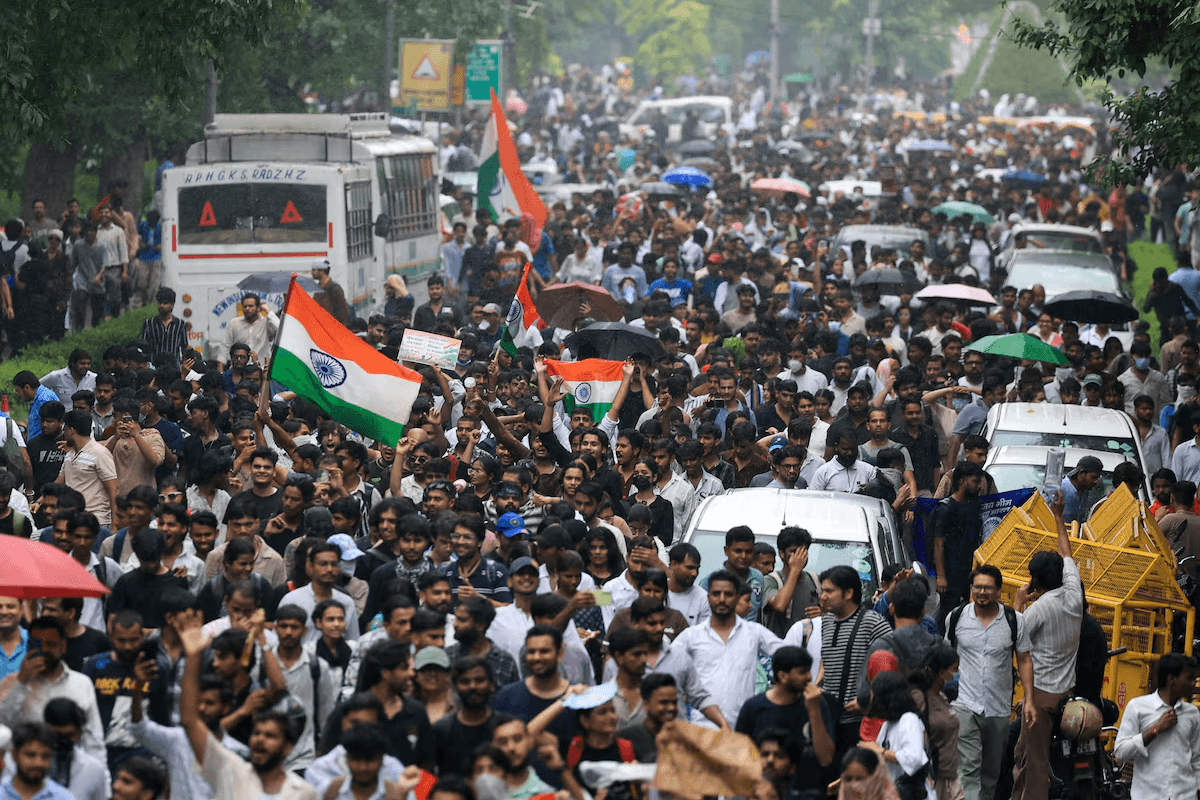
Student unrest spreads across India as pressure mounts for exam reforms.
Reuters
Student protests in India demanding education reforms grew on Thursday despite Prime Minister Narendra Modi vowing a crackdown following a string of exam paper leaks.
Five Gen Z protesters at the main protest site in New Delhi spoke to AFP about what drove them to join the movement.
What sparked India's Gen Z protests?
A medical entrance exam paper leak forced more than two million candidates to sit for a retest, providing the initial spark for the demonstrations. The online Cockroach Janta Party initiated the movement, which has since grown into one of the biggest challenges to Modi's government since his 2024 re-election.
Madhu, 21, said the paper leak gave the Cockroach Janta Party a platform, but the protests have since expanded into a wider forum. "The paper leak was the spark and the CJP provided a platform for people to protest," she said. "But now it has become a forum to talk about our many problems, from unemployment to the lack of freedom to speak up under this government."
She attributed the outpouring of support to years of repressed frustration. "It has been a long time since this government last spoke to us in good faith," she said while cleaning up the protest site. Madhu said her parents feared for her safety, and she covered her face with a surgical mask, but felt obliged to join the movement. "Sometimes you have to overcome your own fears," she said.
Why are protesters demanding the education minister's removal?
Aarohi Singh travelled from Lucknow on an overnight train with no return ticket, a trip made with her family's blessing. "My parents told me to go and mark our presence," said the 23-year-old, who runs a beauty salon. "I don't have a place to stay, but that's fine. At least I have the company of thousands of people."
For the Singh family, the movement is personal. Her younger sister was forced to resit the medical entrance exam but did not pass. "I know how much money my parents spent on her preparation, but after the paper leaked she was demoralized and broken," Singh said. She said she was aghast at the government's reluctance to sack the education minister, the protesters' main demand. "There's the people of the country on one side and the minister on the other," she said. "Why can't the prime minister just sack him?"
How has the movement grown beyond student demands?
Sahil, 28, a corporate employee, has attended the protest daily since Monday after calling in sick at work. On Thursday, he coordinated hundreds of food deliveries sent by well-wishers nationwide. "I am part of this because I can relate to what the affected students must be going through," said Sahil, who asked to be identified by only one name. "I am here to demand accountability."
Sahil said he had watched the movement broaden into a wider expression of anger. "It began with students and education, but people are coming and raising their own set of problems," he said. "People are protesting against what they feel is wrong in the country."
Engineering student Kunal Suryavanshi, from a small town in Madhya Pradesh, said the protest offered a chance to stand among people willing to speak up. "We live in a deeply unequal country where every protest is crushed with brute force," said the 17-year-old. He said he planned to stay in the capital, sleeping at a nearby Sikh temple or on the pavement if needed. "All I have brought with me is hope," he said, his face half-covered by a handkerchief.
Why do protesters say the system needs accountability?
Yuvraj, training to be a lawyer in Punjab, wore a Spiderman mask but could barely conceal his anger. "We live in a surveillance state," the 24-year-old said, giving only one name. "The state is watching us, so we cannot afford to take a chance." He said skipping the protest would have been the biggest regret of his life.
Yuvraj said the entrance test for a government job he applied for last year was also compromised. "You prepare for years for an exam only for the paper to be leaked, and then you're told to try again next time," he said. "It is just not acceptable. There has to be some accountability."



Comments
See what people are discussing