

India de-notifies iconic Jantar Mantar as protest site after 33 years
Delhi Police formally stripped Jantar Mantar of its status as an authorized demonstration venue after more than three decades, designating alternative sites in Ramlila Maidan, Burari, and Shahdara

News Desk
The News Desk provides timely and factual coverage of national and international events, with an emphasis on accuracy and clarity.
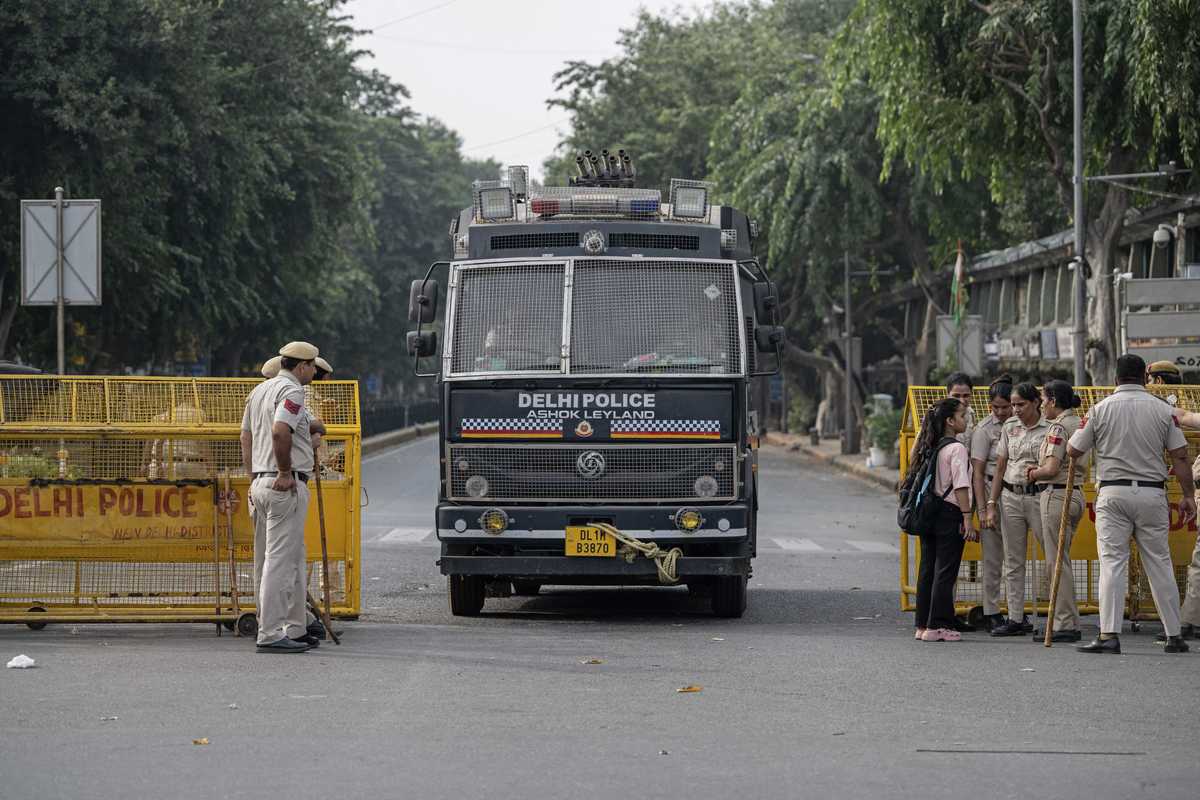
A multi-barrel teargas vehicle passes a temporary checkpoint during protests demanding Indian Chief Election Commissioner Gyanesh Kumar’s resignation over alleged voter roll irregularities in New Delhi on October 11, 2026.
AFP
Delhi Police formally de-notified the iconic Jantar Mantar demonstration site on Monday, October 12, ending more than three decades of authorized public rallies along the historic central avenue and designating alternative locations away from the capital's political core.
Why did Delhi Police de-notify Jantar Mantar and where are protests being relocated?
Under the order issued by Delhi Police, Jantar Mantar was removed from the list of approved demonstration venues without citing an explicit rationale, though the directive follows days of escalating confrontations between security forces and youth demonstrators led by the Cockroach Janta Party (CJP).
The 1.6-kilometer corridor adjacent to the 18th-century astronomical observatory has served as India’s main stage for public dissent since 1993, when authorities moved demonstrations from the Boat Club lawns near India Gate after massive farmer rallies and security reviews.
To replace Jantar Mantar, authorities designated three alternative demonstration spaces: Ramlila Maidan—about three kilometers away and historically used for major agitations—alongside the Burari Ground in north Delhi (21 kilometers away) and the CBD Ground in Shahdara (12 kilometers away). Delhi Police stated that revised standard operating procedures (SOPs) for staging demonstrations and rallies at the three newly notified venues will be issued separately.
How have civil rights groups, CJP organizers, and residents reacted to the order?
The de-notification drew sharp condemnation from human rights advocates and student organizations, who argued that banishing demonstrations to the outskirts diminishes public accountability and democratic oversight. Prominent rights activist Shabnam Hashmi characterized the order as an effort to curb public dissent, emphasizing that Jantar Mantar's proximity to Parliament House, key ministries, and media headquarters was essential for citizen visibility.
Following the announcement, CJP organizers, including founder Abhijeet Dipke, attempted to scale security barricades to "reclaim" the site, leading to fresh detentions and police FIRs. Dipke asserted that Jantar Mantar represents an enduring "spirit of resistance" that cannot be dismantled by administrative decrees.
Conversely, the decision found support among some residents and former security officials. Neighborhood representatives told local media that persistent road closures, noise, and sanitation burdens had disrupted daily life for decades, while former Delhi Police Commissioner Kiran Bedi defended the measure, arguing that the site's sensitive central location made it ill-suited to host ongoing large-scale agitations. Protesters, however, have vowed to sustain peaceful civil disobedience and challenge the order.
According to reporting by The Hindu, Hindustan Times, and India Today, civil liberties groups and student movements are exploring legal petitions before the Supreme Court to contest the closure of central demonstration spaces.





Comments
See what people are discussing