

Pakistan inflation clocks in at 5.8% in January
Official data shows CPI increased from 2.4% in the same month last year

Business Desk
The Business Desk tracks economic trends, market movements, and business developments, offering analysis of both local and global financial news.
Pakistan's inflation rate edged up to 5.8% in January 2026 from 5.6% in December, according to official data released on Monday.
The number was in line with analysts' expectations, who had forecast inflation to remain within the range of 5.8%.
Pakistan tracks inflation weekly and monthly. The weekly tracker is called the Sensitive Price Index (SPI), while the monthly inflation is tracked through the Consumer Price Index (CPI).
According to the Pakistan Bureau of Statistics, the CPI in January 2026 was higher than 2.4% in the same month last year. On a monthly basis, inflation increased by 0.4% compared to a decrease of 0.4% in December.
During the first seven months of fiscal year 2026 (July-January), the average CPI reached 5.24%, a sharp decline from 6.50% during the same period last year.
In January, CPI inflation (Urban) remained stable at 5.8% on a year-on-year basis compared to 5.8% in the previous month and 2.7% in January 2025.
CPI inflation (Rural) increased by 5.8% on a year-on-year basis in January, as compared to an increase of 5.4% in the previous month and 1.9% in January 2025.
Core inflation – which excludes prices of food and energy items – increased by 7.2% year-on-year in January as compared to 6.9% in the previous month and 7.8% in January 2025.
Rural core inflation increased by 8.3% year-on-year in January 2026 compared to 8.1% in the previous month and an increase of 10.4% in January 2025.
On a year-on-year basis, the biggest increase in January was registered in the price of wheat (38.43% for urban, 47.41% for rural). It was followed by wheat flour (23.13% for urban, 33.31% for rural), gas (22.91%), butter (22.51% for urban, 8.85% for rural), and fresh fruits (16.51% for urban, 13.87% for rural).
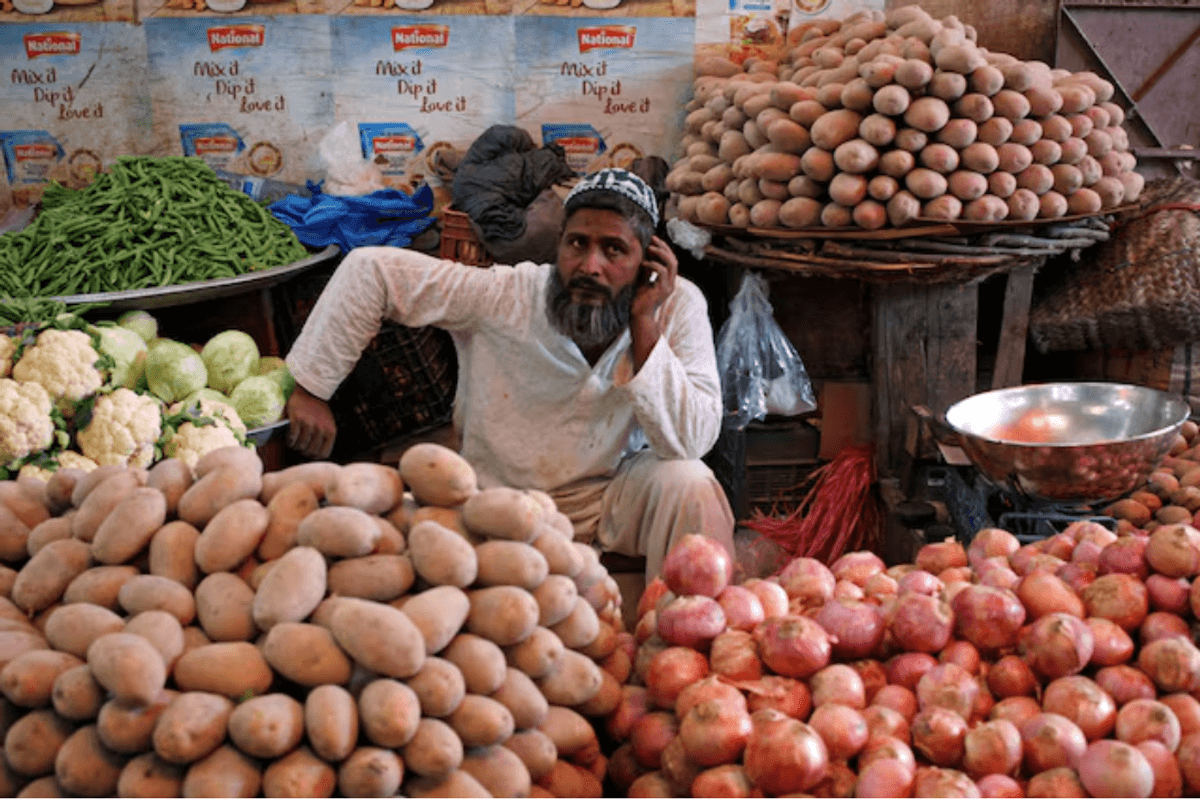
The items whose prices reduced the most included potatoes (42.83% for urban, 48.98% for rural), onions (40.84% for urban, 39.83% for rural), tomatoes (36.03% for urban, 38.95% for rural), pulse gram (29.97% for urban, 28.77% for rural), and besan (25.64% for urban, 23.59% for rural).
The government and the State Bank of Pakistan (SBP) have projected cumulative inflation for fiscal year 2025-26 in the 5% to 7% range, citing improved economic conditions.
The headline inflation had dropped sharply to 4.5% year over year in FY25 from 23.4% in FY24 — its lowest level since FY18. The decline was attributed to lower electricity tariffs, adequate food supplies, favorable base effects, easing global commodity prices, and a market-determined exchange rate.
After its meeting on January 26, the SBP's Monetary Policy Committee kept the policy rate unchanged at 10.5%, surprising markets that had expected a cut. The committee noted that headline inflation remained within the target range of 5-7%, with the central bank projecting inflation to stay within this range through FY26 and FY27.
The committee maintained its inflation outlook due to lower global commodity prices and a "prudent monetary policy stance," though it acknowledged that core inflation remained elevated at around 7.4%.


Comments
See what people are discussing