

Iran, Pakistan, Saudi Arabia, Turkey agree to continue security talks after Tehran huddle
Iran, Pakistan, Saudi Arabia and Turkey agree to continue security talks after their first four-way meeting in Tehran amid Strait of Hormuz tensions.

News Desk
The News Desk provides timely and factual coverage of national and international events, with an emphasis on accuracy and clarity.
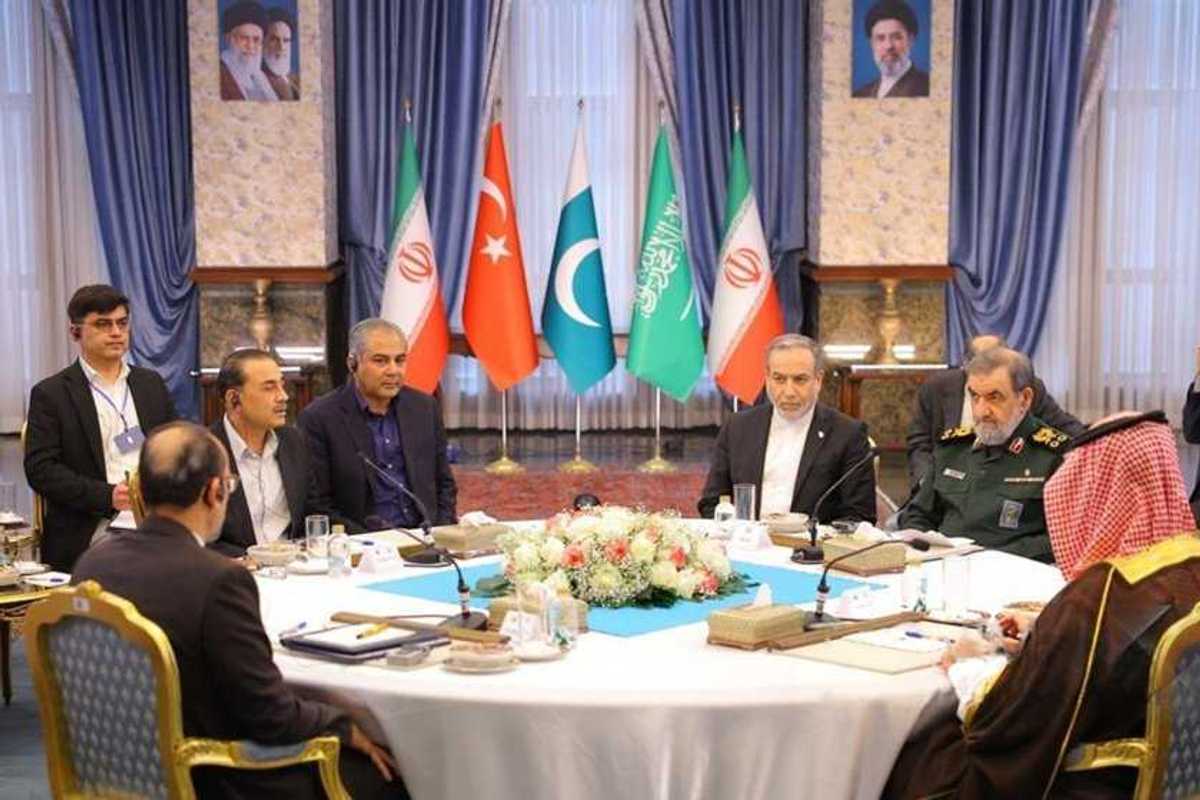
In a joint statement, the participants said they would continue dialogue to strengthen cooperation among the four countries, including on regional peace and security.
Press TV
Iran, Pakistan, Saudi Arabia and Turkey agreed Monday to continue security talks after their first four-way meeting in Tehran, Iranian state television reported. High-level delegations met amid regional tensions and concerns over energy supplies and the Strait of Hormuz.
What did Iran, Pakistan, Saudi Arabia and Turkey agree at the Tehran security talks?
In a joint statement, the participants said they would continue dialogue to strengthen cooperation among the four countries, including on regional peace and security. Iranian officials said the talks would address developments in Palestine and Lebanon, as well as the consequences of the U.S.-Israeli attacks on Iran.
Iranian Foreign Ministry spokesman Esmaeil Baqaei said those consequences and their implications for the wider region would be a central focus. Officials also pointed to what Tehran describes as Israel's expansionist policies.
More footage from the four-way meeting between Iranian, Saudi, Pakistani, and Turkish officials in Tehran.Follow: https://t.co/oa9JV4iSOo https://t.co/CgxhnYjc1h
— Press TV 🔻 (@PressTV) October 26, 2026
Ali Bagheri Kani, deputy secretary of Iran's Supreme National Security Council, said the visit was part of efforts to establish a regional security framework. He said the framework would rest on cooperation among West Asian countries rather than reliance on outside powers.
Who attended the Tehran security talks?
Iranian Supreme National Security Council Secretary Gen. Mohsen Rezaei hosted the meeting. Saudi Defense Minister Prince Khalid bin Salman attended, along with Pakistan's Chief of Army Staff and Chief of Defense Forces Field Marshal Asim Munir and Turkish intelligence chief Ibrahim Kalin.
Iran's SNSC Secretary Major General Rezaei welcomes senior officials from Turkey, Saudi Arabia and Pakistan as a four-way meeting gets underway in Tehran. The talks will focus on regional security, the fallout from military aggression, and support for Palestine and Lebanon. https://t.co/Muc4XunUp6
— Press TV 🔻 (@PressTV) October 26, 2026
🔴 Iran's President Pezeshkian: 🔺 Iran supports any understanding that leads to Islamic countries' unity 🔺 Relying on shared capacities, Islamic states can present world with a model of justice, development https://t.co/pcfX4XFr6s
— Press TV 🔻 (@PressTV) October 26, 2026
Pakistan's military public relations wing confirmed Munir's visit to Tehran earlier Monday but did not provide details of his engagements. Speaking during the meeting, Pezeshkian said Iran supported any understanding that promoted unity among Islamic countries. He said Islamic states could draw on their shared capacities to present the world with a model of justice and development.
Why is the Strait of Hormuz central to the talks?
The meeting comes as a prolonged conflict has disrupted energy supplies, unsettled global markets and heightened tensions across the Middle East. The Strait of Hormuz has emerged as a key flashpoint. Before the conflict, roughly one-fifth of global oil and liquefied natural gas supplies passed through the waterway.
The war began with U.S.-Israeli attacks on Iran in late February. An April ceasefire halted the initial phase of heavy bombardment, but tensions over the strait have continued.
Iran has asserted control over the strait and threatened vessels attempting to transit without its authorization. The United States has imposed a naval counter-blockade on Iranian ports.
The conflict has also widened beyond Iran, with fighting involving Saudi Arabia and Yemen's Iran-backed Houthi movement. The Houthis have targeted Saudi airports and oil facilities, adding to concerns about the security of regional energy infrastructure.
What is the Mecca Joint Defense Agreement?
Pakistan, Saudi Arabia and Turkey signed the Mecca Joint Defense Agreement in August. It provides that an armed attack on one member is treated as an attack on all.
The agreement has taken on added significance as regional hostilities intensify and tensions between Tehran and Washington remain high.





Comments
See what people are discussing