

KSE-100 falls 2.1% in October as oil prices, regional tensions weigh
Pakistan's benchmark index sheds 3,560 points for a second straight monthly decline as foreign investors pull out USD 48.8 million

Business Desk
The Business Desk tracks economic trends, market movements, and business developments, offering analysis of both local and global financial news.
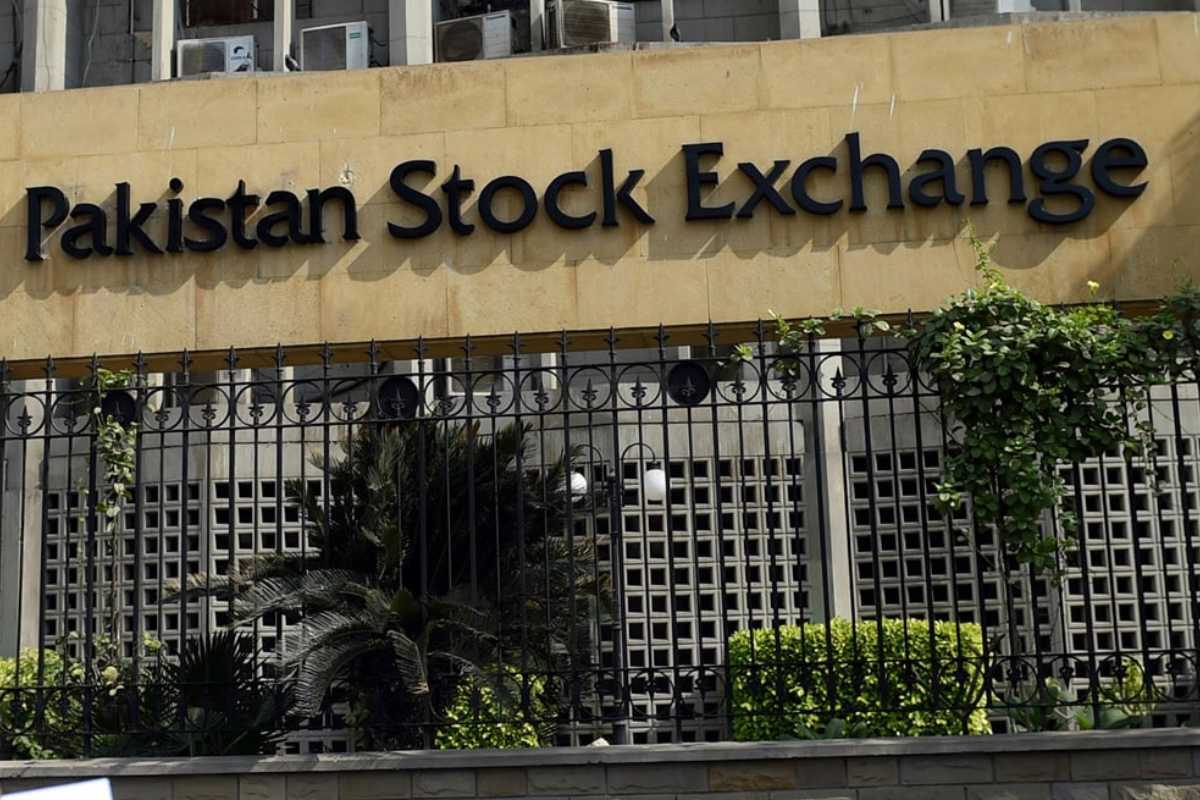
Pakistan’s benchmark KSE-100 index fell 2.1% in October, extending its decline for a second consecutive month as escalating Middle East tensions, rising international oil prices and renewed inflationary pressures dampened investor sentiment, according to a research report.
The index shed 3,560 points during the month to close at 166,409 points, while market capitalization declined 2.3% to PKR 18.49 trillion, equivalent to USD 66.8 billion, the report said.
Market activity also weakened, with average daily trading volume falling 21.9% month-on-month to 470 million shares, while average traded value declined 20.3% to USD 70.07 million.
The sell-off came despite progress under Pakistan’s International Monetary Fund (IMF) program, with a staff-level agreement on the fourth review of the Extended Fund Facility and third review of the Resilience and Sustainability Facility paving the way for about USD 1.2 billion in disbursements, subject to approval by the IMF Executive Board.
However, renewed tensions involving the United States and Iran, escalating regional security concerns and a sharp increase in oil prices triggered profit-taking, while domestic political uncertainty added to market pressure.
International crude prices climbed amid heightened concerns over energy supplies and shipping disruptions around the Strait of Hormuz. West Texas Intermediate crude rose above USD 100 a barrel, while Arab Light crude increased about 10% during October.
The pressure on the external account also weighed on sentiment, with Pakistan’s trade deficit widening to USD 3.53 billion and the current account recording a deficit of USD 356 million in September.
The State Bank of Pakistan subsequently raised its benchmark policy rate by 50 basis points to 12%, citing escalating geopolitical tensions and elevated global energy prices.
The market recovered some losses toward the end of October, posting four consecutive sessions of gains in the final week, supported by banking and fertilizer stocks, corporate earnings and institutional buying.
Which sectors contributed most to the KSE-100 decline?
Among sectors, banks made the largest negative contribution to the benchmark index, shaving 838 points, followed by technology stocks with 774 points and cement companies with 558 points. Exploration and production companies and investment banks contributed another 346 points and 330 points, respectively, to the decline.
At the company level, Meezan Bank contributed 422 points to the index decline, followed by Lucky Cement with 372 points, Systems Limited with 353 points, Pakistan Telecommunication Company with 318 points and Habib Bank Limited with 303 points.
Foreign investors remained net sellers, recording net outflows of USD 48.8 million during October, largely driven by selling in banking and other sectors. Overseas Pakistanis provided some support, bringing in USD 10.36 million.
Domestic investors absorbed some of the foreign selling, with individuals recording net purchases of USD 41.82 million, followed by other investors at USD 27.87 million, companies at USD 18.12 million and banks at USD 17.28 million.
What is the stock market outlook for November?
Looking ahead, the research report said market direction would depend on geopolitical developments, international oil prices, upcoming macroeconomic data, the IMF Executive Board’s approval of the next disbursement and remaining corporate earnings announcements.
Despite the near-term uncertainty, the October correction has brought the market’s forward price-to-earnings ratio to about 6.8 times, below its long-term average of 8.1 times, while the dividend yield stands at around 6.5%.
The report said investors were likely to rely more on corporate earnings growth and dividend income than on a broader market valuation recovery, given elevated oil prices and renewed monetary tightening.
It identified cement companies as potential beneficiaries of a domestic economic recovery, while energy stocks could offer attractive dividend yields and company-specific growth opportunities. Refining stocks also have structural growth potential through the planned brownfield upgrade of Attock Refinery, while banks remain attractive because of earnings resilience and dividend prospects.
The report also noted that historically the KSE-100 index has delivered a median return of 3% in November following a negative October, although geopolitical risks and the sustainability of the global oil-price shock remain important uncertainties.





Comments
See what people are discussing