


News Desk
The News Desk provides timely and factual coverage of national and international events, with an emphasis on accuracy and clarity.
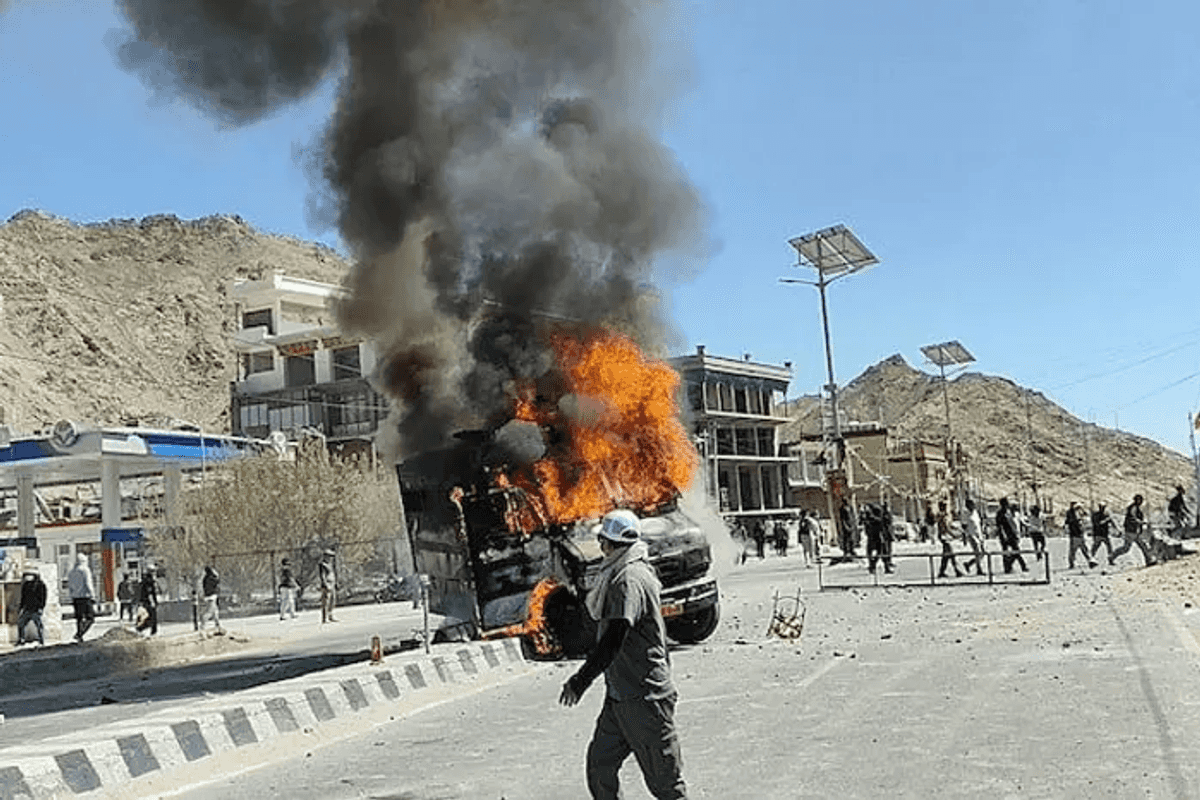
A vehicle is set on fire during a protest by locals demanding statehood for the federal territory and job quotas for local residents in Leh, in the Ladakh region, India, Sept 24, 2025.
Reuters/File
Residents of India's Ladakh staged a virtual shutdown of Leh, the main city, on Thursday to mark one year since four people were killed during a protest for greater regional autonomy. The Ladakh shutdown was called by a Buddhist group.
Why is Ladakh observing a shutdown?
Discontent in Ladakh stems from the Indian government's 2019 decision to cancel its partial autonomy and impose direct rule. Security forces opened fire on September 24, 2025, as demonstrations turned violent in the sparsely populated Himalayan region. The shutdown commemorates those killed and highlights autonomy demands.
What happened in Leh during the Ladakh shutdown?
Shops and businesses in Leh remained shut and streets were deserted on Thursday, witnesses said. A Buddhist group had called for the closure. Residents also organized special Buddhist prayers to commemorate what they called the "martyrs" of the protests.
A member of the Ladakh Buddhist Association, who declined to be named, explained the purpose to AFP. "The shutdown is to commemorate those who laid down their lives for Ladakh and express solidarity with their families, and... to highlight our demands for autonomy," the member said.
Why does Ladakh want autonomy?
Ladakh is strategically important for India because it borders regional rivals China and Pakistan. The vast desert region is sparsely populated by some 300,000 people, half of them Muslim and about 40 percent Buddhist.
Prime Minister Narendra Modi's government split Ladakh from Indian-administered Kashmir in 2019. Since then, residents have said the end of semi-autonomy has stripped them of protections over land, jobs, resources and cultural identity.
New Delhi now makes most decisions on development, and officials from outside Ladakh tend to implement them. This sidelines the local elected council.
Why were cases against Ladakh protesters withdrawn?
On Wednesday, the New Delhi-appointed top administrator of Ladakh said some of the 89 people charged after last year's protests would no longer face criminal prosecutions. Lieutenant Governor Vinai Kumar Saxena announced the decision a day before the anniversary.
"In the larger interest of peace, public tranquility, and social harmony in Ladakh, I have approved the withdrawal of criminal cases against 20 individuals, related to the unfortunate violence that erupted in Leh on September 24 last year," Saxena said. "The decision aims at fostering a more peaceful, united, and harmonious society in Ladakh."
What is the Sixth Schedule demand in Ladakh?
Negotiations with the federal home ministry have been going on since the protests, but local people have secured only some small gains so far. The government has reserved 85 percent of jobs for locals. It has also said Indians from outside Ladakh will not be able to acquire domicile status in the region until 2036.
Residents are demanding comprehensive autonomy under the "Sixth Schedule" of India's constitution. This would allow a local legislature to make laws on land use, jobs and traditional livelihoods.





Comments
See what people are discussing