

Mecca defense pact talks begin in Islamabad with security on agenda
Mecca defense pact talks open in Islamabad as Pakistan, Saudi Arabia and Turkey weigh regional security, military coordination and Syria's possible entry.
Aamir Abbasi
Editor, Islamabad
Aamir; a journalist with 15 years of experience, working in Newspaper, TV and Digital Media. Worked in Field, covered Big Legal Constitutional and Political Events in Pakistan since 2009 with Pakistan’s Top Media Organizations. Graduate of Quaid I Azam University Islamabad.
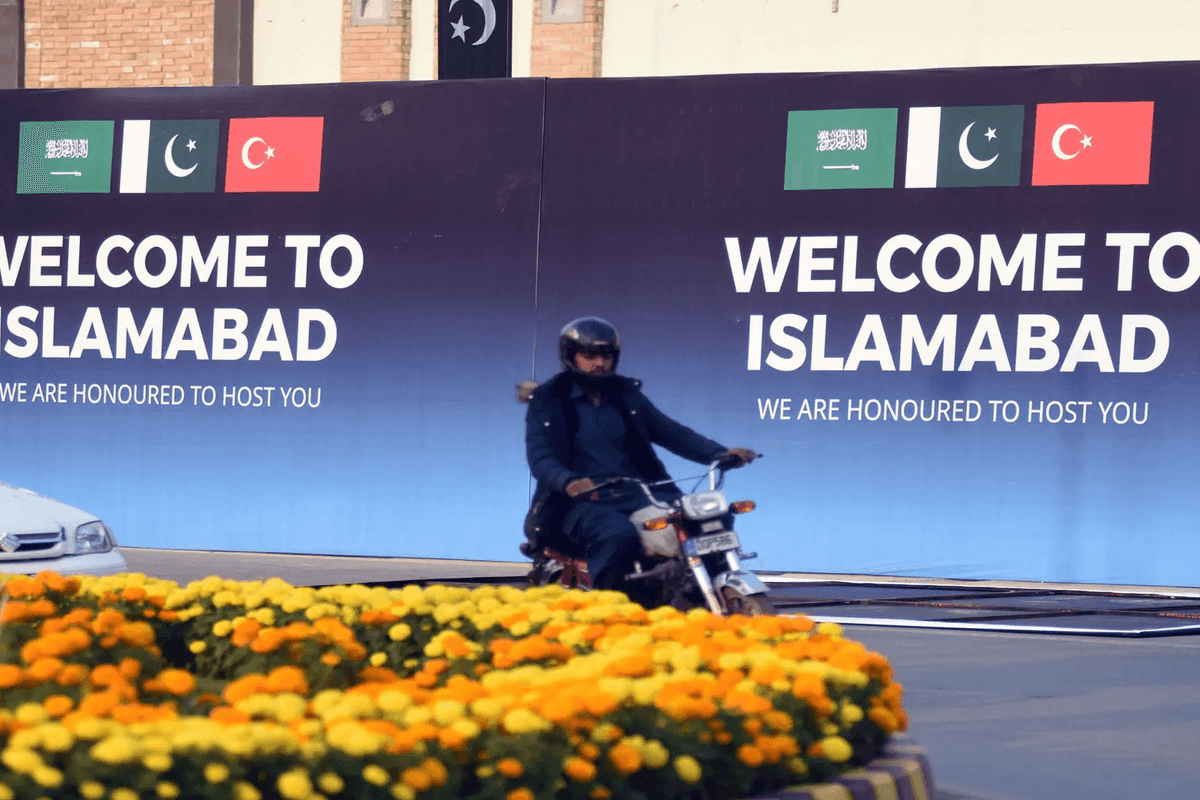
A motorcyclist rides past a board featuring Pakistani, Saudi and Turkish flags and emblazoned with "Welcome to Pakistan" at Islamabad's Constitution Avenue on Nov 26, ahead of a meeting of the Makkah Defence Alliance.
Online Agency
Senior military, defense and foreign affairs officials from Pakistan, Saudi Arabia and Turkey began Mecca defense pact talks in Islamabad on Friday. The high-level meeting aims to strengthen the three-nation alliance, with regional security, military coordination and Syria's possible inclusion on the agenda.
How many countries are in the Mecca defense pact?
Three countries are in the Mecca defense pact: Pakistan, Saudi Arabia and Turkey. Under the Mecca Joint Defense Agreement, signed on Aug. 7, an armed attack on any member is treated as an attack on all three. The members have committed to assist one another through available means, including military support.
Defense Minister Khawaja Asif said the agreement clearly establishes that a threat to Saudi Arabia is also a threat to Pakistan and Turkey. Turkey's ratification completed the accession process for all three countries. Asif has described the pact's institutional and operational arrangements as being at an early stage.
Who is attending the Mecca pact meeting in Islamabad?
Defense chiefs, defense ministers, foreign ministers and intelligence chiefs from the three countries are attending, according to sources. The Saudi delegation reached Islamabad on Thursday night, while the Turkish delegation arrived in Pakistan on Friday morning. Asif said Thursday that the foreign and defense ministers of all three countries would attend.
This is the first meeting of the Strategic Political and Defense Committee (SPDC) held in Pakistan, following two previous sessions in Saudi Arabia and Turkey. The SPDC comprises two representatives from each member state. Its membership also includes the countries' foreign and defense ministers and chiefs of defense staff.
Lieutenant General (retired) Nauman Mahmood, a Pakistani national and the pact's first secretary-general, is also attending. Appointed for a three-year term, he is expected to play a key role in administrative and institutional coordination among member states. A permanent secretariat has been established in Riyadh under his leadership, and a working committee of officials from the three countries is also in place.
What is on the agenda at the Islamabad talks?
The discussions are expected to cover evolving regional developments, common security challenges and ways to strengthen political, strategic and military cooperation. Syria's possible inclusion in the pact and the alliance's final name and abbreviation are also expected to be considered.
A Pakistani official said the meeting would focus on developing standard operating procedures, establishing an implementation framework and defining coordination mechanisms among member states. The talks follow preparatory meetings in Islamabad, where officials completed the groundwork for the high-level discussions.
Developments in the Middle East, particularly the conflict in Yemen and threats to Saudi Arabia, are likely to feature prominently. Asif said instability south of Saudi Arabia would be among the issues discussed. Saudi Arabia has faced repeated attacks by Yemen's Houthi movement, also known as Ansar Allah, during Yemen's prolonged conflict.
How do regional tensions affect the Mecca pact?
The alliance is taking shape amid broader tensions involving Iran, Israel and the United States. These raise questions about how members will define their collective security commitments while managing their respective strategic priorities.
Pakistan has also played a diplomatic role in efforts to ease tensions between Washington and Tehran. Islamabad brokered a June agreement that briefly halted hostilities and outlined steps toward reopening the Strait of Hormuz and holding negotiations over Iran's nuclear program. The arrangement later collapsed amid mutual accusations of violations, and Qatar and Pakistan have since been involved in diplomatic efforts to revive dialogue.
Authorities in Islamabad and Rawalpindi announced local public holidays for Friday in connection with the high-level meeting. Special movement restrictions were also introduced in the capital. The meeting is expected to conclude later Friday.


Comments
See what people are discussing