

Middle East conflict widens as Saudi-Houthi truce collapses
Kamran Khan says widening US-Iran war and renewed Saudi-Houthi fighting deepen regional crisis

News Desk
The News Desk provides timely and factual coverage of national and international events, with an emphasis on accuracy and clarity.
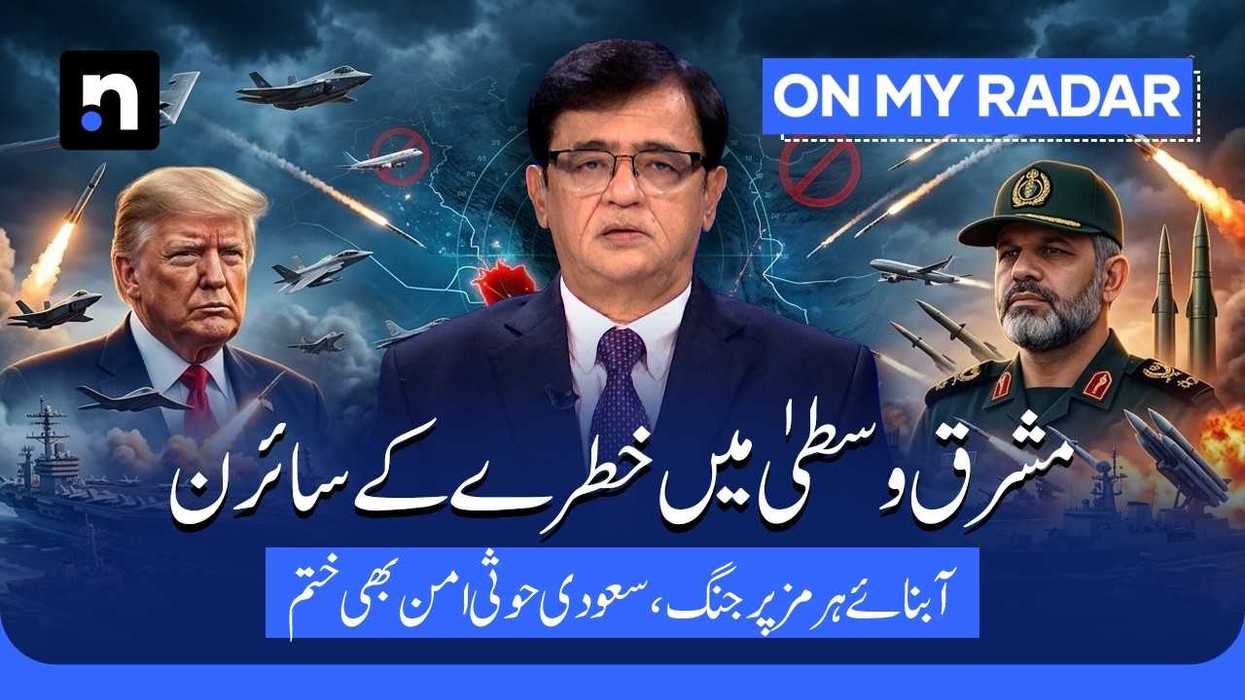
The Middle East moved closer to a broader regional conflict after reports that a four-year truce between Saudi Arabia and Yemen's Iran-backed Houthis collapsed, adding a new front to the escalating U.S.-Iran war, Kamran Khan said on his On My Radar program.
The deteriorating security situation has prompted aviation organizations to advise airlines to avoid the airspace of several Gulf countries. Brent crude climbed to a one-month high of $87 a barrel, global stock markets turned negative again and concerns over energy supplies, trade disruptions and inflation intensified.
The crisis deepened after Iran announced plans to close the Strait of Hormuz. The United States carried out heavy airstrikes on Iran for a third consecutive night. President Donald Trump informed Congress that U.S. military operations in Iran had resumed, announced the restoration of a naval blockade and said the United States would monitor the Strait of Hormuz while imposing a 20% fee on all commercial cargo passing through the waterway.
Iran rejected Trump's position, with senior military leaders saying the future of the Strait of Hormuz cannot be decided by the United States.
Iranian Foreign Minister Abbas Araghchi said protecting Hormuz "is Iran's responsibility and always will be." Mocking Trump's proposal to charge a 20% transit fee, Araghchi said, "That is too much. We will charge a little less."
U.S. military operations have now spread to at least 10 Iranian provinces, according to the program. Qeshm Island and Bandar Abbas have remained under sustained U.S. attacks because they are considered the center of Iran's strategic oversight of the Strait of Hormuz.
Iran has also continued retaliatory operations. The Islamic Revolutionary Guard Corps claimed it targeted U.S. military sites in Jordan, Bahrain, Kuwait and the United Arab Emirates.
The UAE confirmed that an Iranian missile struck two of its oil tankers in the Strait of Hormuz, killing one sailor. In a separate incident on Sunday, an Indian sailor was also killed in Hormuz, prompting India to summon Iran's deputy ambassador and lodge a strong protest.
China called on both Washington and Tehran to immediately restore safe shipping through the Strait of Hormuz. China's Foreign Ministry said ensuring the waterway's security is a shared objective of the international community and pledged to continue diplomatic efforts to reduce tensions.
The conflict has also shaken financial markets. Pakistan's benchmark KSE-100 index plunged more than 6,400 points in a single trading session as investors reacted to growing regional uncertainty.
Despite the continued military escalation, diplomatic efforts remain underway. Iranian Foreign Ministry spokesperson Esmaeil Baghaei said Pakistan, Qatar and Oman are continuing mediation efforts.
Trump also said he has not ruled out diplomacy, stating, "I never reach the conclusion that a solution through negotiations is impossible."
Kamran Khan said Pakistan has remained actively engaged in diplomatic contacts, but those efforts have so far failed to reduce the intensity of the fighting.
Meanwhile, another flashpoint has emerged in Yemen. The Saudi-backed Yemeni government targeted the runway at Sanaa International Airport to prevent an Iranian aircraft from landing, arguing that the flight violated Yemen's sovereignty.
In response, the Iran-backed Houthis accused Saudi Arabia of attacking Sanaa airport, declared an end to the four-year peace agreement and launched missile strikes on Saudi Arabia's Abha International Airport. The Houthis warned airlines against using Saudi airspace until restrictions on Sanaa airport are lifted.
Pakistan backed Saudi Arabia following the attacks. Prime Minister Shehbaz Sharif strongly condemned the missile strike on the Saudi airport.
Kamran Khan concluded by asking whether mediators such as Pakistan, Qatar and Oman can once again bring Washington and Tehran back to the negotiating table, or whether the Middle East is heading toward a longer and more dangerous regional war.





Comments
See what people are discussing