

Pakistan foils 'major' militant plot in Karachi, seizes over 2,000 kg of explosives
Officials say confirmed intelligence led agencies to act jointly, averting a potential 'mass-casualty' attack

News Desk
The News Desk provides timely and factual coverage of national and international events, with an emphasis on accuracy and clarity.
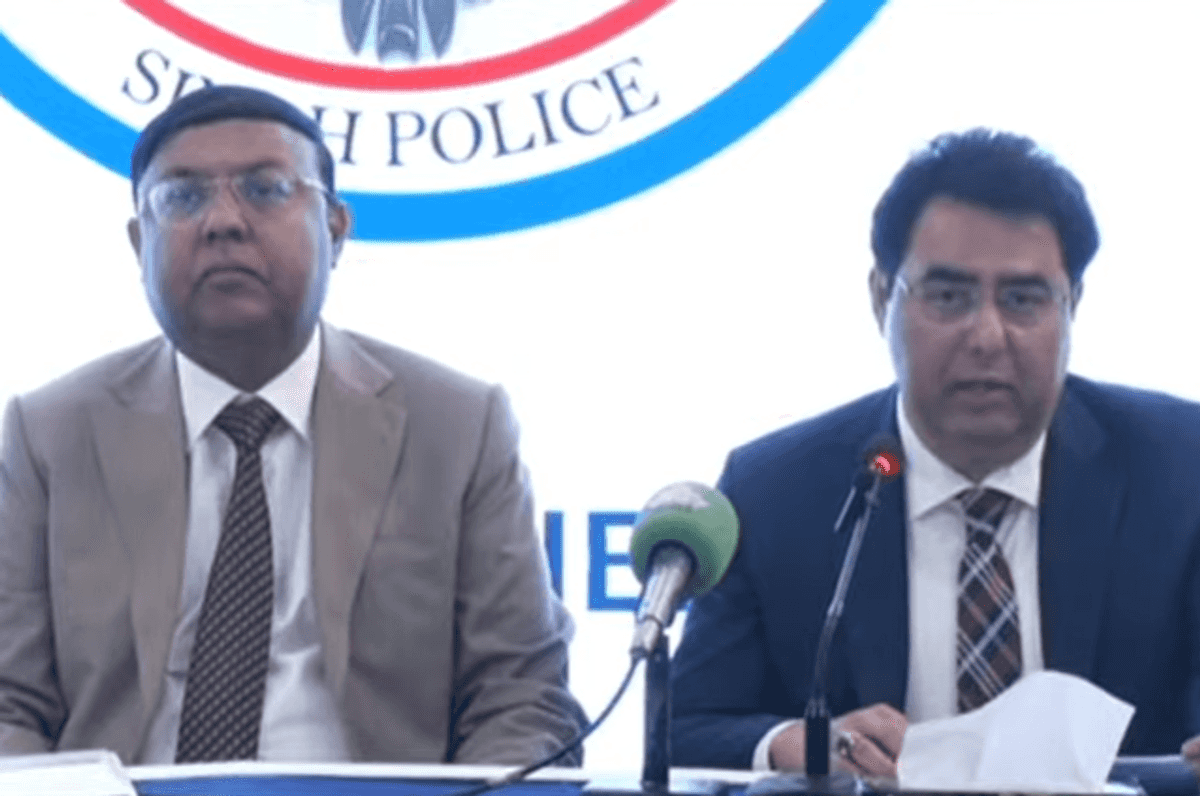
Additional IG CTD Zulfiqar Larik (L) and DIG CTD Ghulam Azfar Mahesar speak at a press conference in Karachi on Monday.
Screengrab
Pakistan’s intelligence and law enforcement agencies said on Monday they had thwarted a major militant plot in the southern port city of Karachi, recovering more than 2,000 kilograms of explosive material following a weeks-long, intelligence-led operation.
Officials said the operation was carried out after confirmed intelligence prompted coordinated action by a premier intelligence agency and the Counter-Terrorism Department (CTD), preventing what they described as a potential mass-casualty attack.
Details of the operation were disclosed at a joint news conference by Additional Inspector General CTD Zulfiqar Larik and Deputy Inspector General CTD Ghulam Azfar Mahesar. They said one suspect was initially detained after sustained surveillance and further questioning led to the arrest of two more suspects late on Sunday.
The suspects were identified as Jaleel Ahmed, also known as Fareed; Niaz Qadir, also known as King; and Hamdan alias Fareed. Authorities said all three are in custody as investigations continue.
Officials said the explosives were discovered at a rented property located about 35 to 40 kilometers outside Karachi, which they said was being used to store material intended for attacks on civilian targets in the city. The explosives were subsequently transported out of Karachi and neutralized in a controlled operation in the Hub area, west of the city.
According to the CTD, the operation was conducted covertly to avoid public panic, with agencies using a combination of human intelligence and technical surveillance. Officials added that potential hazards, including booby traps, were assessed during the operation.
More than 30 plastic drums containing explosive material and five metal gas cylinders were recovered from the site, authorities said. Preliminary findings suggest the explosives were moved into Pakistan from Afghanistan via the southwestern province of Balochistan before being transported to Karachi.
Officials revealed that the network was being operated from outside the country. They said militant groups operating in "India’s interests", including the Baloch Liberation Army (BLA) and the Baloch Liberation Front (BLF), were involved and were using safe havens in Afghanistan.
Authorities also said the network had links to figures and factions including Bashir Zeb, the BLA, and the Majeed Brigade. They noted that urea-based explosives, which are widely available as fertilizer, are commonly used in militant attacks, and said disrupting supply chains remains a priority.
Officials added that investigations have highlighted the role of local facilitators, who they said often assist militants for small payments and the frequent use of rented residential properties to store or assemble explosives. They called for stricter monitoring of rental properties and tighter enforcement of regulations governing the sale and use of chemicals.
Security agencies said efforts are ongoing to identify and arrest all those connected to the plot and that further information would be released as the investigation progresses.




Comments
See what people are discussing