

‘Not grounded in strategic reality’: Pakistani analysts reject US claim on missile threat
Former caretaker foreign minister Jalil Abbas Jilani says Pakistan’s nuclear doctrine is India-specific and aimed at maintaining credible deterrence in South Asia

News Desk
The News Desk provides timely and factual coverage of national and international events, with an emphasis on accuracy and clarity.
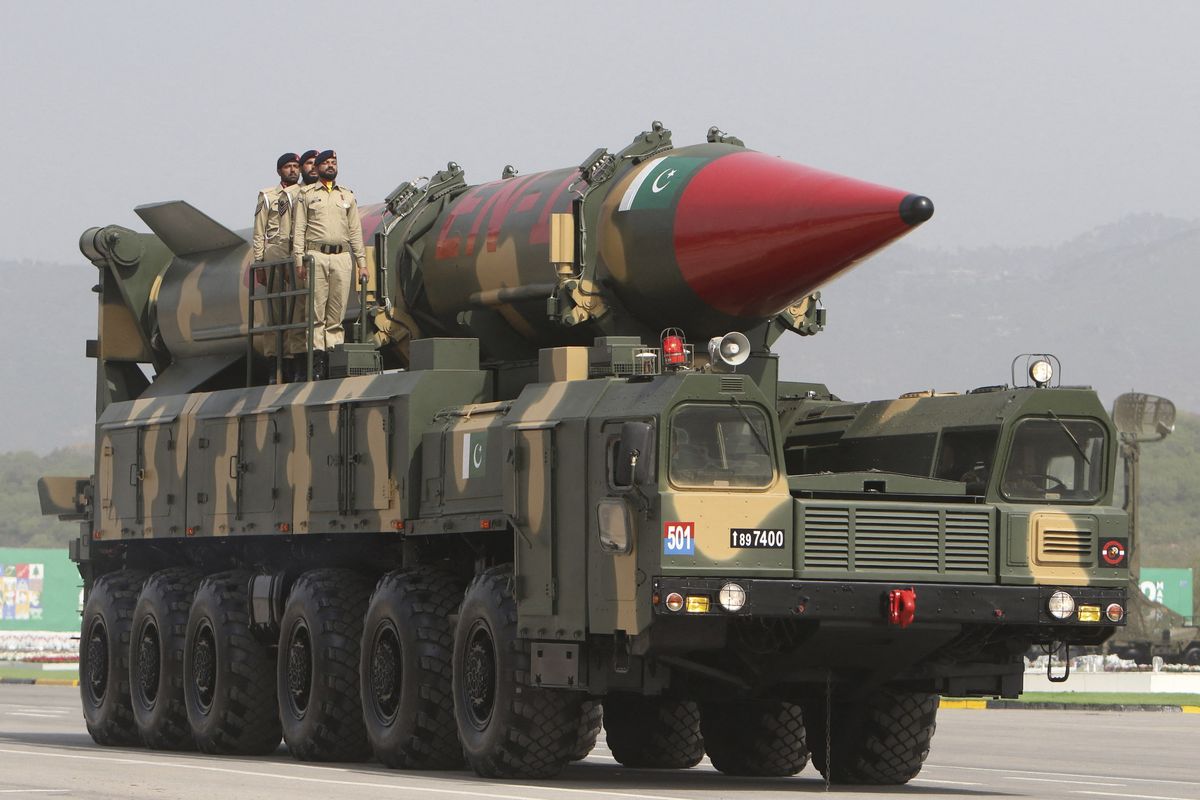
Former caretaker foreign minister Jalil Abbas Jilani and Pakistani academic Rabia Akhtar have rejected a U.S. intelligence assessment suggesting Pakistan’s missile development could put the American homeland within range, calling the assertion detached from regional strategic realities.
In posts on X, Jilani and Akhtar said Pakistan’s nuclear and missile posture remains focused on India and is not designed to project power globally or threaten the United States.
Jilani said Tulsi Gabbard’s remarks during a U.S. Senate hearing were “not grounded in strategic reality.” He stated that Pakistan’s nuclear doctrine is India-specific and aimed at maintaining credible deterrence in South Asia, rather than targeting distant countries.
@TulsiGabbardDNI assertion at the Senate hearing that the US homeland is within range of Pakistan’s Nuclear/Con missiles is not grounded in strategic reality.Pakistan’s N doctrine is India specific aimed at maintaining credible deterrence in S Asia,not projecting power globally
— Jalil Abbas Jilani (@JalilJilani) March 18, 2026
“Pakistan’s N doctrine is India specific aimed at maintaining credible deterrence in S Asia, not projecting power globally,” Jilani wrote.
Akhtar, dean of the Faculty of Social Sciences at the University of Lahore, said Gabbard’s comments reflected what she described as a persistent flaw in U.S. threat assessments. She argued that worst-case speculation was being substituted for grounded analysis.
Tulsi Gabbard’s statement reflects a persistent flaw in US threat assessments: substituting worst-case speculation for grounded analysis. Pakistan’s deterrence posture is India-centric. Folding it into a US homeland threat narrative is misleading.
For those interested in the… https://t.co/Sf1j2FFh3p
— Rabia Akhtar (@Rabs_AA) March 18, 2026
“Pakistan’s deterrence posture is India-centric,” Akhtar wrote. “Folding it into a U.S. homeland threat narrative is misleading.”
Akhtar said there was no evidence that Pakistan was pursuing capabilities to target the United States. She said Pakistan’s nuclear program, doctrine and missile development had remained focused on India for decades.
According to Akhtar, even Pakistan’s longest-range systems are calibrated to counter India’s capabilities and deny it strategic depth, rather than project power beyond the region.
She added that what some interpret as expansion in Pakistan’s missile program is more plausibly a response to India’s growing reach, including ballistic missile defense systems, multiple independently targetable reentry vehicles, and an expanding network of overseas bases in the Indian Ocean.
“Deterrence adapts, folks! It does not operate in a vacuum,” she wrote.
Akhtar also cautioned against equating Pakistan with North Korea or incorporating it into what she described as a generic U.S. homeland threat narrative. She said such framing obscures the regional dynamics driving instability in South Asia.
“There is no evidence that Pakistan is designing missiles to reach beyond targets associated with India’s present or future capabilities,” she said, calling for a more serious conversation focused on regional nuclear logic rather than worst-case scenarios.
The comments followed testimony on Wednesday by Tulsi Gabbard before the United States Senate Intelligence Committee, where she presented the 2026 Annual Threat Assessment.
Gabbard said Russia, China, North Korea, Iran and Pakistan have been researching and developing an array of missile delivery systems with nuclear and conventional payloads that could put the U.S. homeland within range.
“Pakistan’s long-range ballistic missile development potentially could include ICBMs with the range capable of striking the Homeland,” she told the committee.
Gabbard said the nations identified in the assessment would likely seek to understand U.S. plans for advanced missile defense in order to shape their own missile development programs and assess U.S. intentions regarding deterrence.
She also said the U.S. intelligence community foresees a sharp rise in missile threats over the next decade. According to her testimony, threats to the U.S. homeland could expand collectively to more than 16,000 missiles by 2035, up from a current assessed figure of more than 3,000.
Analysts have described Pakistan’s inclusion among principal nuclear threats as consistent with previous U.S. policy trends.
In December 2024, a senior White House official accused Pakistan of developing long-range ballistic missile capabilities that could eventually allow it to strike targets outside South Asia, including in the United States.
The same month, the United States announced additional sanctions related to Pakistan’s ballistic missile program. The measures targeted four entities that U.S. officials alleged were contributing to the proliferation or delivery of such weapons.
Pakistan has consistently maintained that its nuclear program is intended for deterrence against India and is not directed at any other country.





Comments
See what people are discussing