

Oil tops $100 as war shakes energy routes

News Desk
The News Desk provides timely and factual coverage of national and international events, with an emphasis on accuracy and clarity.
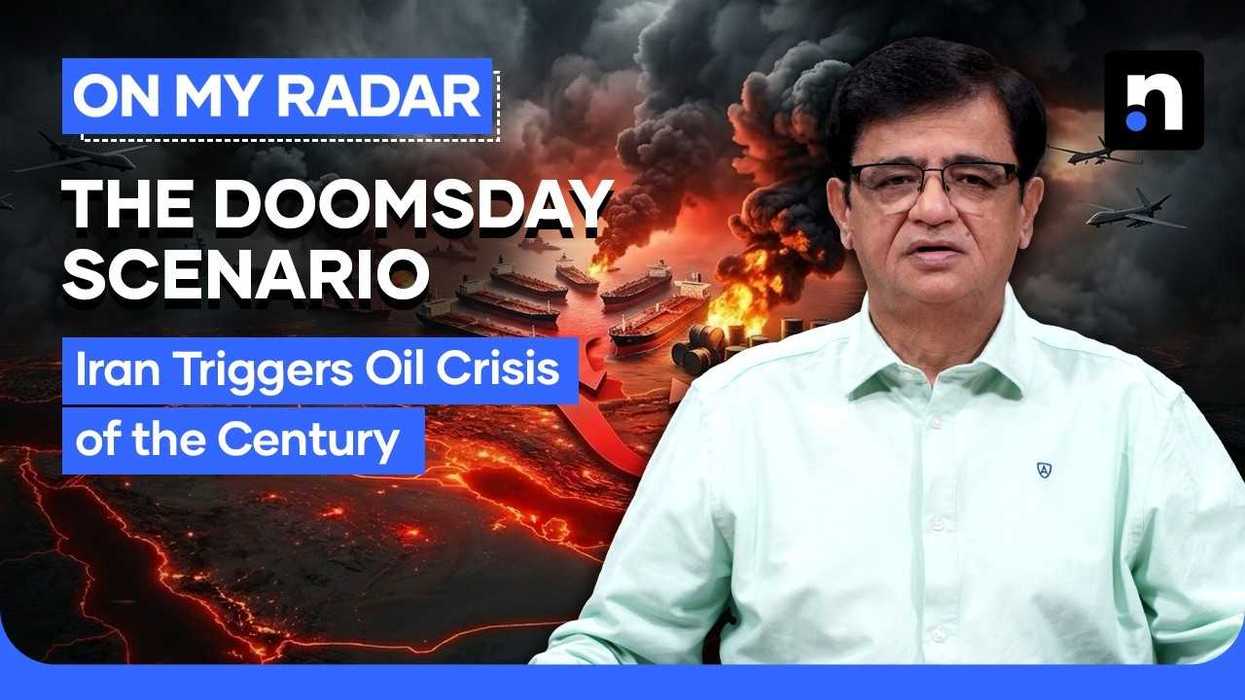
Kamran Khan has said that the 13-day conflict involving the United States, Israel and Iran has pushed the world toward what market analysts are calling a “doomsday scenario.”
Speaking on his show “On My Radar,” Khan said the war has shaken the basic balance of the global economy, energy supply chains and geopolitics, with conditions worsening each day.
Oil markets have swung sharply.
Brent crude crossed $100 a barrel for the second time this week. On Monday, prices climbed to $120 a barrel, their highest level since 2022. They fell back to $81 on Tuesday before rebounding again to about $102.
Khan, citing reports from Reuters, The Associated Press and CNBC, said the global energy supply chain is standing at the edge of “systemic collapse.”
He said Tehran has adopted what military strategists describe as a scorched-earth approach, targeting oil and gas transit routes.
The crisis is centered on the Strait of Hormuz, a narrow waterway between the Persian Gulf and the Gulf of Oman.
Roughly 21% of the world’s oil and about 20% of global liquefied natural gas shipments pass through the strait.
Khan said that for the first time in modern history, the channel has effectively become impassable.
He said insurance premiums for oil tankers have “effectively disappeared,” with commercial vessels unwilling to risk transit.
Since Feb. 28, when U.S. and Israeli strikes were reported, Iran has attacked 13 ships passing through the strait, Khan said. Three oil tankers were targeted in a single day this week.
Iran’s Revolutionary Guard has laid between 2,000 and 6,000 naval mines in the area, he said, vowing that “not a liter of oil” would reach enemy countries or their partners.
In response, the U.S. Navy has shifted its Fifth Fleet into a defensive posture. U.S. forces say they have destroyed 16 Iranian vessels involved in laying mines.
Khan said clearing the mines could take weeks, if not months, leaving markets bracing for a prolonged oil shock.
The retaliation has not been limited to sea lanes.
He cited an Associated Press report that a drone strike on Qatar’s Ras Laffan gas complex disrupted nearly one-fifth of global LNG supply. Within 48 hours, natural gas prices in Europe and Asia surged by more than 100%.
In Iraq, Iranian-backed militias forced the closure of major oil fields, Khan said. Missile strikes on refining centers in the United Arab Emirates and Saudi Arabia temporarily removed an additional 140 million barrels from global markets.
While that volume represents only several days of global demand, he said, the psychological and financial impact has been far broader.
In the United States, average gasoline prices have risen to $3.58 per gallon, reaching $5.34 in California. Khan said California relies heavily on products from Asian refineries, now being redirected to alternative markets.
China faces mounting pressure as well. About 38% of its oil imports transit the Strait of Hormuz, with 13% coming from Iran. Khan said the 13-day disruption has raised concerns for China’s manufacturing-driven economy.
He also warned of spillover effects on food systems.
According to The Guardian, roughly one-third of the world’s fertilizer shipments move through the Strait of Hormuz. Agricultural experts have cautioned that even a brief blockade could lay the groundwork for higher global food prices in 2026.
The financial burden of the conflict is also climbing.
The Pentagon says U.S. costs exceeded $11 billion in the first week alone. Khan described Washington as being in a “paradoxical” position: now a modest energy exporter, the United States may be less exposed than its European and Asian allies.
Some producers appear to be benefiting.
Non-Gulf suppliers such as Norway and Russia have seen increased demand as buyers seek to reduce dependence on Middle Eastern sources.
The International Energy Agency has approved the emergency release of 400 million barrels of oil, the largest coordinated drawdown of reserves on record.
But Khan said analysts view the move as a temporary fix.
Estimates from Chatham House suggest that if the Strait of Hormuz remains closed for 30 more days, oil prices could reach $150 a barrel, potentially triggering a global economic crisis larger than that of 2008.
“For now,” Khan said, “the world’s eyes are fixed on the Persian Gulf,” where a decades-old oil-for-security arrangement between Western powers and Gulf states appears increasingly fragile.



Comments
See what people are discussing