

Pakistan accuses India of ‘weaponizing water,’ briefs diplomatic corps on treaty violations
Deputy PM Dar urges int'l community to press India to restore Indus Waters Treaty, uphold international law, and refrain from actions that could destabilize South Asia

Aamir Abbasi
Editor, Islamabad
Aamir; a journalist with 15 years of experience, working in Newspaper, TV and Digital Media. Worked in Field, covered Big Legal Constitutional and Political Events in Pakistan since 2009 with Pakistan’s Top Media Organizations. Graduate of Quaid I Azam University Islamabad.
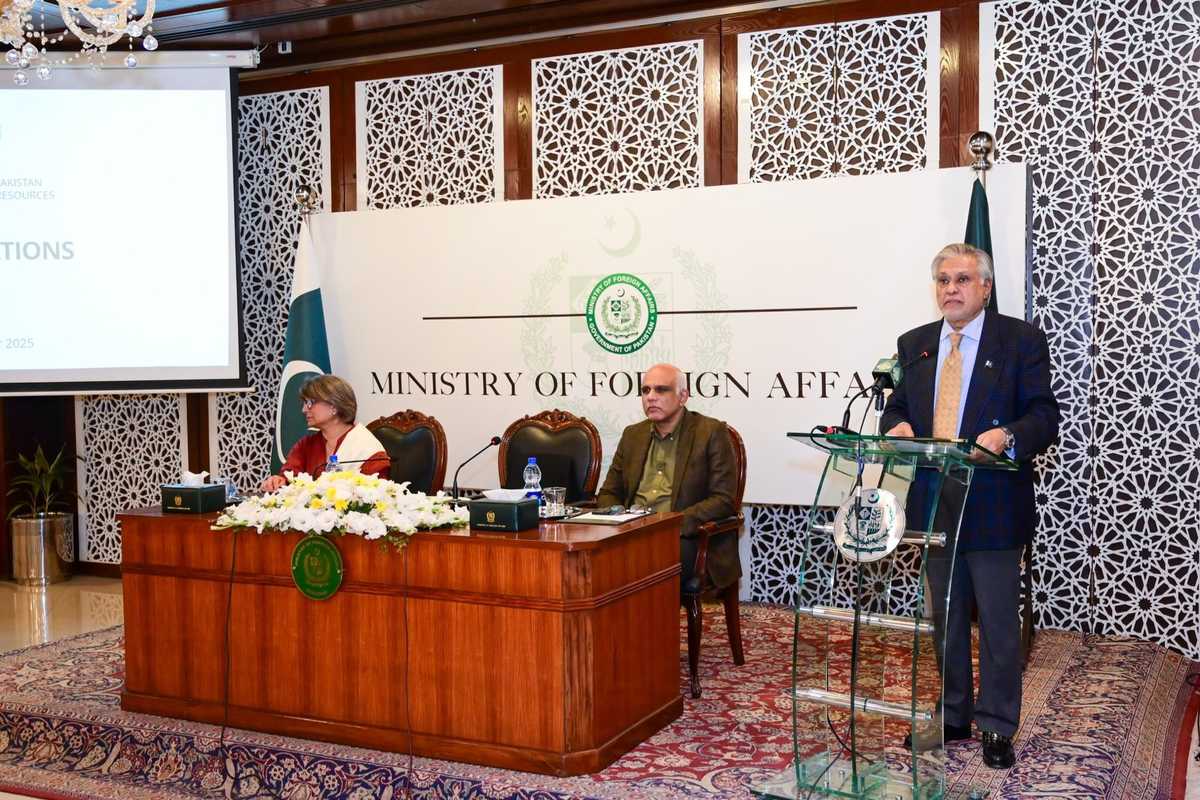
The Deputy Prime Minister/Foreign Minister, Senator Mohammad Ishaq Dar holds an urgent briefing for the diplomatic corps on India’s persistent material breaches of the Indus Waters Treaty (IWT).
Courtesy: X/@ForeignOfficePk
Pakistan accused India of serious and repeated violations of the Indus Waters Treaty (IWT) on Friday, warning that New Delhi’s actions threaten regional peace, international law, and the livelihoods of millions of Pakistanis.
Addressing the diplomatic corps in Islamabad, Deputy Prime Minister and Foreign Minister Ishaq Dar said India’s recent conduct amounted to the “weaponization of water,” particularly through unilateral manipulation of river flows without prior notification, in breach of treaty obligations.
The foreign minister recalled that in April this year, India unilaterally placed the Indus Waters Treaty (IWT) in abeyance, a move Pakistan considers a gross violation of international law, including Article 26 of the Vienna Convention on the Law of Treaties.
The Deputy Prime Minister/Foreign Minister, Senator Mohammad Ishaq Dar @MIshaqDar50, held an urgent briefing for the Diplomatic Corps on India’s persistent material breaches of the Indus Waters Treaty (IWT).
India’s repeated manipulation of water flows, construction of illegal… pic.twitter.com/JGD9s3CCfi
— Ministry of Foreign Affairs - Pakistan (@ForeignOfficePk) December 19, 2025
He said the situation had since worsened, with what Pakistan views as material breaches that strike at the core of the six-decade-old treaty.
According to the briefing, Pakistan observed unusual and abrupt variations in the flow of River Chenab during two periods this year - from April 30 to May 21, and again from December 7 to 15.
Dar said these fluctuations indicated unilateral release of water by India, carried out without sharing data or advance information, as required under the treaty.
He told diplomats that Pakistan’s Indus Water Commissioner has formally sought clarification from his Indian counterpart, and that technical details would be shared by the Secretary of Water Resources, who also attended the briefing.
The FM stressed that the timing of the water manipulation was particularly alarming, as it coincided with Pakistan’s critical agricultural cycle. He warned that such actions directly threaten food security, economic stability, and the lives and livelihoods of Pakistan’s population.
Pakistan, he said, expects India to respond to official queries, refrain from unilateral actions, and fully comply with the IWT in both letter and spirit.
'Pattern of systemic violations'
Highlighting what he termed a pattern of systemic violations, the foreign minister pointed to Indian hydropower projects such as Kishanganga and Ratle, alleging that their design features violate the treaty’s technical specifications. He further accused India of constructing illegal dams to create a fait accompli and expanding its capacity to store and manipulate water, posing serious risks to Pakistan’s security and economy.
He also said India has halted the sharing of advance information, hydrological data, and joint oversight mechanisms under the treaty, exposing Pakistan to increased risks of floods and droughts.
Describing the situation as potentially humanitarian in nature, the foreign minister said India’s actions contravene international human rights and humanitarian law and undermine progress toward Sustainable Development Goals related to poverty and hunger.
He warned that allowing treaty violations to go unchecked would set a dangerous precedent, particularly as India is also, according to Pakistan, subverting the treaty’s dispute-resolution mechanisms by refusing to participate in proceedings before the Court of Arbitration and the Neutral Expert.
Dar also referred to a recent public communication issued on December 15 by several UN Special Procedures and mandate holders, which raised serious legal, human rights, and humanitarian concerns regarding India’s actions related to the treaty.
'Water should not be weaponized'
He further recalled a statement by India’s Home Minister in June 2025, in which he reportedly said India would “never” restore the treaty and would divert waters to Rajasthan through a new canal. Pakistan’s National Security Committee, he noted, has declared that any attempt to stop or divert treaty waters would be considered an “act of war.”
While reaffirming Pakistan’s commitment to peaceful resolution of disputes with India, he emphasized that Islamabad would not compromise on what he described as the existential water rights of its people.
He urged the international community, particularly members of the UN Security Council, to take immediate steps to address the situation and called on diplomats to press India, in their national capacities, to restore the Indus Waters Treaty, stop the weaponization of water, uphold international law, and refrain from actions that could destabilize South Asia.
“Water is life and cannot be weaponized,” the deputy PM maintained.




Comments
See what people are discussing