

Pakistan agriculture faces deep crisis as output, investment decline
Kamran Khan calls Pakistan’s agriculture a 'slow‑burn crisis' driven by policy neglect and climate stress

News Desk
The News Desk provides timely and factual coverage of national and international events, with an emphasis on accuracy and clarity.
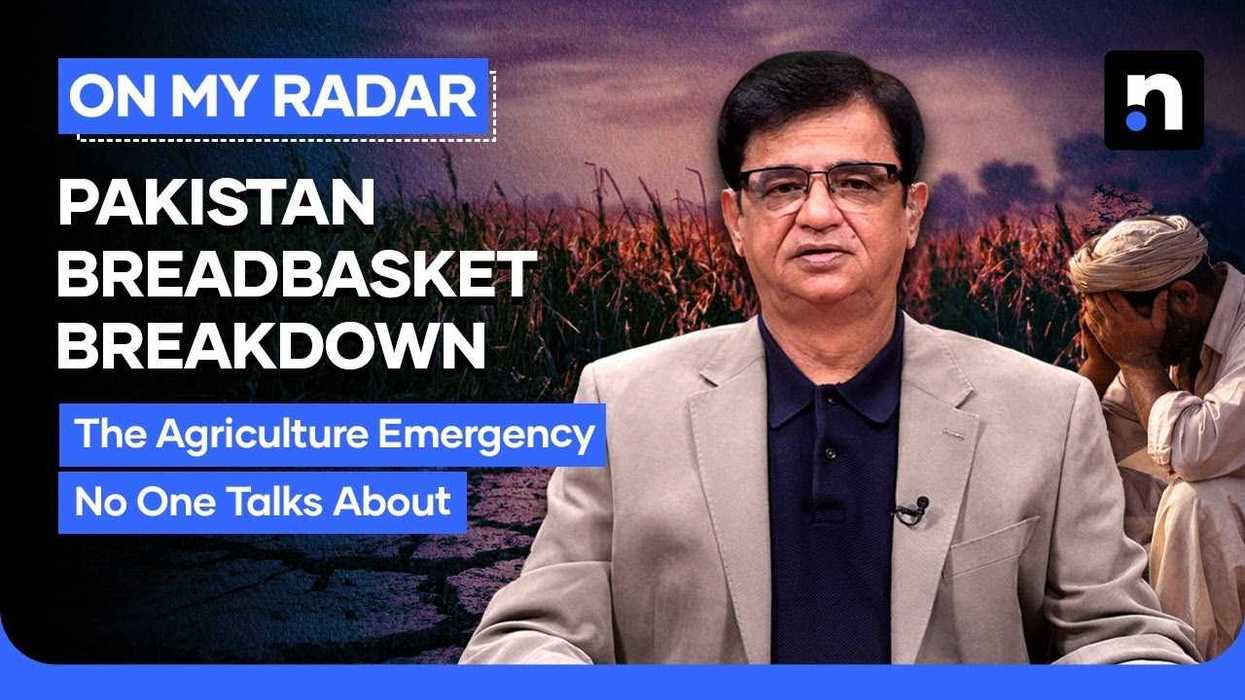
Pakistan’s once‑vibrant agricultural sector - long regarded as the backbone of the economy and the cornerstone of rural livelihoods - is now under severe strain, with declining production, shrinking investment and increasing climate‑related shocks threatening food security and economic stability.
In the latest episode of On My Radar, Kamran Khan described the situation as “a slow‑burn crisis with mounting consequences,” saying the sector’s decline reflects decades of policy neglect and environmental stress that have eroded farmers’ capacity to produce and invest. “This is not just a rural problem - it is a national emergency that could redefine Pakistan’s economic prospects,” he said.
Analysts and officials point to a combination of factors behind the deterioration. Climate change, unpredictable weather patterns, severe floods, unplanned urbanization and what many farmers describe as persistent government inaction have all contributed to a sharp downturn. Agriculture, which contributes about 23.5 percent of GDP and 37.4 percent of employment, now struggles with falling output, rising costs and weakening rural economies.
A key indicator of the sector’s distress is tractor sales, widely viewed by experts as a barometer of farmers’ confidence and investment capacity. According to the Pakistan Automotive Manufacturers Association, only 12,929 tractors were sold nationwide in the first half of the 2026 fiscal year - a 26 percent decline from 17,397 units sold in the same period a year earlier. The figure is nearly half the sales recorded in 2022, when roughly 26,000 units were sold in the comparable period.
“The drop in tractor sales reveals that farmers are neither willing nor able to invest in their fields,” said a senior agriculture economist in Lahore. “That points to deeper economic and structural problems beyond just weather shocks.”
Climate impacts have compounded these challenges. Rising temperatures, erratic rainfall, heatwaves and prolonged droughts have disrupted planting and harvest cycles. The devastating 2022 floods, which submerged nearly one‑third of the country’s agricultural land, illustrated the sector’s vulnerability. In 2025 alone, floods caused an estimated 409 billion Pakistani rupees ($2.3 billion) in economic losses, equivalent to 0.33 percent of GDP, according to government data.
The downturn in crop production paints a similar picture. The Pakistan Economic Survey 2023–24 reported a 13.5 percent decline in total output of major crops. Wheat production dropped to 28.98 million tons from 31.81 million tons the previous year. Cotton, once a flagship export commodity, saw a 30.7 percent fall, from 8.17 million bales in 2023–24 to 5.45 million bales in 2024–25. Just a decade ago, annual cotton production exceeded 15 million bales.
Rice production showed a modest increase in per‑acre yields, but export barriers, stiff competition, border issues and water scarcity have eroded economic gains. Data from the State Bank of Pakistan shows rice export values fell by 40 percent in the first half of the current fiscal year, from $296 million to $188 million.
Other crops are also struggling. Sugarcane output has stagnated, while maize - a critical staple - has declined by more than 15 percent in recent years, officials say.
The crisis is exacerbated by shrinking agricultural land as housing developments and a growing population put pressure on arable areas. Rising food demand has heightened concerns over long‑term food security.
Despite high‑profile initiatives such as the Special Investment Facilitation Council (SIFC), which was promoted as a potential catalyst for modernizing agriculture, results have been limited. Projects such as the proposed six new canals under the Green Pakistan Initiative faced political obstacles in Sindh and appear to have stalled, depriving farmers of key irrigation support.
Farmers continue to grapple with high input costs for fertilizer and fuel, weak government procurement systems and little to no significant private investment at the rural level, according to local farming associations.
Yet experts say the sector is not beyond recovery. With policy reforms that prioritize farmers, transparent pricing systems, affordable energy, practical adoption of modern technologies and promotion of low‑water crops, Pakistan’s agriculture could stabilize and even contribute to broader economic resilience.



Comments
See what people are discussing