

Pakistan Army says 274 Afghan regime operatives killed in Operation Ghazab lil-Haq
Military’s spokesperson says 12 Pakistani soldiers killed and 47 injured in operation launched last night following deadly border clashes

News Desk
The News Desk provides timely and factual coverage of national and international events, with an emphasis on accuracy and clarity.
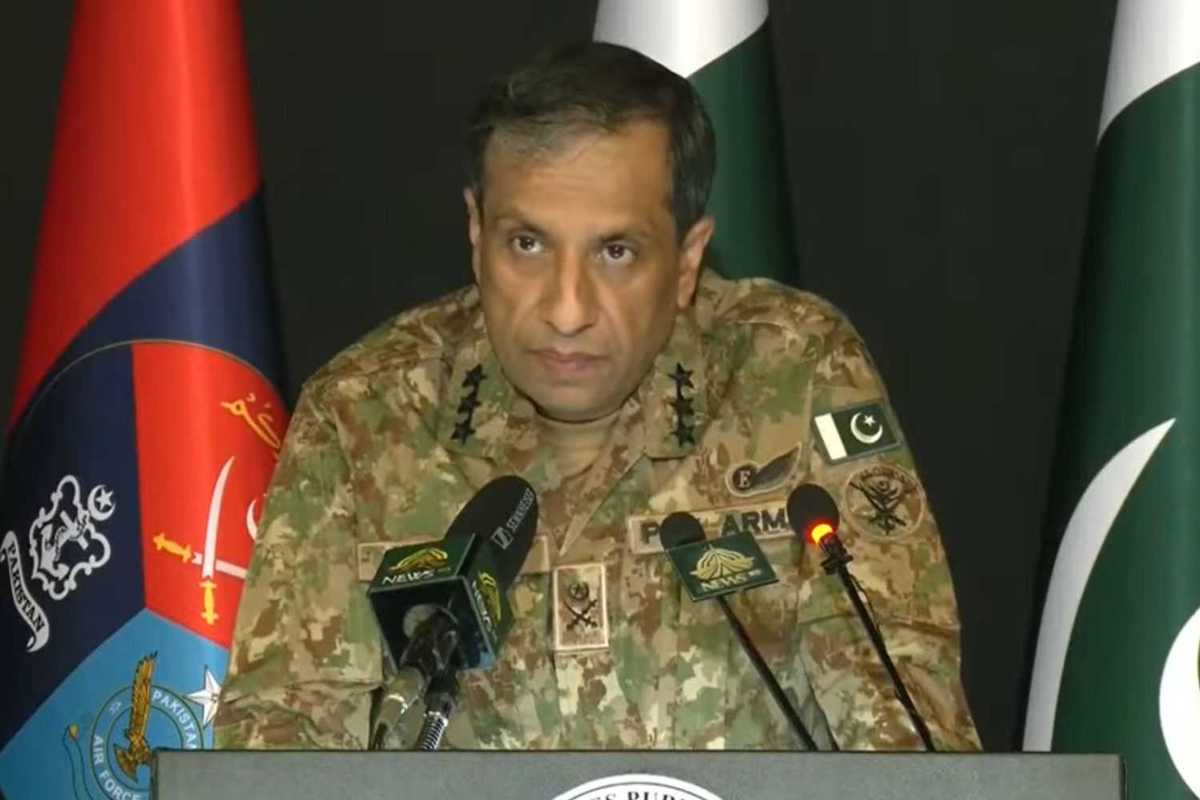
Pakistan military's spokesperson Lt. Gen Ahmed Sharif Chaudhry briefing the media over Operation Ghazab lil-Haq against Afghanistan.
Courtesy: ISPR
At least 274 Afghan Taliban regime operatives and terrorists were killed in the recent escalation between Pakistan and Afghanistan, the Pakistani military’s spokesperson confirmed on Friday.
Addressing a press briefing over Operation Ghazab lil-Haq – launched last night against Afghanistan following hours of deadly clashes - Director General of the Inter-Services Public Relations (ISPR) Lt. Gen. Ahmed Sharif Chaudhry stated that Pakistan “gave a befitting response to the Afghan Taliban regime’s actions from last night”.
“More than 400 have been injured,” he added.
He added that Pakistan’s armed forces destroyed 73 positions and taken control of 17 others. The DG ISPR stated that an estimated 115 tanks, armored personnel carriers and artillery units had also been destroyed.
The DG further confirmed that at least 12 Pakistani soldiers were also killed in the attack, whereas 27 were injured.
Calling Afghanistan the central sponsor behind militant groups operating in the region, the army spokesperson said “this master proxy” mobilized overnight in coordination with fighters belonging to what he described as “Fitna al Khawarij” (Arabic for the Strife of the Seceders) – terrorists of the Tehreek-e-Taliban Pakistan (TTP).
The DG ISPR delivered a strong warning, saying those responsible for terrorist attacks in Pakistan “will find no safe haven anywhere.”
‘No collateral damage’
Revealing further details, the DG ISPR stated that 22 sites across Kabul, Kandahar, Paktia, Laghman, Khost, and Paktika were specifically chosen for the strikes.
“These targets were carefully identified based on intelligence,” he said, adding that “they are all military sites, and measures were taken to avoid civilian casualties.”
He further explained that the targets included “key Afghan Taliban headquarters, brigade and battalion offices, sector commands, ammunition depots, logistics bases, and hideouts used by terrorists and their supporters.”
The DG ISPR cautioned that Afghan media, social media, and what he called “Hindustan proxies” were spreading false claims that Pakistan had struck civilian areas.
“You have been hearing these lies since last night,” he said, emphasizing, “No civilian infrastructure was targeted; all sites were military installations.”
He added that the locations targeted were used by Afghan Taliban forces to launch attacks against Pakistan.
The DG ISPR, outlining the operation in response to the Afghan Taliban regime’s aggression, stated that the Pakistan Armed Forces delivered an “effective, immediate, and brutal response.” He described it as “a well-deserved reaction against terrorists and their facilitators — the main proxy of terrorism in the region.”
“First India was shocked by Bunyan-i-Marsoos… now Afghanistan has received a similar shock,” he added.
Lt. Gen Chaudhry reiterated that Pakistan’s response to terrorism anywhere inside its territory will be to ensure that no location in Afghanistan sheltering terrorists or their supporters remains safe.
Clashes' timeline
Pakistan launched a large-scale military operation, Ghazab-lil-Haq, late Thursday night in response to renewed violence along the Pakistan-Afghanistan border for a second time this week.
Last week, Pakistan carried out airstrikes targeting camps of the Tehreek-e-Taliban Pakistan (TTP) and Islamic State Khorasan Province (ISKP) in Afghanistan, following a series of attacks in Pakistan, including a suicide bombing in the capital, Islamabad.
Pakistani security sources reported that more than 80 militants were killed in the strikes.
Pakistan has long maintained that the TTP leaders operate from Afghan soil, a claim that Kabul has consistently denied.
Tensions between Pakistan and Afghanistan escalated following a series of explosions in Kabul on October 9 last year, which prompted Taliban forces to attack areas along Pakistan’s border. In response, Islamabad carried out cross-border shelling, causing casualties and infrastructure damage on both sides and leading to the suspension of trade as border crossings were closed on October 12.
Since then, Pakistan and Afghanistan’s Taliban government have held multiple rounds of negotiations in Qatar and Turkey, but the talks have so far failed to produce a resolution.




Comments
See what people are discussing