

Pakistan’s car ownership among lowest in developing world
Data show just 6% of households own a car, underscoring weak demand and structural limits in auto sector

Business Desk
The Business Desk tracks economic trends, market movements, and business developments, offering analysis of both local and global financial news.
Shutterstock
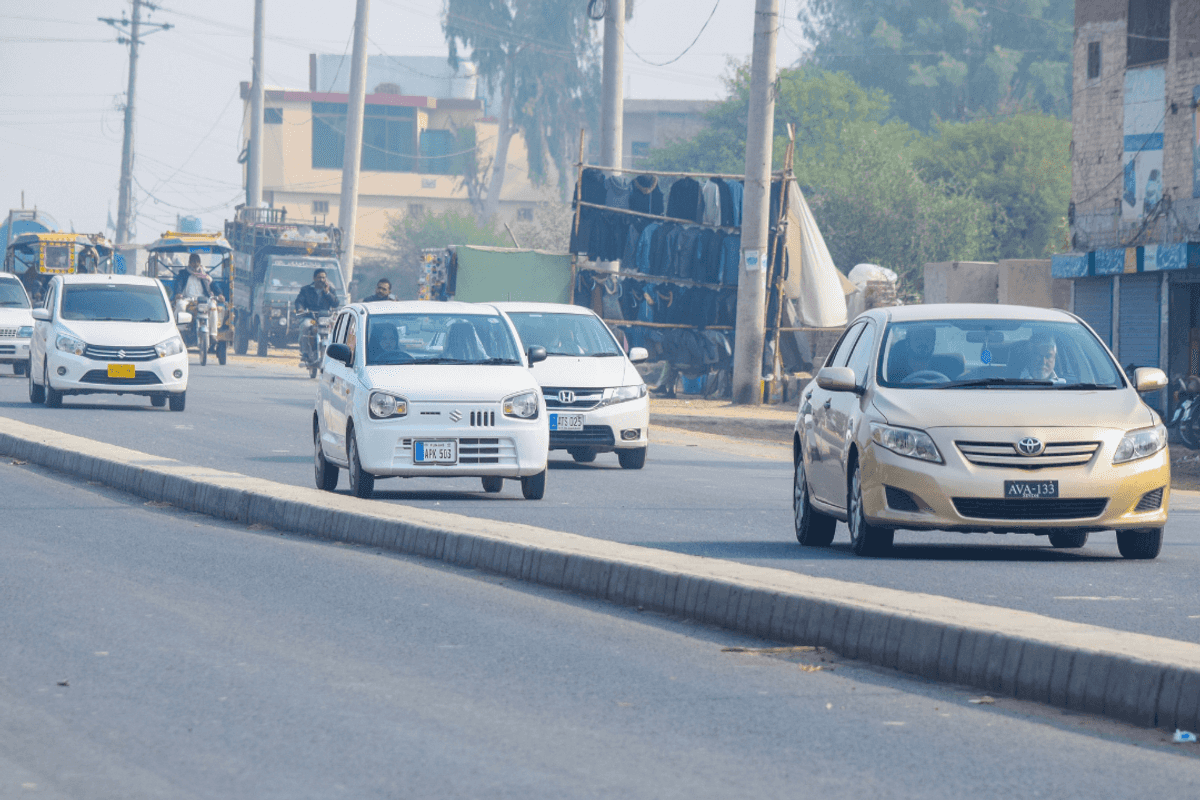
Despite worsening traffic congestion in major cities, car ownership in Pakistan remains among the lowest in the developing world, according to official data and industry figures.
The Pakistan Social and Living Standards Measurement (PSLM) Survey 2019-20 shows that about 94% of households in the country do not own a single car. Even in urban areas, fewer than 10% of households own a vehicle, while in rural regions the figure drops below 4%.
Out of roughly 32 million households nationwide, fewer than 2 million own a car. Of those, about 1.1 million are located in urban centers.
The figures challenge the common perception that rising traffic congestion in cities such as Karachi, Lahore and Islamabad reflects widespread car ownership. Instead, analysts say the data points to a narrow ownership base and limited domestic demand for new vehicles.
Low ownership levels are mirrored in weak production volumes. Although government auto policies have introduced incentives for new entrants and expansion of existing plants, annual vehicle production continues to fluctuate between 200,000 and 300,000 units — well below installed capacity.
The country now has 13 automobile assemblers, yet overall output remains comparable to levels produced by three major manufacturers a decade ago. Industry experts say the resulting fragmentation has reduced economies of scale, keeping per-unit costs high and limiting competitiveness.
Pakistan’s motorization ratio — a key measure of vehicle penetration — remains below 20 vehicles per 1,000 people. By comparison, India has 33 vehicles per 1,000 people, Vietnam 46 and Thailand 147.
Why does the gap exist?
Economists say the gap reflects structural challenges, including policy inconsistencies and macroeconomic instability. While incentives have been offered to both new and existing manufacturers, critics argue that concessions on completely knocked down (CKD) imports and continued used-car imports have limited the development of a strong local manufacturing base.
As a result, vehicle prices have risen while demand has remained suppressed. Low production volumes, industry representatives say, discourage investment in localization and research and development, which require predictable, high-volume output to be viable.
The auto sector is also highly sensitive to economic cycles. Pakistan has experienced repeated boom-and-bust patterns driven by external account pressures, currency depreciation and fiscal tightening. Each downturn disrupts auto sales and discourages long-term planning and investment.
Global trends indicate that motorization accelerates once per capita income exceeds about $2,500. Pakistan’s per capita income currently stands at roughly $1,825, below that threshold. Analysts say that until incomes rise and macroeconomic stability improves, large-scale vehicle ownership will remain out of reach for most households.
Sustained annual economic growth of around 7% over the next five years, combined with stable exchange rates and improved purchasing power, would be necessary to expand the domestic vehicle market meaningfully, economists say.
Without broader economic reforms, they add, policy incentives alone are unlikely to generate durable growth in Pakistan’s automobile industry.




Comments
See what people are discussing