

Pakistan, China stress dialogue and de-escalation amid Mideast tensions
Pakistan’s Deputy Prime Minister and Foreign Minister Ishaq Dar and Chinese Foreign Minister Wang Yi stress dialogue and UN principles to prevent further escalation in Middle East
Aamir Abbasi
Editor, Islamabad
Aamir; a journalist with 15 years of experience, working in Newspaper, TV and Digital Media. Worked in Field, covered Big Legal Constitutional and Political Events in Pakistan since 2009 with Pakistan’s Top Media Organizations. Graduate of Quaid I Azam University Islamabad.
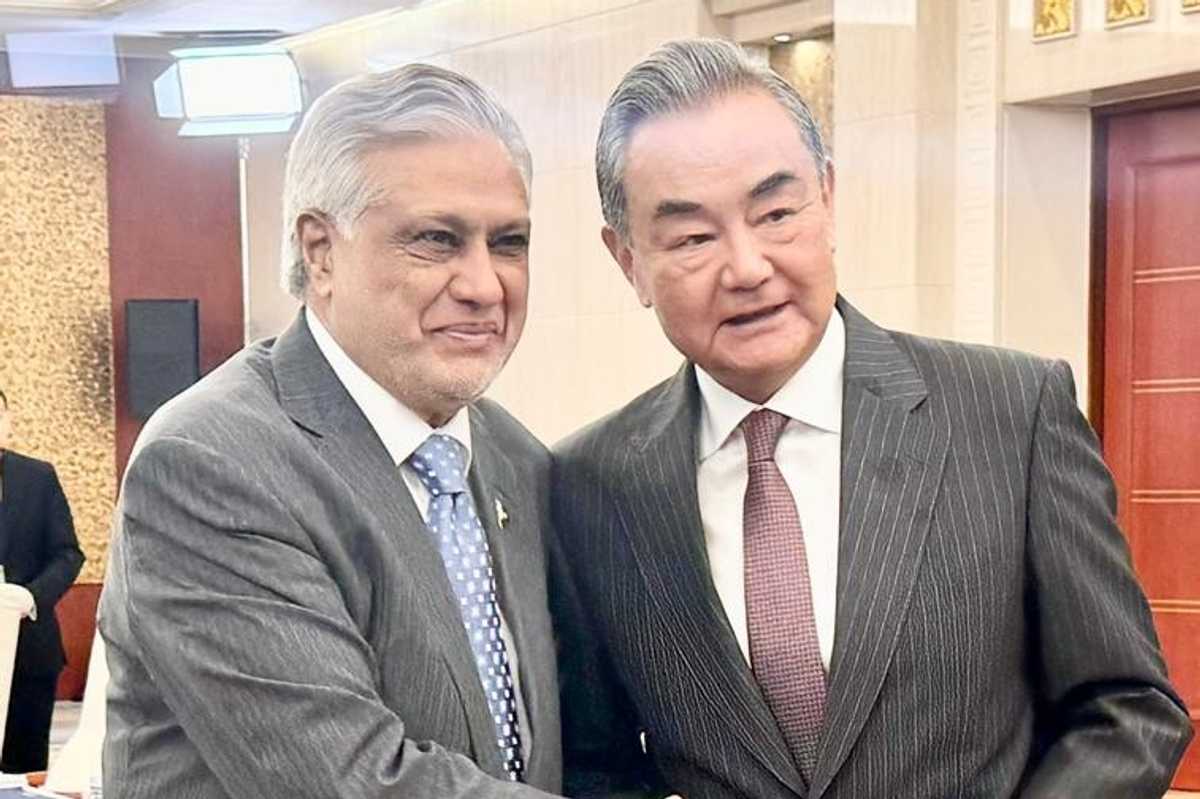
Pakistan's Foreign Minister Ishaq Dar meet Chinese counterpart Wang Yi on the sidelines of SCO meeting.
Pakistan Foreign Ministry/File
Pakistan and China emphasized diplomacy and dialogue on Tuesday as regional tensions in the Middle East remained high.
Pakistan’s Deputy Prime Minister and Foreign Minister Ishaq Dar spoke by phone with Chinese Foreign Minister Wang Yi to discuss the evolving regional situation and broader global developments.
Dar shared Pakistan’s perspective on current developments and stressed the urgent need to ease tensions and prevent further escalation. He highlighted the importance of diplomatic efforts to maintain stability in the Middle East.
Wang Yi welcomed Pakistan’s role in supporting de-escalation and recognized Islamabad’s commitment to regional peace. Both leaders reiterated the importance of acting in line with United Nations principles.
The two sides reaffirmed the strength of the Pakistan-China All-Weather Strategic Cooperative Partnership and agreed to maintain close contact on regional and international developments.
Pakistan conveys condolences to Iran’s new leader
In a separate development, Prime Minister Shehbaz Sharif sent a letter to Iran’s newly appointed Supreme Leader Mojtaba Khamenei expressing condolences over the death of Ali Khamenei, Iran’s previous Supreme Leader.
Sharif conveyed the “heartfelt condolences and prayers of the people of Pakistan” to the people of Iran and the wider Muslim Ummah. He offered congratulations to Mojtaba Khamenei on assuming leadership and expressed hope for peace, stability, and prosperity under his tenure.
I congratulate His Eminence Ayatollah Mojtaba Khamenei on his assumption of the responsibilities of Supreme Leader of the Islamic Republic of Iran. I also reiterate deepest condolences and prayers on behalf of the people of Pakistan on the martyrdom of his father, Ayatollah Ali…
— Shehbaz Sharif (@CMShehbaz) March 10, 2026
The prime minister also highlighted deep-rooted ties between Pakistan and Iran, based on shared faith, history, culture, and language. He reaffirmed Pakistan’s commitment to strengthening bilateral cooperation in all areas of mutual interest.
Meanwhile, U.S. President Donald Trump indicated in a Fox News interview that he might engage in talks with Iran, depending on the terms. He said he had heard Tehran “wanted to talk badly” but expressed skepticism about Iran’s new leader.
Trump reiterated his view that U.S. military operations in Iran exceeded expectations and expressed surprise at Iranian missile and drone strikes targeting Gulf countries.
Oil markets retreat after historic surge
Global oil prices fell sharply Tuesday following a record surge on Monday. Brent crude dropped $6.64, or 6.7%, to $92.32 a barrel, while U.S. West Texas Intermediate fell $5.44, or 5.7%, to $89.33. Earlier, both benchmarks had climbed above $119 a barrel, the highest since mid-2022, amid supply concerns linked to the conflict with Iran.
Volumes also declined, with Brent contracts falling to 284,000, the lowest since Feb. 27, and WTI to 255,000, the lowest since Feb. 20. Analysts said market fears eased after Trump suggested the conflict could be short-lived.
Russia’s President Vladimir Putin held a phone call with Trump, sharing proposals for a quick settlement, according to a Kremlin aide. Meanwhile, Iran’s Islamic Revolutionary Guards Corps said it would “determine the end of the war” and warned of oil export disruptions if attacks continued.
Trump is also considering easing oil sanctions on Russia and releasing emergency crude stockpiles to curb prices, according to multiple sources. Analysts said these measures, along with signs of potential de-escalation, helped reduce the “panic premium” that had pushed oil above $100 a barrel.
Saudi Aramco warned of “catastrophic consequences” if the conflict disrupted shipping through the Strait of Hormuz, while JPMorgan and Goldman Sachs noted that policy measures may have limited impact without guaranteed safe passage.
Energy ministers from the Group of Seven industrialized nations were scheduled to discuss the rising prices on Tuesday, with European Union leaders expected to address the issue later.


Comments
See what people are discussing