

Pakistan gains strategic relevance as US-Iran diplomacy reshapes region
Kamran Khan says the key question is how Pakistan can turn its geographic position and connectivity into real gains in trade, investment and economic activity

News Desk
The News Desk provides timely and factual coverage of national and international events, with an emphasis on accuracy and clarity.
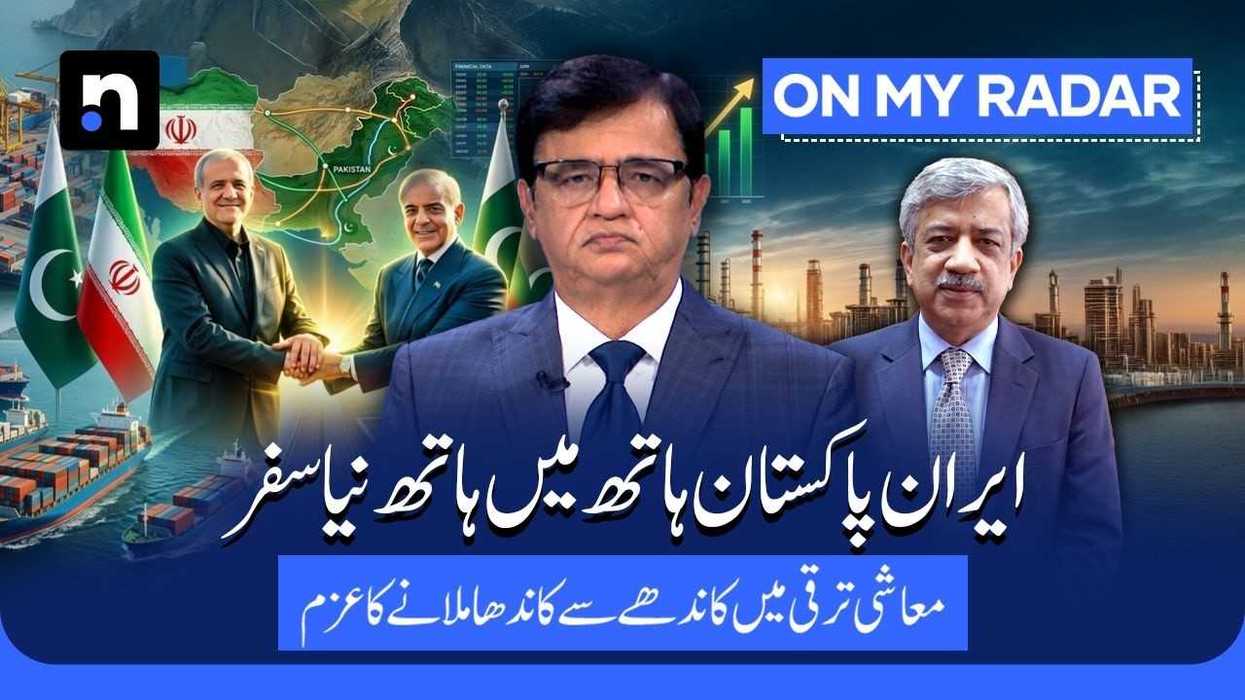
Pakistan is emerging as a key diplomatic node in evolving US–Iran engagement, with Islamabad increasingly positioned as a facilitator of regional dialogue and a potential bridge for broader peace and economic cooperation in the Middle East and South Asia.
In recognition of Pakistan’s diplomatic efforts, Iranian President Masoud Pezeshkian arrived in Islamabad on an official visit, where he expressed gratitude to Pakistan for its role in supporting dialogue and de-escalation efforts.
In the latest episode of On My Radar, Kamran Khan noted that Pakistan’s involvement in the US–Iran peace process has elevated its diplomatic standing in the region.
The visit comes amid shifting regional dynamics following the recent Iran–Israel conflict. It is also notable that after the 12-day war between Iran and Israel last year, Pezeshkian chose Pakistan as his first foreign destination, underscoring the importance Tehran places on its relationship with Islamabad.
Pezeshkian’s latest visit is being viewed as more than routine diplomacy. It signals the beginning of a potentially strengthened phase in Pakistan-Iran relations, shaped by evolving geopolitical and strategic realities in the region.
The trip also reflects Iran’s acknowledgment of Pakistan’s diplomatic engagement during a period of heightened regional tensions. Islamabad not only extended political support to Tehran during the conflict but also played a facilitating role in encouraging dialogue between Iran and the United States, which contributed to a broader peace understanding.
This development is also being seen as a step toward deeper future economic cooperation between the two countries.
The US–Iran peace process has opened up potential new economic opportunities for Pakistan.
If sanctions on Iran are eased, Pakistan could benefit across multiple sectors, including trade, energy cooperation, transit trade, and broader regional connectivity.
Key long-discussed projects such as expanded border trade, the strategic development of Gwadar, the Iran–Pakistan gas pipeline, and legal imports of Iranian oil, which have remained stalled for years, could potentially be revived.
On the other hand, while the China–Pakistan Economic Corridor (CPEC) has largely been viewed as a bilateral framework between China and Pakistan, improved Iran–regional economic integration could expand its scope under the broader Belt and Road Initiative (BRI). This may open new pathways for energy cooperation, transit trade, logistics networks, and industrial collaboration involving Pakistan, Iran, and Central Asia.
However, a key question remains how effectively Pakistan can convert its geographic position and regional connectivity into tangible gains in trade, investment, and economic activity. This issue is likely to remain a central focus for policymakers, business circles, and investors in the period ahead.



Comments
See what people are discussing