


Business Desk
The Business Desk tracks economic trends, market movements, and business developments, offering analysis of both local and global financial news.

Pakistan's Finance Minister Muhammad Aurangzeb (C) releases a copy of the country's Economic Survey 2025-26 ahead of the state budget during a press conference in Islamabad on June 11, 2026.
AFP
Pakistan's economy grew 3.7% in fiscal year 2025-26, up from 3.2% the previous year, Finance Minister Muhammad Aurangzeb said on Thursday while presenting the Economic Survey ahead of the federal budget.
The size of the economy reached a record $452 billion, equivalent to PKR 126.9 trillion, while per capita income rose to $1,901. Growth was broad-based, spanning agriculture, industry and services.
What drove Pakistan's GDP growth in FY2025-26?
Pakistan's 3.7% GDP growth was supported by expansion across all three major sectors. Agriculture grew 2.89%, industry expanded 3.51% and services posted the strongest growth at 4.09%. Large-scale manufacturing rose 6.1%, its highest level in four years, while information and communication services grew 7.5%.
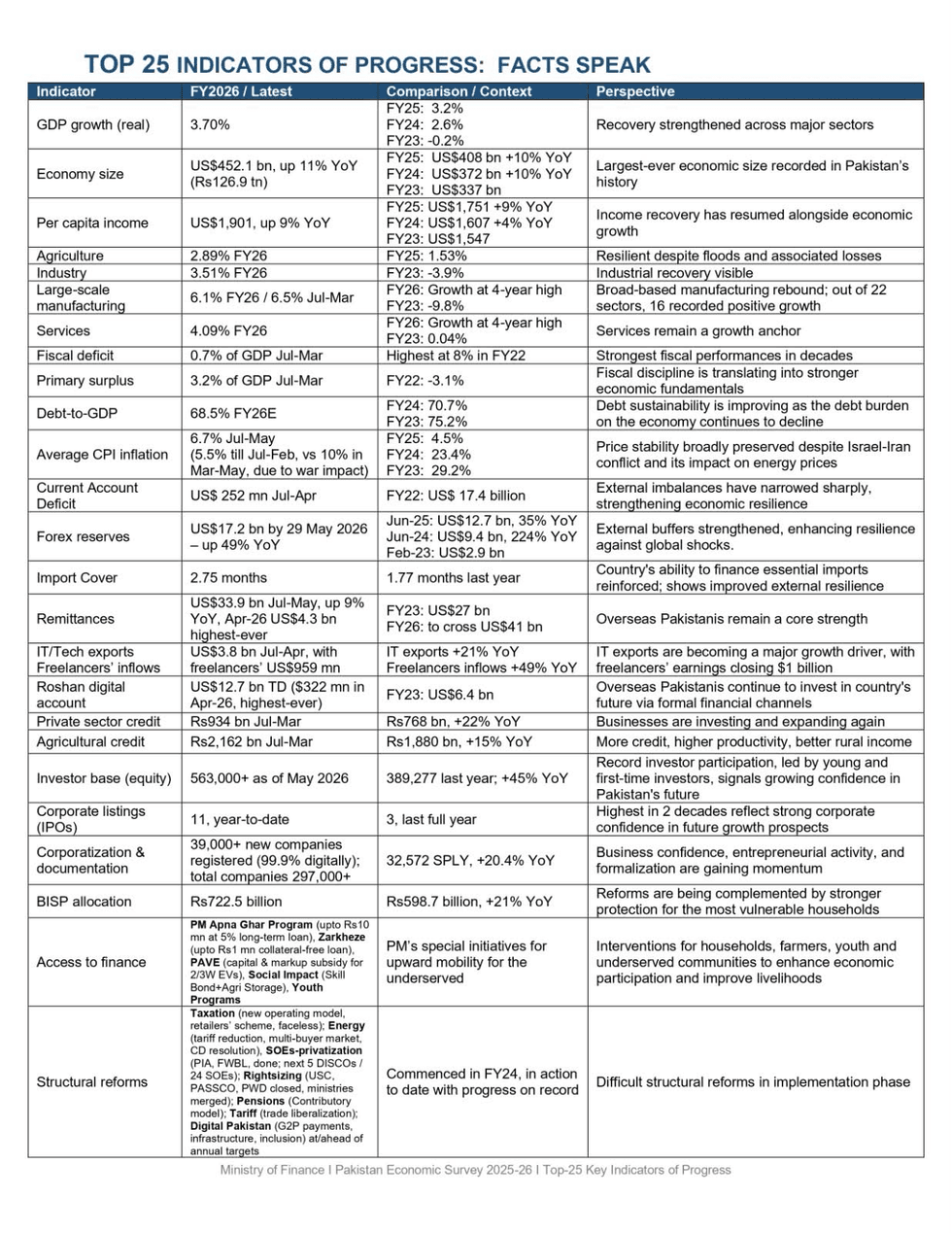
Construction also strengthened during the year, contributing to the industrial rebound. Average inflation slowed sharply to 6.7%, compared with elevated levels in previous years, easing pressure on households and businesses. Aurangzeb said ongoing structural reforms in taxation, energy pricing, privatisation, pensions and digital governance were beginning to yield results.
How have Pakistan's fiscal and external accounts improved?
The budget deficit narrowed to 0.7% of GDP during July to March, while the primary surplus stood at 3.2% of GDP, reflecting improved fiscal discipline. Pakistan's debt-to-GDP ratio declined to 68.5%, easing the country's debt burden. The current account deficit narrowed sharply to $252 million during July to April.
Foreign exchange reserves rose to $17.2 billion by end-May, up 49% year-on-year, while import cover improved to 2.75 months. Workers' remittances climbed to $33.9 billion during July to May, with total remittances projected to exceed $41 billion by the end of the fiscal year. The strong remittance performance was a key driver of external account improvement.
What is the state of Pakistan's investment and digital economy?
IT exports reached $3.8 billion during the fiscal year, while freelance earnings rose to $959 million, reflecting the growing contribution of the digital economy. Private-sector credit expanded to PKR 934 billion during July to March, up from PKR 768 billion a year earlier. Agricultural lending also rose, reaching PKR 2.16 trillion.
Investor participation in the stock market increased more than 45% year-on-year, with over 563,000 accounts registered. Eleven companies launched initial public offerings during the year, the highest number in two decades. More than 39,000 companies were registered during the fiscal year, almost entirely through digital channels, pointing to continued formalization of the economy.
Social protection spending also rose, with allocations for the Benazir Income Support Program increasing to PKR 722.5 billion. Aurangzeb said the reforms underway would support sustainable growth in the coming years. The Economic Survey is released one day before the federal budget as an official assessment of economic performance in the outgoing fiscal year.





Comments
See what people are discussing