

Pakistan, Qatar step up diplomacy as US-Iran fighting eases
Kamran Khan says technical talks continue despite clashes, keeping hopes alive for the Islamabad MoU

News Desk
The News Desk provides timely and factual coverage of national and international events, with an emphasis on accuracy and clarity.
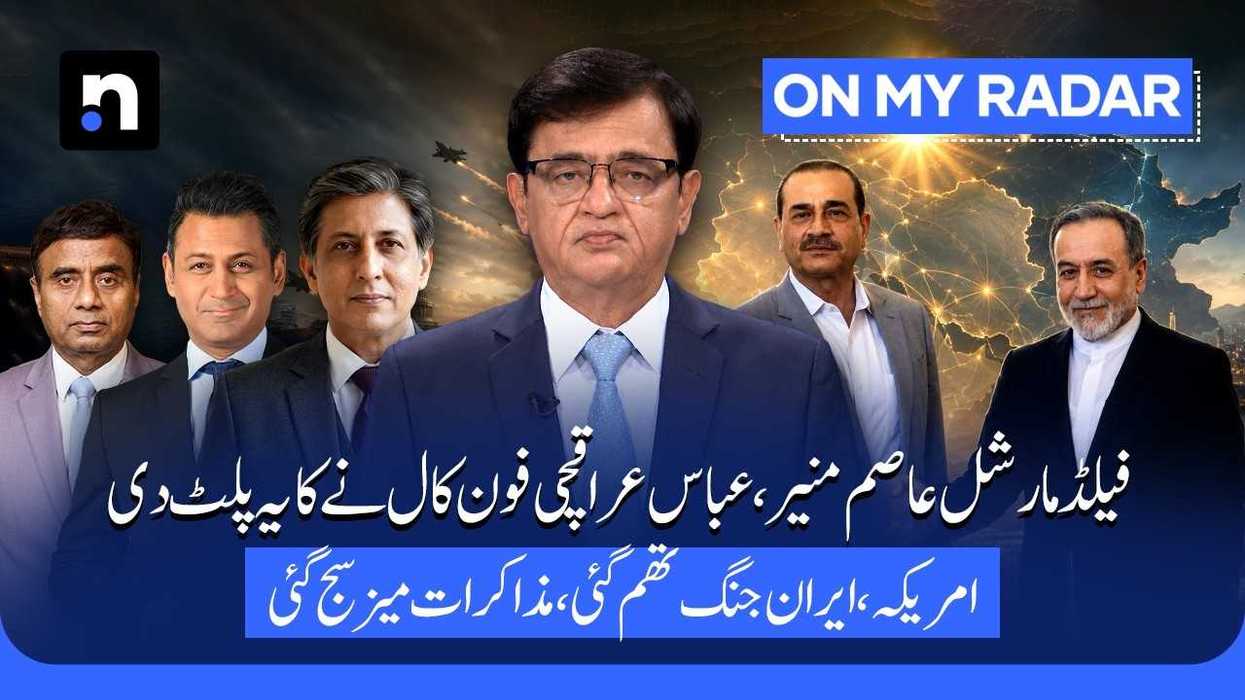
A temporary lull in fighting between the United States and Iran has renewed diplomatic efforts led by Pakistan and Qatar to bring both sides back to negotiations, even after two days of some of the heaviest military exchanges since the Islamabad Memorandum of Understanding (MoU), according to the latest episode of Kamran Khan's On My Radar.
The program said that despite the recent escalation, Washington and Tehran have not severed contacts, and technical discussions related to the 14-point Islamabad MoU have continued. Neither side has formally declared the agreement terminated, leaving open the possibility of renewed negotiations.
The diplomatic contacts continued even as U.S. President Donald Trump declared that the ceasefire had effectively ended. During the latest round of fighting, the United States said it struck 170 targets inside Iran, while Iran responded with attacks on U.S. military installations and other sites in Bahrain, Kuwait, Qatar, Jordan and Iraq.
According to CNN and Axios, Pakistan, Qatar and other regional mediators are working to reduce tensions and revive nuclear negotiations between Washington and Tehran.
The program said senior officials from Pakistan, Qatar, Türkiye, Egypt and Saudi Arabia held telephone conversations with U.S. and Iranian leaders on Wednesday in an effort to prevent the conflict from escalating further.
Reuters reported that Qatari negotiators arrived in Iran on Thursday for meetings with Iranian officials aimed at easing tensions and creating conditions for renewed U.S.-Iran negotiations.
Iran's Foreign Ministry also said Foreign Minister Abbas Araghchi spoke by telephone with Pakistan's Field Marshal Asim Munir. According to the ministry, Araghchi said recent statements by U.S. officials showed Washington remained committed to violating the Islamabad MoU and pursuing policies that increase tensions.
Following two days of heavy exchanges, the security situation appeared relatively calm on Thursday. According to the program, a U.S. official attributed the pause in fighting to ongoing diplomatic efforts.
Axios, citing a regional source, reported that Iran's recent actions in the Strait of Hormuz were carried out by factions within the Iranian government opposed to the Islamabad Memorandum and seeking to derail it.
The program also highlighted comments by U.S. Vice President JD Vance, who said, "U.S. Will Act if Iran Hits Ships."
Trump later met with his national security team to discuss the administration's next steps on Iran. After the meeting, a U.S. official said the administration still favored a diplomatic solution and that technical negotiations on a nuclear agreement remained underway.
The program also cited journalist Adam Roberts as saying, "Trump Is Trapped Between War and Diplomacy."
Last week, Al Arabiya reported that the next round of U.S.-Iran negotiations is expected to take place in Pakistan.
The latest fighting has disrupted commercial shipping through the Strait of Hormuz, one of the world's most important maritime trade routes. According to the program, the number of commercial vessels using the passage fell from 45 on Monday to just five on Wednesday.
Despite the disruption, global oil markets remained relatively stable, with Brent crude trading at about $76 per barrel.
The program also reported that Iran's former Supreme Leader Ayatollah Ali Khamenei was buried overnight in his hometown of Mashhad within the shrine complex of Imam Reza. His son, Mostafa Khamenei, led funeral prayers during a private burial attended only by family members.
The burial followed a week of public mourning and processions that Iranian authorities said drew more than 15 million participants.
However, Mojtaba Khamenei, the late leader's son and widely viewed successor, did not appear at the funeral. According to the program, he has not been seen in public since the Feb. 28 attack.
Kamran Khan said that while the battlefield has fallen temporarily quiet, the real test now lies with Pakistani and Qatari diplomacy. He noted that despite the recent escalation, neither Washington nor Tehran has formally withdrawn from the Islamabad MoU, preserving hopes that the diplomatic process can still be revived.
The program featured analysis from defense and foreign affairs analyst Aijaz Haider, senior political analyst Fahd Hussain, and Washington-based senior journalist Faiz Rehman.



Comments
See what people are discussing