

Pakistan's new provinces debate puts PML-N, PPP under pressure
Kamran Khan questions whether the ruling parties will surrender control over billions in provincial resources

News Desk
The News Desk provides timely and factual coverage of national and international events, with an emphasis on accuracy and clarity.
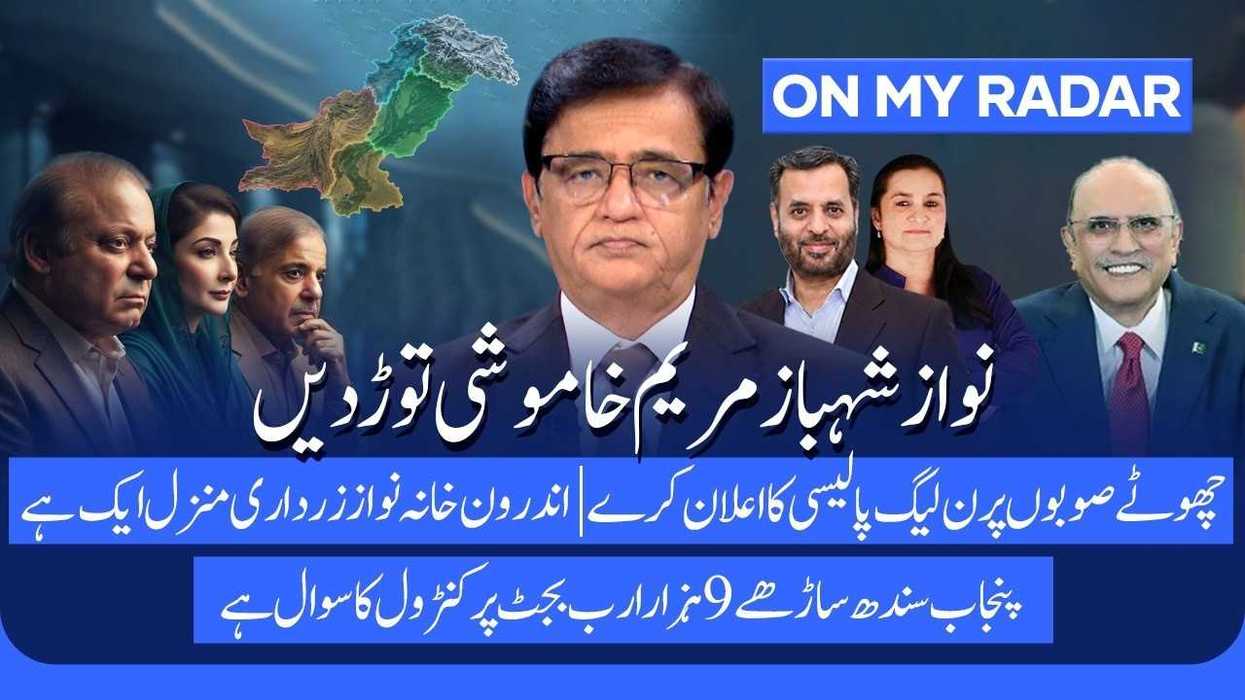
Pakistan's debate over creating new provinces and decentralizing political and financial powers is entering a decisive phase, with the country's two major governing parties, the Pakistan Muslim League-Nawaz (PML-N) and Pakistan Peoples Party (PPP), facing questions over their willingness to share provincial authority, Kamran Khan said.
In his latest episode of On My Radar, Khan argued that the political resistance to redistributing powers and resources stems largely from the desire of established political leaderships to retain control over enormous provincial budgets and administrative structures.
He said the PPP had openly opposed proposals to divide Sindh into smaller administrative units, while the PML-N leadership had maintained what he described as an unusually prolonged silence on the future of Punjab and the creation of new provinces.
The debate has gained momentum over the past three months, with proposals ranging from establishing new provinces to creating smaller administrative units to bring government services and resources closer to the people.
Khan said PPP Chairman Bilawal Bhutto Zardari, party founder and President Asif Ali Zardari, Sindh Chief Minister Murad Ali Shah and the party's majority in the Sindh Assembly had all opposed dividing the province. The provincial assembly has also passed several resolutions against such proposals.
The PML-N's position, however, remains unclear. Party leader Nawaz Sharif, Prime Minister Shehbaz Sharif and Punjab Chief Minister Maryam Nawaz have yet to announce a clear policy, despite repeated expectations that the party would explain its position.
Khan contrasted the party's current silence with Nawaz Sharif's earlier support for smaller provinces when he was out of power. He argued that the PML-N's political record suggested that retaining control over Punjab's resources and administrative authority was as important to the party as preserving Sindh's political structure was to the PPP.
Control over Rs9.5 trillion in provincial budgets
The financial stakes are substantial. Punjab and Sindh together control annual budgets worth approximately 9.5 trillion rupees ($34 billion), making the debate about new provinces more than an administrative question.
Punjab's current annual budget stands at 5.903 trillion rupees, over which Maryam Nawaz's provincial government exercises authority. Sindh's budget is 3.562 trillion rupees, formally managed by Chief Minister Murad Ali Shah, although Khan argued that Zardari exercises significant political influence over provincial decisions.
Under the National Finance Commission (NFC) arrangement, Punjab is estimated to receive approximately 4.391 trillion rupees and Sindh 2.263 trillion rupees.
Khan said dividing Punjab into three or four provinces and Sindh into two or three administrative units would fundamentally alter the existing distribution of political power, budgets and administrative authority.
Instead of one powerful government controlling Punjab from Lahore, several elected provincial governments would share authority and resources. A similar arrangement in Sindh would reduce the concentration of administrative and financial power in Karachi.
He argued that this prospect helps explain the political sensitivity surrounding the proposals and the reluctance of established parties to support them.
PML-N's record on local governments
Khan said the PML-N's record on transferring authority to elected local governments offered further insight into its position.
Punjab last held local government elections in 2015, and the province has not established a new elected local government system in the 11 years since then, despite significant population growth and increasing administrative demands.
The local government elections were previously scheduled for May 2022 but were repeatedly postponed following changes to laws and amendments governing the LG system.
The Election Commission of Pakistan has now scheduled the first phase of local government elections in Punjab for February 2027. The ruling party had already requested a postponement until April 2027, but the commission rejected the request.
Khan questioned how a provincial government that had struggled to establish an effective system of empowered mayors, district councils and local administrations could be expected to surrender authority and financial resources to three or four additional provincial governments.
He also highlighted the absence of a permanent and effective Provincial Finance Commission (PFC) system in Punjab.
Article 160 of Pakistan's Constitution provides for the NFC to distribute financial resources between the federal government and provinces. Similarly, Article 140A requires provinces to devolve political, administrative and financial authority to elected local governments.
However, Khan said Punjab had failed to establish a permanent PFC mechanism, while local governments in Sindh had also struggled to achieve meaningful financial independence despite the PPP governing the province for 19 years.
He argued that the two parties had similar records when it came to transferring resources and authority to lower levels of government.
Referendum and constitutional amendment enter debate
The discussion is now extending beyond political statements, with proposals involving a referendum, a possible 28th Constitutional Amendment and a potential role for the Federal Constitutional Court.
Khan said some influential decision-makers had begun recognizing that maintaining the existing four-province structure alone would not necessarily improve people's lives or ensure effective governance.
Defense Minister Khawaja Asif has expressed support for creating new provinces, while Punjab Assembly Speaker Malik Muhammad Ahmad Khan has backed holding a referendum on the issue.
However, Khan said the decisive position would depend on the top PML-N leadership, particularly Nawaz Sharif, Shehbaz Sharif and Maryam Nawaz.
He warned that if the PPP's resistance to dividing Sindh and the PML-N's silence over restructuring Punjab prevailed, the goal of bringing political authority and financial resources closer to citizens would once again remain unfulfilled.
The episode also featured Federal Health Minister Mustafa Kamal and senior political affairs analyst Nasim Zehra.



Comments
See what people are discussing