

Pakistan weighs referendum on creating 12 provinces
Kamran Khan says government is preparing for a public vote before the proposed 28th constitutional amendment

News Desk
The News Desk provides timely and factual coverage of national and international events, with an emphasis on accuracy and clarity.
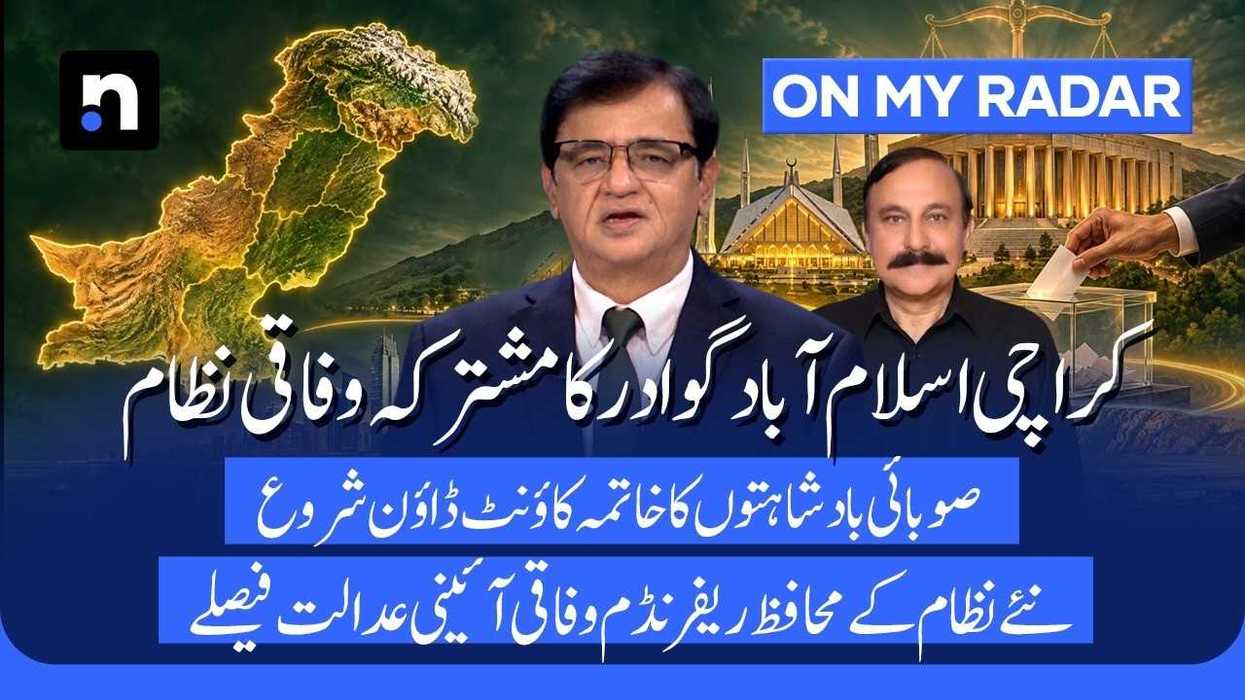
Pakistan is preparing to seek public approval for a major restructuring of its four provinces, with a referendum on creating up to 12 provinces emerging as a key proposal ahead of a possible 28th constitutional amendment, according to the latest episode of Kamran Khan's "On My Radar."
The proposed administrative model would divide Punjab into four provinces, while Khyber Pakhtunkhwa and Balochistan would each have three and Sindh would have two. The plan is gaining attention following a series of meetings and statements by senior government and political figures over the past week.
Government sources say preparations for a referendum are underway and that the vote could take place before the 28th constitutional amendment is introduced later this year. A timeline is reportedly being considered to make progress on the issue before the Senate elections scheduled for March 2027.
The government is also considering approaching the Federal Constitutional Court to determine the constitutional and legal status of the proposed referendum.
Defense Minister Khawaja Asif has backed the idea of establishing 12 provinces, arguing that new administrative boundaries should be based on governance needs rather than ethnic or linguistic identities.
He said efforts to build consensus on the issue had been underway for several weeks, adding that Pakistan could enter the new year under a new administrative system and that significant progress could be made before then.
Federal Minister and Muttahida Qaumi Movement-Pakistan leader Mustafa Kamal also supported the proposal, saying a referendum on new provinces would take place. He described December as a potentially decisive month for the issue.
Interior Minister Mohsin Naqvi last Thursday renewed the proposal for a public referendum, saying the longstanding dispute over creating new provinces or administrative units should be settled "once and for all."
His remarks were followed by a surprise visit to Nawabshah, where he met President Asif Ali Zardari at Zardari House for about an hour. Sources claim the meeting was aimed at persuading Zardari to support the referendum proposal.
Zardari subsequently traveled to Lahore on Saturday to meet Prime Minister Shehbaz Sharif. Senior leaders from both parties were present during discussions on the proposed creation of additional provinces across the country.
Media reports said the meeting focused on the legal and constitutional process for holding a referendum. Sources said Sharif and his team briefed the president on the federal government's preparations.
The government has reportedly completed preliminary work on using Article 48(6) of the Constitution to hold the referendum. Under the proposal, approval would be sought through a joint sitting of Parliament. If the government fails to secure a majority, it could approach the Federal Constitutional Court to determine the legal and constitutional position.
Punjab Assembly Speaker Malik Ahmed Khan has also stressed the importance of a direct public vote, arguing that the decision of voters should take precedence over the views of their elected representatives.
He said the Federal Constitutional Court could be approached to resolve legal questions surrounding the referendum.
PTI also backs smaller provinces
The renewed debate has coincided with a series of developments involving Pakistan Tehreek-e-Insaf (PTI) founder and former Prime Minister Imran Khan.
These include permission for his lawyers to hold extended meetings with him in prison, the release of his sisters, Dr. Uzma Khan and Noreen Niazi, and the resumption of hearings on appeals against the prison sentences handed to Imran and his wife, Bushra Bibi, in the Al-Qadir Trust case. The appeals had remained pending before the Islamabad High Court for several months.
After a meeting with Imran lasting more than three hours, his lawyer Latif Khosa told reporters that they had discussed the changing political situation, particularly the proposed 28th constitutional amendment and the creation of new provinces.
Imran also conveyed a message to PTI Secretary-General Salman Akram Raja through his lawyer Salman Safdar. Raja later said in an interview that the party leader had issued instructions on several important matters, including the provincial structure.
Raja reiterated Imran's longstanding support for smaller provinces and administrative units.
During his tenure as prime minister, Imran repeatedly advocated creating smaller provinces or establishing administrative units at the divisional level.
Karachi at the center of the debate
The proposal has particular significance for Karachi, Pakistan's economic center, where demands for greater administrative autonomy and a fairer distribution of resources have persisted for decades.
Supporters of additional provinces argue that the existing system has concentrated power in provincial capitals, limiting local governments' ability to address urban challenges and deliver public services.
Imran has also previously argued that Karachi's scale and economic importance require a distinct administrative approach, saying the city should be run almost like an independent country. He has maintained that a state cannot function effectively if all authority remains concentrated in one center.
The debate over new provinces therefore extends beyond changing administrative boundaries. It raises questions about the distribution of political authority, financial resources and governance responsibilities across Pakistan.
Federal Minister for Parliamentary Affairs Dr. Tariq Fazal Chaudhry and senior political analyst Nasim Zehra also discussed the issue in the program.





Comments
See what people are discussing