

Pakistan stocks fall for third straight week as Middle East tensions, oil prices weigh on sentiment
Investors await earnings and a central bank rate decision as the KSE-100 extends weekly losses

Business Desk
The Business Desk tracks economic trends, market movements, and business developments, offering analysis of both local and global financial news.
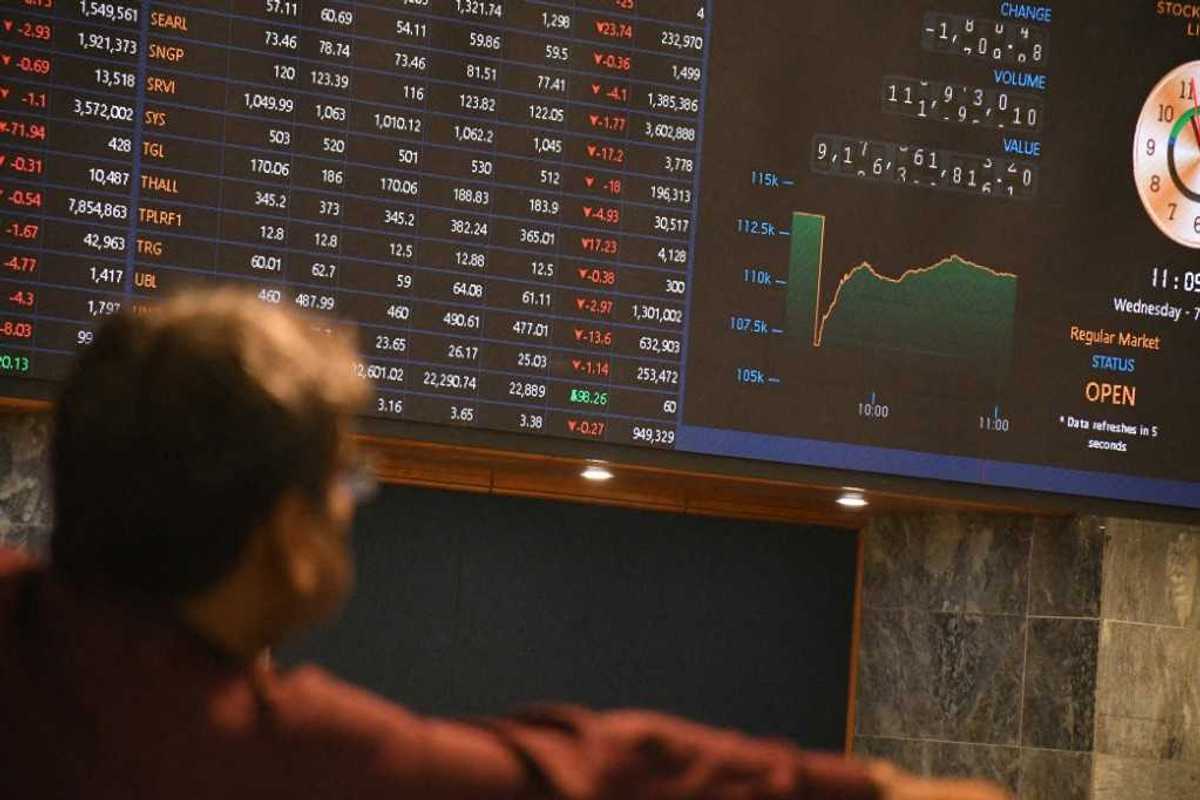
Pakistan’s benchmark KSE-100 Index extended losses for a third consecutive week, declining 2.7% as escalating tensions in the Middle East and higher global oil prices weighed on investor sentiment.
The KSE-100 Index closed at 171,021.20 points, down 4,782 points, with the market remaining under pressure throughout the week amid geopolitical uncertainty and cautious trading activity.
Market sentiment weakened further after Yemen’s Houthi movement announced a blockade in the Red Sea, pushing Brent crude prices above $100 per barrel for the first time in nearly two months.
On the domestic front, Pakistan received a positive sovereign credit development after S&P Global Ratings upgraded the country’s long-term sovereign credit rating to “B” from “B-,” citing improved institutional stability and effective implementation of reforms supported by the International Monetary Fund.
Meanwhile, the Oil and Gas Regulatory Authority introduced a daily petroleum pricing mechanism during the week. Under the new system, cumulative increases reached PKR 15.37 per liter, or 4.9%, for motor spirit, commonly known as petrol, and PKR 24.31 per liter, or 6.9%, for high-speed diesel, reflecting higher international oil prices.
Analysts said the market’s near-term direction will depend on geopolitical developments, corporate earnings and the State Bank of Pakistan’s upcoming monetary policy decision.
An analyst at Arif Habib Ltd. said market performance remains closely linked to developments in the Middle East and the ongoing corporate earnings season. The analyst said the State Bank of Pakistan is expected to keep its benchmark policy rate unchanged at 11.5% as policymakers assess external risks and their impact on inflation before considering further monetary easing.
An analyst at Intermarket Securities said investor attention is likely to remain focused on Middle East developments and the start of the June-quarter earnings season.
Despite recent weakness, the analyst said valuations remain supportive, with the brokerage’s coverage universe trading at about 7.1 times forward price-to-earnings, below its long-term average of around 8.1 times.
An analyst at AKD Securities said the trajectory of the U.S.-Iran conflict, international oil prices and the upcoming Monetary Policy Committee meeting will remain the main near-term market catalysts.
The analyst added that strong financial results for the quarter ended June 2026 could help improve investor sentiment and said the market continues to trade at what the brokerage considers attractive valuations, with a current price-to-earnings ratio of about 7.8 times.
AKD Securities maintained its year-end target for the KSE-100 Index at 263,800 points by December 2026.
An analyst at Spectrum Securities said trading is expected to remain cautious and data-driven in the coming week, with the central bank’s policy rate announcement seen as a key trigger for market direction.
The analyst added that any escalation in the U.S.-Iran conflict could also influence market behavior because of its potential impact on international oil prices and government decisions on domestic fuel pricing under the new daily adjustment mechanism.





Comments
See what people are discussing