

Pakistan's capital market holds up in Q3 despite war-driven selloff and foreign outflows
The KSE-100 fell 14.54% over the quarter but domestic investors absorbed PKR 111.55 billion in foreign outflows, cushioning the blow

Business Desk
The Business Desk tracks economic trends, market movements, and business developments, offering analysis of both local and global financial news.
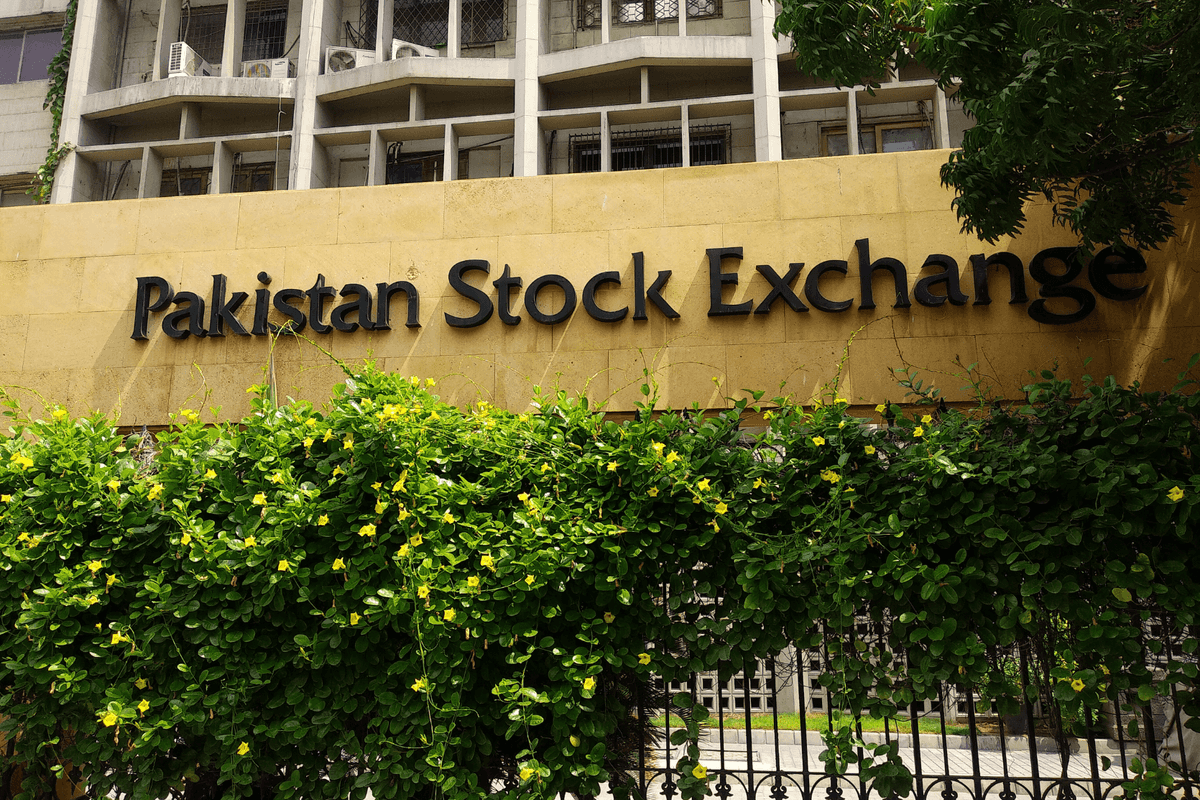
A signboard outside the Pakistan Stock Exchange in Karachi
Pakistan's capital market remained broadly resilient in the third quarter of fiscal year 2026 despite a sharp correction driven by the US-Iran war, rising global oil prices, and a broad risk-off shift among international investors, according to the Securities and Exchange Commission of Pakistan's quarterly market review.
The KSE-100 index opened the quarter at 174,054 points and hit an all-time high of 191,033 on January 26 before declining steeply. It closed at 148,743 on March 31, a quarterly decline of 14.54%. The intra-quarter low of 144,119, reached on March 19, represented a peak-to-trough fall of 22.57%. The KSE All Share index fell 14.85% over the period while the KSE-30 declined 15.52%.
The quarterly performance was uneven across months. January was strong, with the KSE-100 gaining 5.81%. Sentiment deteriorated in February as rising costs, geopolitical risks, and profit-taking pushed the index down 3.75%. The correction deepened in March, with the index falling 11.50%.
Global backdrop
The quarter coincided with a difficult global environment. The SECP said the US-Iran conflict pushed Brent crude up 10-13% in its early days, while US software stocks fell around 23%. The S&P 500 declined 4.3%, MSCI Europe ex-UK dropped 3.2%, MSCI Asia slipped 1.1%, and MSCI Emerging Markets eased 0.1%.
Domestic investors absorb foreign exit
Despite the selloff, market activity remained broad-based. Total traded volume reached 48.8 billion shares, with traded value of PKR 2.68 trillion. Average daily volume stood at 791.7 million shares and average daily value at PKR 44.03 billion, with around 485 symbols active per session.
Foreign investors recorded net outflows of PKR 111.61 billion during the quarter, with foreign corporates alone selling PKR 117.07 billion. Domestic investors absorbed the exit entirely, with net purchases of PKR 111.55 billion. Companies led with PKR 73.51 billion, followed by mutual funds at PKR 23.78 billion and individual investors at PKR 20.25 billion.
Market capitalization fell from PKR 19.69 trillion to PKR 16.53 trillion, a decline of PKR 3.15 trillion over the quarter.
Blue chips and primary markets
Trading was concentrated in blue-chip stocks. National Bank of Pakistan led by traded value at PKR 182.42 billion, followed by Pakistan Petroleum, OGDC, Fauji Fertilizer, and Habib Bank. By volume, K-Electric led with 4.64 billion shares, followed by Bank of Punjab and WorldCall Telecom.
The SECP approved three IPOs during the quarter, reflecting continued confidence in primary market activity. On the debt side, three Government of Pakistan Ijara Sukuk auctions were held with a combined target of PKR 800 billion. Total bids reached PKR 2.03 trillion — a bid-to-cover ratio of 2.54 times — with the government accepting PKR 811.53 billion. Secondary debt market activity also held up, with GoP Ijara Sukuk worth PKR 185.14 billion traded across 2,062 transactions and PSX bills and bonds counter activity reaching PKR 260.94 billion. Two privately placed corporate sukuk were also listed during the quarter.
The SECP said that while the quarter was exceptionally challenging, strong domestic participation, active debt markets, sustained IPO activity, and ongoing regulatory reforms helped maintain market stability and underpin long-term investor confidence.



Comments
See what people are discussing