

Pakistan ready for ‘composite, result-oriented’ dialogue with India, PM Shehbaz tells UNGA
Prime minister insists that South Asia needs “proactive rather than provocative leadership”

News Desk
The News Desk provides timely and factual coverage of national and international events, with an emphasis on accuracy and clarity.
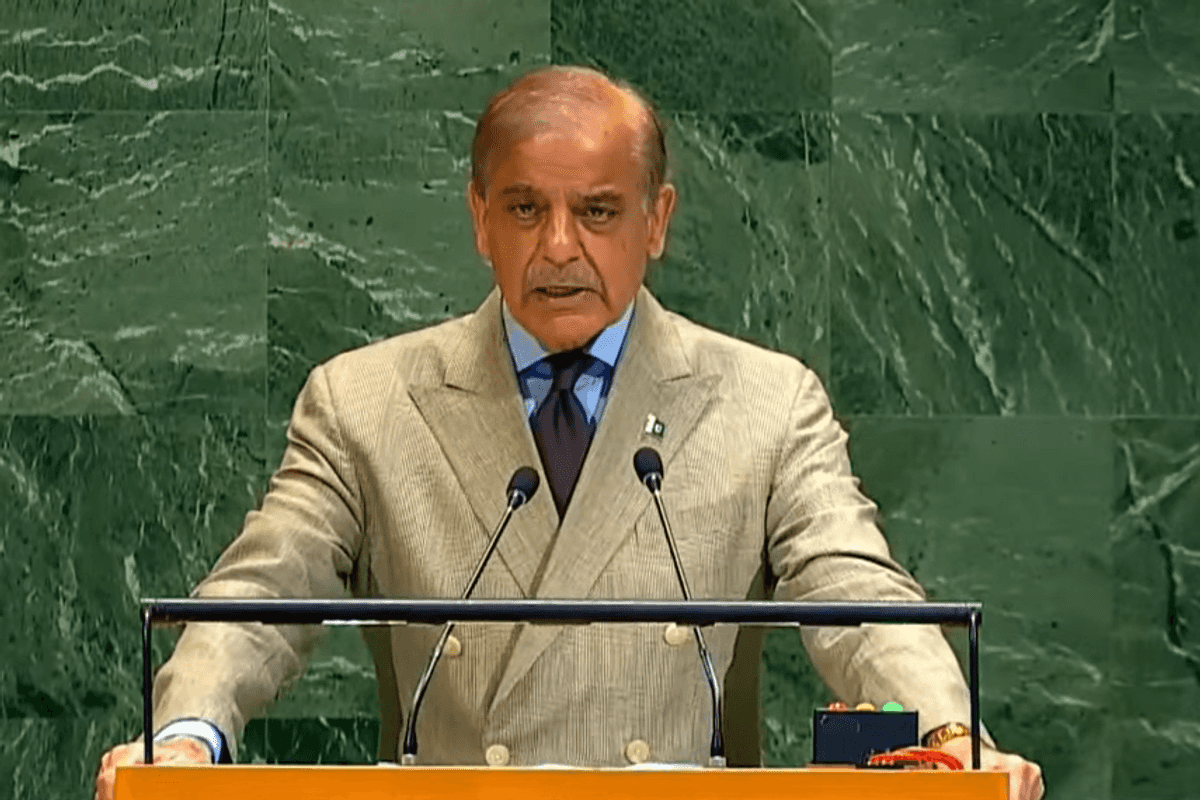
Pakistan’s Prime Minister Shehbaz Sharif addresses the United Nations General Assembly session on Friday.
UNGA
Pakistan’s Prime Minister Shehbaz Sharif Friday said that Islamabad stands ready for a “composite, comprehensive and result-oriented dialogue” with India on all outstanding issues, stressing that Pakistan’s approach to peace comes “from a position of strength.”
Addressing the United Nations General Assembly session, Sharif recalled Pakistan’s response to Indian aggression earlier this year, saying the country exercised its right to self-defense under Article 51 of the UN Charter.
He accused India of refusing to cooperate in investigating the Pahalgam incident and instead targeting Pakistani cities and civilians.
Praising the military’s performance, he said Pakistan’s armed forces, under Field Marshal Syed Asim Munir and Air Chief Marshal Zaheer Ahmad Babar, had shown “exceptional courage,” claiming they downed seven Indian fighter jets during the confrontation. He also paid tribute to fallen soldiers, saying their sacrifices would “forever guide the nation with honor and dignity.”
Praise for Trump and international partners
Sharif said Pakistan agreed to a ceasefire after four days of escalation, once it had demonstrated its capabilities. He credited U.S. President Donald Trump with preventing a broader conflict.
“President Trump’s timely and decisive intervention helped avert a full-fledged war in South Asia,” he said. “In recognition of his efforts to promote peace, Pakistan nominated him for the Nobel Peace Prize. I think he truly is a man of peace.”
He also thanked China, Turkey, Saudi Arabia, Qatar, Azerbaijan, Iran, the United Arab Emirates, and UN Secretary-General António Guterres for their diplomatic support during the crisis.
Sharif went on to stress that South Asia needs “proactive rather than provocative leadership.” He warned against India’s “unilateral and illegal attempt” to suspend the Indus Waters Treaty, calling it a violation of both the treaty’s provisions and international law. Pakistan, he said, would “definitely and ardently defend the right of our 240 million people on these waters.”
Expressing solidarity with the people of Kashmir, Sharif said India’s “tyranny in the valley will one day come to a grinding halt.” He reiterated Pakistan’s call for an impartial plebiscite under UN auspices, saying, “Kashmir will gain its fundamental right to self-determination.”
Global challenges and Pakistan’s outlook
Earlier, Sharif opened his speech with a Quranic recitation, congratulated the president of the 80th UNGA session, and praised Guterres for his “bold leadership in extremely difficult times.”
He described today’s world as “more complex than ever,” with intensifying conflicts, humanitarian crises, violations of international law, terrorism, disinformation, and climate change. “For countries like Pakistan, climate change threatens our very survival,” he warned.
Sharif said Pakistan’s foreign policy, guided by the vision of its founding father, rests on peaceful coexistence, mutual respect, and diplomacy. He reiterated Pakistan’s willingness to seek peace with India: “We have won the war, and now we seek to win peace in our part of the world. Pakistan stands ready for a composite, comprehensive and result-oriented dialogue with India.”


Comments
See what people are discussing